Introduction
- Date of Birth
- 07 Aug 1871
- Zodiac sign
- Leo
- Date of Death
- 05 Dec 1951
- Age
- 80
- Place of Birth
- Calcutta, West Bengal, India
- State Country of Birth
- West Bengal, India
1895
- Studied under the private tutelage of Olinto Gilhardi and Charles Palmer
1905
- Tutored by Yokoyama Taikan on Japanese brushwork
- Government College of Arts & Craft, Kolkata, India
1910
- Studied and discovered Indian art with E.B. Havell
1892
- Drawings reproduced in Rabindranath Tagore's play, Chitrangada. Member, Bharatiya Shilpa SamitiAssociated Institution
1895
- Established a studioAssociated Institution
- Book illustration for Abhijnan Sakuntalam by KalidasaAssociated Institution
1896
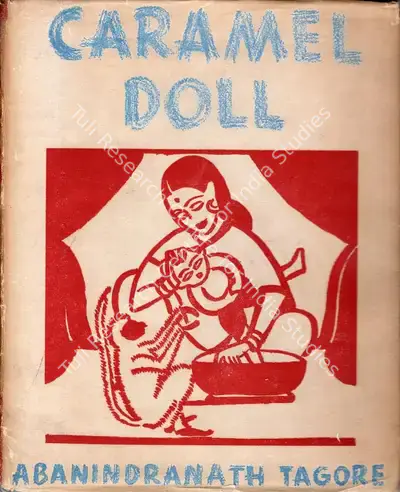
- Illustrations for his own book Ksirer PutulAssociated Institution
1902
- Paintings reproduced in articles on his works by Havell, in the Studio MagazineAssociated Institution
1905
- Paintings reproduced in articles on his works by Havell, in the Studio MagazineAssociated Institution
- Paintings reproduced in magazines The Modem Review and PrabasiAssociated Institution
- Secretary, Bangiya Kala SamsadOfficial Position
- Vice-Principal, Government College of Arts & Craft, Kolkata, India (His department was known as the Advanced Design Class)Official Position
1905 – 1906
1906
- Acting Principal, after the resignation of E.B. Havell as Principal, Government College of Art & Craft, Kolkata, IndiaOfficial Position
1906 – 1909
1907
- Founding member and Joint Secretary, the Indian Society of Oriental Art, Kolkata, IndiaOfficial Position
1908
- Paintings reproduced in articles on his works by Havell, in the Studio MagazineAssociated Institution
- Colour plates of paintings reproduced by Ramanand Chatterjee in his journal The Modern Review and also sold as printsAssociated Institution
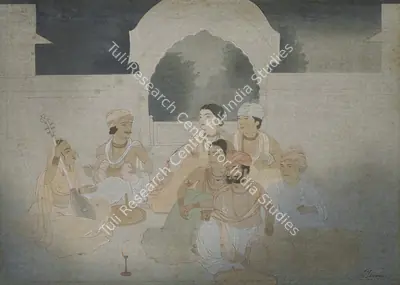
- The Music Party published in 'Okakura's Kokka'Associated Institution
1909
- Percy Brown was brought in as Principal and Abanindranath made Vice-PrincipalOfficial Position
1909 – 1915
- Abanindranath ultimately resigned from the art school and set up his own teaching classAssociated Institution
1909 – 1915
1918
- Drawings reproduced in Rabindranath Tagore's works Gitanjali, Fruit Gathering and The Parrot's TrainingAssociated Institution
1930
- Wrote 'Jatras' or folk dramas on themes from the Mahabharata and other Puranic storiesAssociated Institution
1930 – 1938
1940
- Created toys called 'Kutum Katum' from roots and branches of trees, made to resemble an animal or human formAssociated Institution
- Formed the purchase committee of the Government Art Gallery, along with Gaganendranath Tagore, Justice Woodroffe, Norman Blount, Rueboson and MullerAssociated Institution
Exhibitions
1900
- Government College of Arts & Craft, Kolkata, India (Inaugurated by Lord Curzon)
1902
- Congress Industrial Exhibition, Kolkata, India
1911
- Indian Society of Oriental Art's United Provinces Exhibition, Allahabad, India
- Festival of Empire, George V's Coronation, Organised by Indian Society of Oriental Art, at Crystal Palace, England
1914
- 22nd Exhibition of Societe des Peintres Orientalistes, France
- Retrospective, Imperial Institute, London, UK
- Francais, Grand Palais, Paris, France (Travelling to Belgium, Holland and Imperial Institute, England)
1915
- Young Men's Indian Association, Chennai, India
- Indian Society of Oriental Art Exhibition, Kolkata, India
1924
- Travelling exhibition organised by American Federation of Art & the Indian Society of Oriental Art in USA
1928
- Athenee Gallery, Organised by James Cousins, Geneva, Switzerland
1974
- A Handbook of Sculptures. New Delhi: National Gallery of Modern Art, national-gallery-of-modern-art, New Delhi, India
1975
- A Handbook of Bengal School. New Delhi: National Gallery of Modern Art,New Delhi
1976
- Academy of Fine Arts and Rabindra Bharati Society, Kolkata, India
16 Aug 1976 to 27 Aug 1976
1978
- Academy of Fine Arts and Rabindra Bharati Society, Kolkata, India
01 Sep 1978 to 05 Sep 1978
1979
- Academy of Fine Arts and Rabindra Bharati Society, Kolkata, India
01 Sep 1979 to 07 Sep 1979
1991
- The Two Tagores - The Early Indian Modern Painters. New Delhi: CMC Art Gallery
1996
- Nandan Gallery, Santiniketan, India
1997
- Intuitive Logic: A Festival of Indian Contemporary Painting, Presented by The Tuli Foundation for Holistic Education & Art (HEART) at, National Gallery of Modern Art (NGMA), Mumbai, India
01 Mar 1997 to 19 Apr 1997
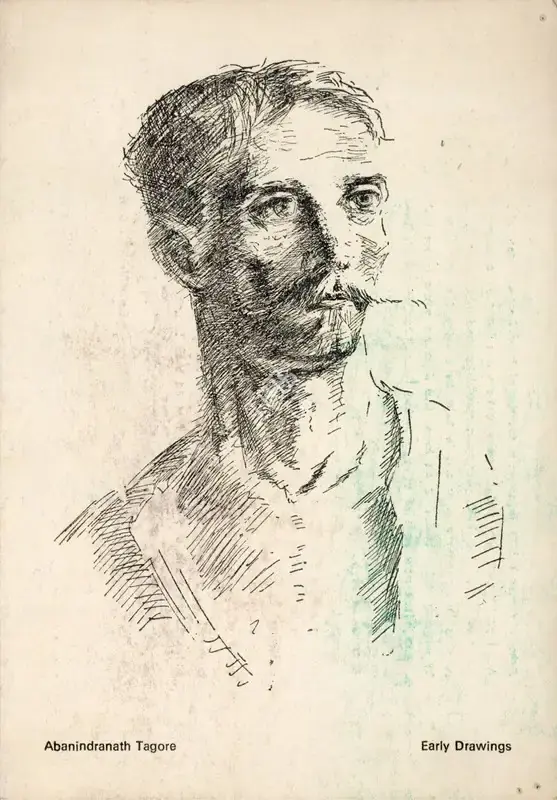
Tagore, Abanindranath (Artist). Exhibition of Early Drawings & Sketches of Abanindranath Tagore, 1991 | Solo Exhibition Invitation | 00859987
1900
- Government College of Arts & Craft, Kolkata, India (Inaugurated by Lord Curzon)
1902
- Congress Industrial Exhibition, Kolkata, India
1911
- Indian Society of Oriental Art's United Provinces Exhibition, Allahabad, India
- Festival of Empire, George V's Coronation, Organised by Indian Society of Oriental Art, at Crystal Palace, England
1914
- 22nd Exhibition of Societe des Peintres Orientalistes, France
- Retrospective, Imperial Institute, London, UK
- Francais, Grand Palais, Paris, France (Travelling to Belgium, Holland and Imperial Institute, England)
1915
- Young Men's Indian Association, Chennai, India
- Indian Society of Oriental Art Exhibition, Kolkata, India
1924
- Travelling exhibition organised by American Federation of Art & the Indian Society of Oriental Art in USA
1928
- Athenee Gallery, Organised by James Cousins, Geneva, Switzerland
1976
- Academy of Fine Arts and Rabindra Bharati Society, Kolkata, India
16 Aug 1976 to 27 Aug 1976
1978
- Academy of Fine Arts and Rabindra Bharati Society, Kolkata, India
01 Sep 1978 to 05 Sep 1978
1979
- Academy of Fine Arts and Rabindra Bharati Society, Kolkata, India
01 Sep 1979 to 07 Sep 1979
1991
2020
- The Great Maestro | Abanindranath Tagore, National Gallery of Modern Art, New Delhi, India
07 Aug 2020
Tagore, Abanindranath (Artist). Exhibition of Early Drawings & Sketches of Abanindranath Tagore, 1991 | Solo Exhibition Invitation | 00859987
Chronicled Highlights
Economics of Art
Research Centre
Posts 2
- Tuli Research Centre for India Studies presents All Living Souls - Expressed in the Modern and Contemporary Fine & Popular Indian Arts Curated by Neville Tuli As part of launching the 16th Research Category for India Studies - "The Animal-Human-Nature-Continuum" we present a fascinating exhibition of modern and contemporary Indian fine and popular arts and their expression of the ideas and forms related to the dialogue between animals and humans, and the larger cosmic and spiritual thoughts which abide therein. Please visit the Exhibition and see the artworks by modern and contemporary masters such as Rabindranath Tagore, D.P. Roy Chowdhury, M.F. Husain, J. Swaminathan, J. Sultan Ali, Somnath Hore, Ganesh Pyne, Manjit Bawa, K. Laxma Goud, Krishna Reddy, Jyoti Bhatt, Rekha Rodwittiya, Amit Ambalal, among others, along with vintage and rare prints from the pioneering Indian chromolithographic presses such as Chitrashala, Ravi Varma, Calcutta Art Studio, Chore Bagan & Kansaripara.
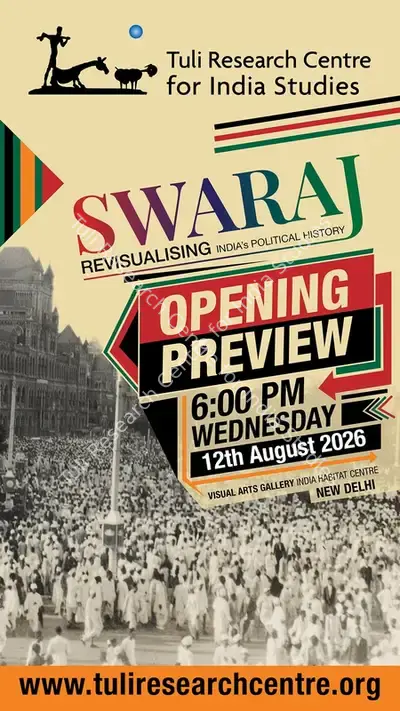
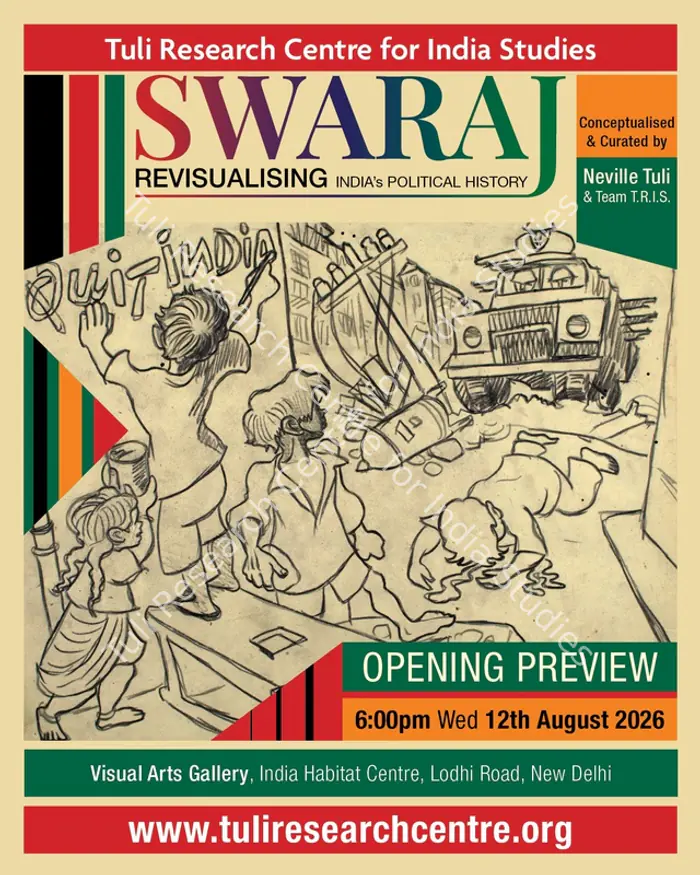
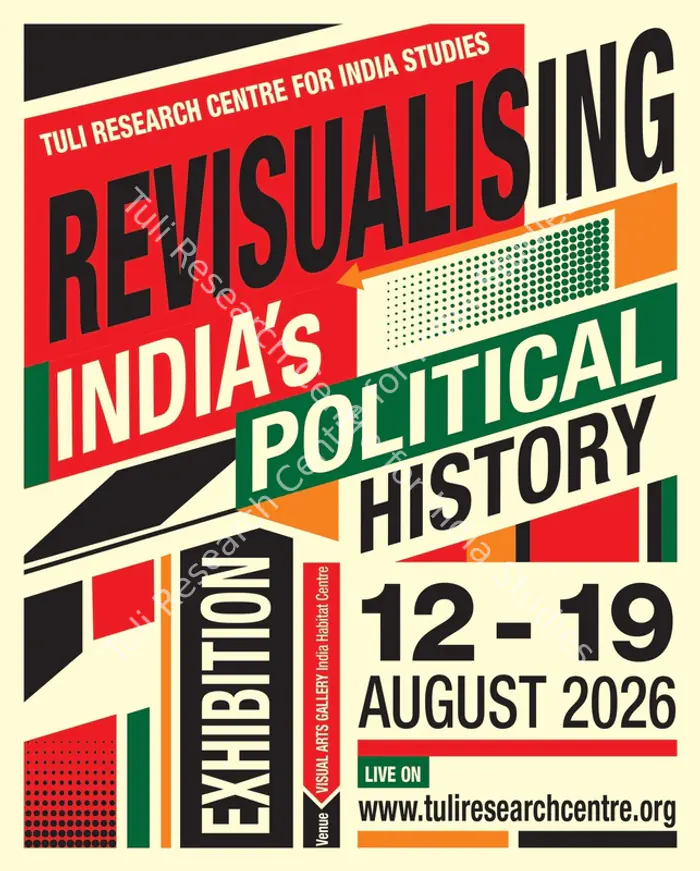
- "What does 𝗦𝘄𝗮𝗿𝗮𝗷 truly mean? Is freedom achieved at a single historic moment or period, or must self-rule be continually imagined, questioned and renewed? India's journey towards Swaraj was shaped not by one voice or one path, but through reform and resistance, revolution and non-violence, political thought, public protest, art, print, photography, cinema and the collective will of its people. The Tuli Research Centre for India Studies (T.R.I.S.) presents 𝗦𝗪𝗔𝗥𝗔𝗝: 𝗥𝗲𝘃𝗶𝘀𝘂𝗮𝗹𝗶𝘀𝗶𝗻𝗴 𝗜𝗻𝗱𝗶𝗮'𝘀 𝗣𝗼𝗹𝗶𝘁𝗶𝗰𝗮𝗹 𝗛𝗶𝘀𝘁𝗼𝗿𝘆, a pioneering exhibition curated by Neville Tuli. Bringing together rare artworks, prints, photographs, books, film publicity art, political propaganda and visual-textual-audio archives, SWARAJ traces India's complex journey towards political self-rule and self-discovery. From early European coastal encounters, the Bengal Renaissance and the First War of Independence in 1857 to the rise of Bharat Mata, the Tiranga, Gandhiji's inspired satyagraha, civil disobedience and mass mobilisation, the exhibition explores how the idea of India was envisioned, contested and transformed. It journeys through revolutionary movements and non-violence, subaltern uprisings, the Partition, the Constitution, the integration of the Princely States, the Emergency, wars, civic dissent and people's protests. It also foregrounds the vital role of artists, photographers, publishers, newspapers, journals, cartoons and cinema in recording and shaping the nation's political consciousness. SWARAJ invites us to encounter history not as something distant or settled, but as a daily living inheritance that continues to influence who we are and how we understand freedom, identity, and ourselves today. Watch the video for a glimpse into this expansive visual journey, and follow the exhibition as it revisualises India's political history through art, image, text and sound.

Calendar 3
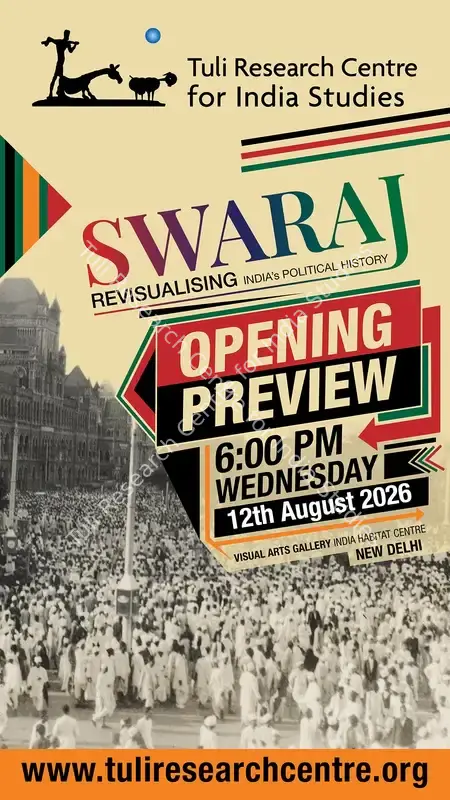
- ArchivedOpening PreviewProject 82SWARAJ - Revisualising India's Political HistoryAn Exhibition of Modern & Contemporary Fine & Popular Arts, Photography, Film Memorabilia and Visual-Textual-Audio Archive12th August 20266:00 PM - 9:00 PMVisual Arts Gallery, India Habitat Centre, Lodhi Road, New Delhi,The Tuli Research Centre for India Studies (T.R.I.S.) announces its seventh exhibition. “Swaraj – Revisualising India's Political History” -- An exhibition of Modern and Contemporary Fine and Popular Arts, Photography, Film Memorabilia and Visual-Textual-Audio Archives. Swaraj will open at 6 p.m. on Wednesday, 12 August 2026 at the Visual Arts Gallery and will remain open till 7 p.m. Sunday, 16 August 2026. Tuli Research Centre for India Studies (T.R.I.S.) presents SWARAJ | Revisualising India's Political History, a pioneering inter-disciplinary offline-online exhibition conceptualised and curated by Neville Tuli with Team T.R.I.S.. SWARAJ explores India's journey towards political self-rule and self-discovery through a remarkable collection of rare modern and contemporary fine and popular arts, albums, photographs, books, prints, propaganda, cartoons, film publicity artworks and other "text-visual-audio" archives contextualised within a clear historical framework, which defines T.R.I.S.' pedagogic approach to learning. The Exhibition will be of particular interest to students and scholars of India & Cultural Studies, and India's political and modern histories as well as those interested in the passage of events and ideas from the mid-1850s leading up to the turn of the 21st century. Unique to the Tuli Research Centre for India Studies is the richness of visual material that not only exhorts a deeper understanding of the art and archival materials on display but also brings alive the multi-layered narratives of the exhibition and naturally India's journey in being ad searching for herself.Read More →
- ArchivedExhibitionProject 81SWARAJ - Revisualising India's Political HistoryAn Exhibition of Modern & Contemporary Fine & Popular Arts, Photography, Film Memorabilia and Visual-Textual-Audio Archive12th - 19th August 202610:00 AM - 7:00 PMVisual Arts Gallery, India Habitat Centre, Lodhi Road, New Delhi,19The Tuli Research Centre for India Studies (T.R.I.S.) announces its seventh exhibition. “Swaraj – Revisualising India's Political History” -- An exhibition of Modern and Contemporary Fine and Popular Arts, Photography, Film Memorabilia and Visual-Textual-Audio Archives. Swaraj will open at 6 p.m. on Wednesday, 12 August 2026 at the Visual Arts Gallery and will remain open till 7 p.m. Sunday, 16 August 2026. Tuli Research Centre for India Studies (T.R.I.S.) presents SWARAJ | Revisualising India's Political History, a pioneering inter-disciplinary offline-online exhibition conceptualised and curated by Neville Tuli with Team T.R.I.S.. SWARAJ explores India's journey towards political self-rule and self-discovery through a remarkable collection of rare modern and contemporary fine and popular arts, albums, photographs, books, prints, propaganda, cartoons, film publicity artworks and other "text-visual-audio" archives contextualised within a clear historical framework, which defines T.R.I.S.' pedagogic approach to learning. The Exhibition will be of particular interest to students and scholars of India & Cultural Studies, and India's political and modern histories as well as those interested in the passage of events and ideas from the mid-1850s leading up to the turn of the 21st century. Unique to the Tuli Research Centre for India Studies is the richness of visual material that not only exhorts a deeper understanding of the art and archival materials on display but also brings alive the multi-layered narratives of the exhibition and naturally India's journey in being ad searching for herself.Read More →
- ArchivedExhibitionProject 5Self Discovery via Rediscovering India Series Part IV Building www.tuliresearchcentre.org20th - 23rd February 2025Self Discovery via Rediscovering India Series Part IVRead More →
Related
52
Personalities
31
Institutions
15
Themes
3
Locations
1