TRIS logo image
Search names, films, exhibitions

EN

EN

English

HI

Hindi

EN

EN

English

HI

Hindi

Tuli Research Centre for India Studies

Home

Tuli Research Centre for India Studies

Vision

Manifesto

Archive & Library

Vanraja Sanctuary & Hospice

Research Categories

Browse All

ICore

1_CinemaEducation_Cinema as a Critical Educational Resource

2_FineArts_Modern and Contemporary Indian Fine Arts

3_Photography_Photography in India

4_PopCulture_The Printed Image, Popular Arts, and Crafts

IIMaterial

5_ArcHeritage_India's Architectural Heritage as Inspiration

6_EconomicsArt_Economics of Art & Cultural Industry

7_Travel_Automobile, Transport and Travel Heritage

8_Uncertainty_Uncertainty

IIICritical

9_SocialDuty_Social Responsibility of the Creative Mind

10_Childhood_The Changing Smile of Childhood & Its Second Coming

11_Sensuality_The Sensual Discipline within Creativity

12_Scholarship_The History & Historiography of Scholarship in the Arts, Humanities, and Social Sciences

IVMeaningful

13_SeekJustice_Seeking Justice and Political Integrity

14_IndoWorld_India and her Relationship with the World

15_SpiritualPoetics_The Religious-Spiritual-Poetic-Philosophical Framework

16_Continuum_The Animal-Human-Nature Continuum

Explore

All

Posts

Masterlists

Calendar

Live | Upcoming

All Events

Timetable

Search names, films, exhibitions

EN

EN

English

HI

Hindi

Jehangir Sabavala

Jehangir Sabavala

Virgob. 23 Aug 1922, Bombay, Maharashtra, Indiad. 02 Sep 2011, Bombay, Maharashtra, India

Personality.Artist
A-Graphy
Introduction
Exhibitions194
Integrated Timeline74
Chronicled Highlights26
Economics of Art230
Research Centre1,176
All1,176
Library808
Archive368
Highlights15
Home/Modern and Contemporary Indian Fine Arts/Personality · Artist/Jehangir Sabavala
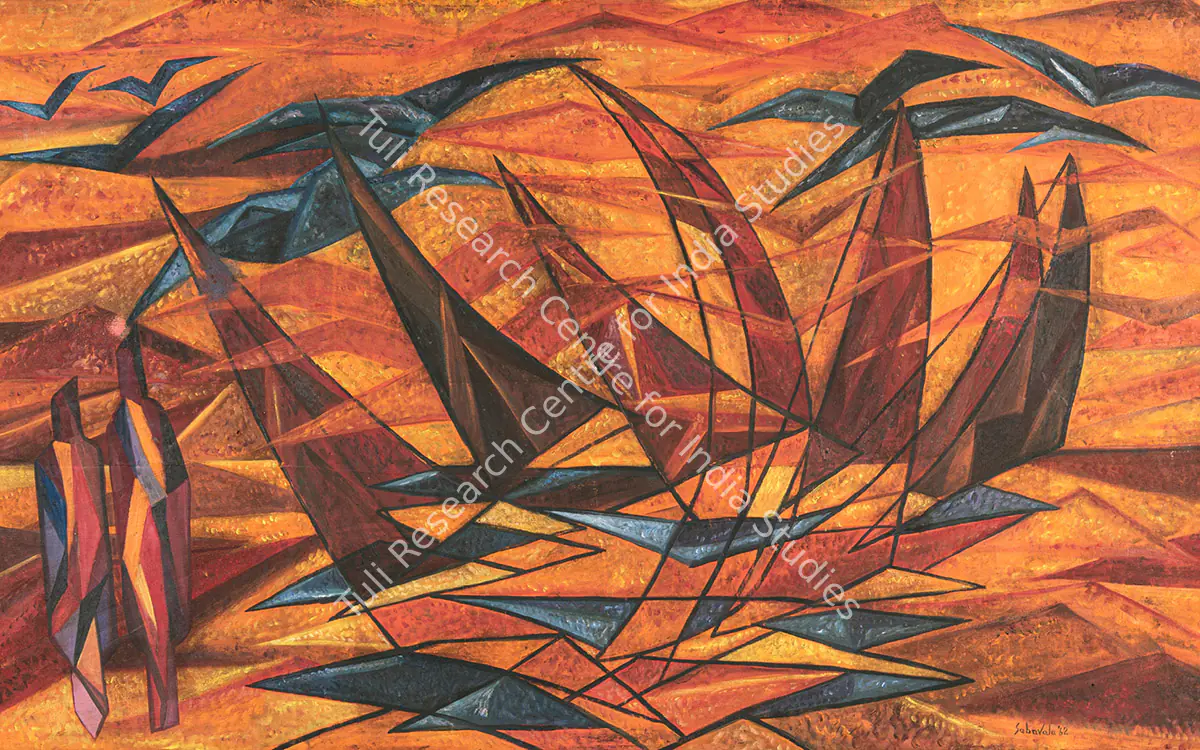
Jehangir Sabavala — featured artwork

Introduction

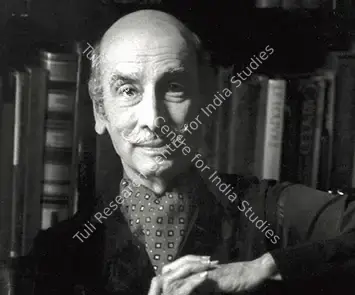
Born in an affluent Parsi family whose history was intertwined with the history of Bombay, Jehangir Sabavala was among the first generation of post-colonial artists in India. Sabavala strayed away from any group affiliations that were prominent during his time and developed his pictorial language that was inspired and shaped by his art school training, his international travels and the cubist pedagogy imparted by his mentor Andre Lhote. His closeness to nature results in vivid and serene landscapes that are often desolate and sometimes populated by the figures of magicians, sorcerers and ascetics.

Date of Birth
23 Aug 1922
Zodiac sign
Virgo
Date of Death
02 Sep 2011
Age
89
Place of Birth
Bombay, Maharashtra, India
Place of Death
Bombay, Maharashtra, India
Spouse(s)
Shirin Sabavala (1924 – 2017)
Year Marriage Registered
1948
Children
Aafreed Sabavala (b. 1959)
Parent(s)
Ardeshir Pestonjee Sabavala (1890 – 1955), Meherbai Sabavala (1891 – 1970)
Grandparent(s)
Sir Jehangir Cowasjee Jehangir (16 Feb 1879 – 17 Oct 1962)
Ancestor(s)
Hirji Jivanji, Sir Cowasjee Jehangir Readymoney (24 May 1812 – 19 Jul 1878)
Siblings
Sharokh Sabavala
State Country of Birth
Maharashtra, India
State Country of Death
Maharashtra, India
  1. 1939

    1. Elphinstone College, University of Mumbai, India

      1939 – 1941

  2. 1942

    1. Sir J.J. School of Art, Mumbai, India

      1942 – 1944

  3. 1945

    1. Heatherley School of Art, London, UK

      1945 – 1947

  4. 1948

    1. Academie Andre Lhote, Paris, France

      1948 – 1951

  5. 1953

    1. Attended the Academie Julian, Paris, France

      1953 – 1954

  6. 1957

    1. Attended the Academie de la Grande Chaumiere, Paris, France

Exhibitions

  1. 1949

    1. Exposition du ler Grand Prix de Peinture, Monaco
  2. 1950

    1. Salon National Independent, Paris, France
  3. 1951

    1. 02 Apr 1951 to 11 Apr 1951

  4. 1952

    1. Annual Exhibition, Bombay Art Society, Mumbai, India
  5. 1953

    1. 28 Feb 1953 to 09 Mar 1953

    2. Annual Exhibition, Bombay Art Society, Mumbai, India
  6. 1954

    1. Annual Exhibition, Bombay Art Society, Mumbai, India
    2. Exhibited at the 'Venice Biennale', Italy
  7. 1955

    1. 3rd One-Man Show, Jehangir Art Gallery, Mumbai, India

      15 Oct 1955 to 23 Oct 1955

    2. Annual Exhibition, Bombay Art Society, Mumbai, India
    3. Annual Exhibition, Lalit Kala Akademi, New Delhi, India
  8. 1956

    1. One Man Show at the All India Fine Arts & Crafts Society (AIFACS), New Delhi, India

      03 Jan 1956 to 11 Jan 1956

    2. Annual Exhibition, Lalit Kala Akademi, New Delhi, India
  9. 1957

    1. Annual Exhibition, Lalit Kala Akademi, New Delhi, India
  10. 1958

    1. 15 Oct 1958 to 23 Nov 1958

  11. 1960

    1. Annual Exhibition, Bombay Art Society, Mumbai, India
    2. Annual Exhibition, Calcutta Art Society, Kolkata, India
  12. 1961

    1. Exhibition of Paintings - Jehangir Sabavala, Jehangir Art Gallery, Mumbai, India

      27 Oct 1961 to 02 Nov 1961

    2. Annual Exhibition, Calcutta Art Society, Kolkata, India
  13. 1962

    1. 07 Jan 1962 to 14 Jan 1962

20 of 194
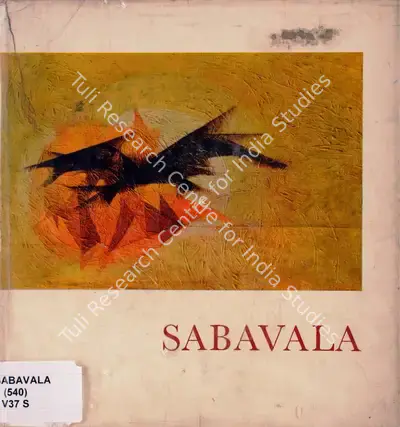
Sabavala, Jehangir (Artist). Jehangir Sabavala, 1951 | Solo Exhibition Catalogue | 00172360
1 / 4

Sabavala, Jehangir (Artist). Jehangir Sabavala, 1951 | Solo Exhibition Catalogue | 00172360

  1. 1951

    1. 02 Apr 1951 to 11 Apr 1951

  2. 1953

    1. 28 Feb 1953 to 09 Mar 1953

  3. 1955

    1. 3rd One-Man Show, Jehangir Art Gallery, Mumbai, India

      15 Oct 1955 to 23 Oct 1955

  4. 1956

    1. One Man Show at the All India Fine Arts & Crafts Society (AIFACS), New Delhi, India

      03 Jan 1956 to 11 Jan 1956

  5. 1958

    1. 15 Oct 1958 to 23 Nov 1958

  6. 1961

    1. Exhibition of Paintings - Jehangir Sabavala, Jehangir Art Gallery, Mumbai, India

      27 Oct 1961 to 02 Nov 1961

  7. 1962

    1. 07 Jan 1962 to 14 Jan 1962

  8. 1963

    1. 21 Feb 1963 to 04 Mar 1963

  9. 1964

    1. 29 Jan 1964 to 07 Feb 1964

  10. 1966

    1. Kunika-Chemould Art Centre, New Delhi, India

      12 Dec 1966 to 21 Dec 1966

    2. 17 Nov 1966 to 26 Nov 1966

  11. 1969

    1. 19 Jun 1969 to 28 Jun 1969

    2. Commonwealth Institute Art Gallery, Edinburgh, Scotland, UK

      10 Oct 1969 to 23 Oct 1969

    3. 29 Aug 1969 to 21 Sep 1969

  12. 1972

    1. 12 Dec 1972 to 22 Dec 1972

  13. 1973

    1. 23 Feb 1973 to 03 Mar 1973

    2. Jehangir Art Gallery, Mumbai, India

      16 Feb 1973 to 22 Feb 1973

  14. 1976

    1. Jehangir Art Gallery, Mumbai, India

      19 Mar 1976 to 25 Mar 1976

20 of 46
Sabavala, Jehangir (Artist). Jehangir Sabavala, 1951 | Solo Exhibition Catalogue | 00172360
1 / 13

Sabavala, Jehangir (Artist). Jehangir Sabavala, 1951 | Solo Exhibition Catalogue | 00172360

  1. 1949

    1. Exposition du ler Grand Prix de Peinture, Monaco
  2. 1950

    1. Salon National Independent, Paris, France
  3. 1952

    1. Annual Exhibition, Bombay Art Society, Mumbai, India
  4. 1953

    1. Annual Exhibition, Bombay Art Society, Mumbai, India
  5. 1954

    1. Annual Exhibition, Bombay Art Society, Mumbai, India
    2. Exhibited at the 'Venice Biennale', Italy
  6. 1955

    1. Annual Exhibition, Bombay Art Society, Mumbai, India
    2. Annual Exhibition, Lalit Kala Akademi, New Delhi, India
  7. 1956

    1. Annual Exhibition, Lalit Kala Akademi, New Delhi, India
  8. 1957

    1. Annual Exhibition, Lalit Kala Akademi, New Delhi, India
  9. 1960

    1. Annual Exhibition, Bombay Art Society, Mumbai, India
    2. Annual Exhibition, Calcutta Art Society, Kolkata, India
  10. 1961

    1. Annual Exhibition, Calcutta Art Society, Kolkata, India
  11. 1962

    1. Annual Exhibition, Calcutta Art Society, Kolkata, India
  12. 1963

    1. Annual Exhibition, Bombay Art Society, Mumbai, India
    2. Annual Exhibition, Calcutta Art Society, Kolkata, India
  13. 1964

    1. Annual Exhibition, Bombay Art Society, Mumbai, India
    2. Contemporary Indian Art, Exhibition at Farmer's Blaxland Gallery, Sydney, Australia
    3. The New Man, Exhibition held for the 38th International Eucharistic Congress, Mumbai, India
  14. 1965

    1. The Laing Art gallery, Newcastle-on-Tyne, UK
20 of 148

Integrated Timeline

74 entries
Jehangir Sabavala was born in the Readymoney House—his grandfather Sir Jehangir Cowasji Jehangir's town house in the Malabar Hills—to one Bombay's most prosperous Parsi families. "I remember a home, a way of life, that existed a long time ago. Its flavour was special and belonged to a family that was feudal but benevolent, rooted in tradition yet contemporary...Once upon a time—there was a small curly-haired boy, who lived in a large house set in a palm-fringed garden bordering a surf-ridden sea. An extended family inhabited different sections of the rambling old mansion. The law of trespass did not apply as such, but unwritten conventions were understood and observed."
Sabavala's immediate family consisted of his parents, Meherbai (affectionately known as Bapsy) and Ardeshir Sabavala, and his brother, Sharokh. The family moved from his birthplace, Readymoney House in Malabar Hills, to Europe, and later returned to their other Bombay bungalow, 'The Retreat', before eventually settling in a house called 'Aewan-e-Rafiyat'. This opulent bungalow, which had once belonged to Nazli Begum of Janjira, was constructed from red sandstone and showcased the Mughal architectural style of Fatehpur Sikri. Bapsy Sabavala—herself a theatre enthusiast and skilled in horse riding and piano—undertook several projects and formed a close-knit circle of friends, including actress Devika Rani, dancer Leela Sokhi, and poet-politician Sarojini Naidu, among others who frequently visited her residence.
Trouble in Bapsy and Ardeshir's marriage starts brewing up as Jehangir grows up, eventually leading to their separation by the mid-1940s. Bapsy travels across the Indian subcontinent and Europe with her children. These early travels leave an indelible impact on Sabavala's mind.
At 17, Sabavala sails home. The year 1939 was going to change the course of events for Europe—war had broken out and Sabavala was advised to leave for India. India too was preparing to overthrow the yoke of Imperialism. Instigated by Britain's unilateral decision to declare war on the Axis powers and involve India into it without consulting the nationalists sparked unrest. The Indian National Congress decided to support Britain on the condition that India be given its Independence. Britain's refusal to concede accelerated the agitation against the colonial rule—by 1942, Gandhiji launched the 'Quit India Movement'. It was in these times of political upheaval that Sabavala returns home—only to go back to Europe again after a few years for apprenticeship.
He enrolled in the English Literature program at Elphinstone College in Bombay but later transferred to the Jamsetjee Jeejeebhoy School of Art without having to sit for a formal examination, thanks to the assistance of the institution's last British principal, Charles Gerrard. Sabavala recalled: "At art school, I was put through a rigorous apprenticeship. Roman plaster casts for a start—to be realistically portrayed in charcoal, in crayon. I was pleased with my youthful, individualised rendering of Michelangelo's 'David'. That the Faculty frowned was another matter."
Boards the Arundel Castle and arrives in London, which although destroyed by the war to a large extent, still had an efflorescence of culture. Painters and sculptors such as Matthew Smith, Henry Moore, Graham Sutherland and Francis Bacon were active at the time. His influences are several—from Egon Schiele whose influence can be seen in the expressionistic portrayals of the human body to J. M. W. Turner whose romantic landscapes and sailing ships call to mind Sabavala's own land and seascapes. From 1945-47, Sabavala studies at the Heatherly School of Art where he meets the renowned writer and painter Richard Lannoy, with whom he would go on to develop a lifelong friendship.
Theatre being his original inclination, he carries in his mind some notion of studying the dramatic arts while leaving for Britain. His mother's flair for theatre was already imbibed in young Jehangir and he had taken elocution lessons as well as acted in some productions with the Bombay Theatre. Upon reaching Britain though, he would take the decisive step towards a painterly vocation. An introverted predisposition would make him recede inwards. Elements of theatre: crowd positions, groupings, the play of light and shade on the figure would get incorporated in his paintings instead.
Between 1947-51 Sabavala joins Académie Julian where he studies Impressionism and then at L'Académie André Lhote where he learns the Cubist pictorial language imparted by the eponymous Lhote. Lhote, himself a former pupil of the Spanish painter Juan Gris, initially refused to accept Sabavala as his student. However, he eventually relented in the face of Sabavala's determination. It was under Lhote's guidance that Sabavala was compelled to evolve beyond his grounding in Impressionism and develop the skill and acuity to perceive objects in relation to one another— the fundamental principle of Cubism. Reflecting on this period, Sabavala admitted, 'Abstraction was alien to me. I was the master's worst pupil.'
Marries his companion Shirin Dastur who was also studying Sociology in London at the time on a scholarship. She came from an important family of academicians herself and played a pivotal role in the process of Jehangir's evolution. "I have never felt left out of his painting. Jehangir is very considerate, he shares his work with me", Shirin said years later in an interview given to the Eve's Weekly, India's oldest women's publication.
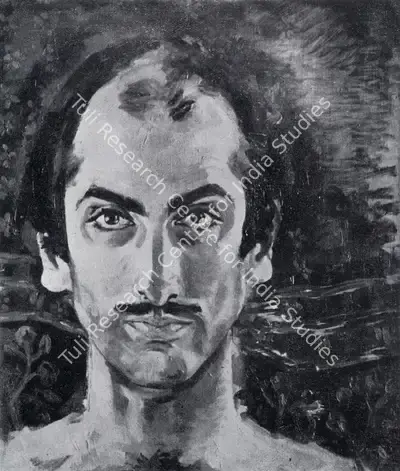
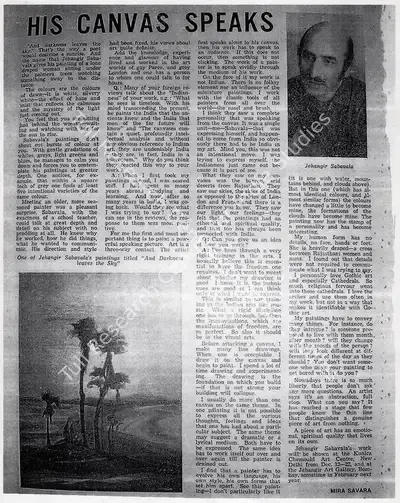
Paints several romantic self portraits during this period. A deeply private person, he would enjoy the pleasures of conversation but also often, when needed, retreat into solitude. "I step into my private world of paint and canvas every day—working almost without cease—into this private world of joy and pain, because I have such a deep need to find my own equilibrium, try to find a semblance of serenity. Whether one succeeds or not is a totally different matter." Expressing his need for solitude, even at a later stage in his life, he would write: "And then there have been numerous exhibitions, truly a plethora of them—and just when one wants to pull in, to be left alone, to work and think again, to plumb one's own depths, such as they are. Not easy, when outwardly you carry a 'social' load which can't be totally ignored, placed as one is, in a city such as this. But little by little, I fight to work again, cocoon myself against the onslaught of living in this turbulent country, with one's hopes and fears and dreams. What a strange and secret world the world of paint is."
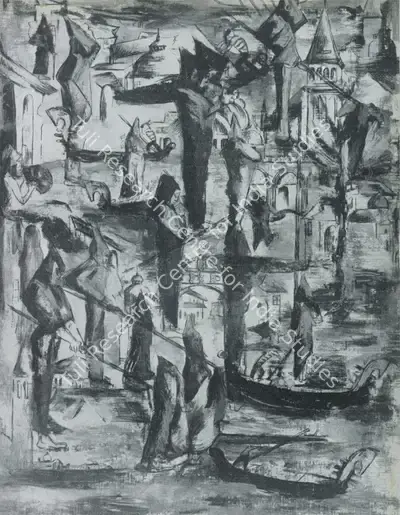
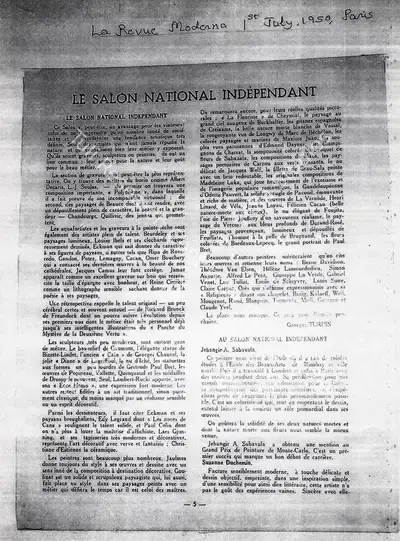
Sabavala participated in a group exhibition for the first time in Monaco in 1949, followed by another group show in Paris a year later. He was part of a generation of young Indian painters in Paris during the 1940s and '50s, including Nirode Mazumdar, Ram Kumar, and Paritosh Sen, and later joined by artists such as Laxman Pai, S.H. Raza, and Akbar Padamsee. Like Ram Kumar and Padamsee, Sabavala developed a deep affinity for landscapes, which became a recurring theme in his work. Paris remained etched in his memory, as reflected in his evocative recollection: 'The constant glimpses of well-loved vistas—as the battered old metro rattles across the gleaming river, and all the intricate steel of the Eiffel Tower stands revealed, braving the elements and piercing the sky...' These early experiences and his travels across Europe left a lasting impact, nurturing his innate inclination to paint landscapes. Alongside these, he also created numerous portraits and still lifes, showcasing his finesse and acuity in capturing the human form with vivid color and sensitivity.
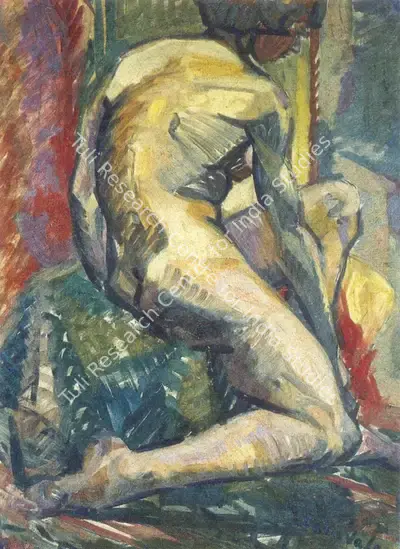
Drawn as he was to human anatomy and the fundamentals of form, he emphatically proclaimed: "A painter who cannot paint a nude cannot paint a landscape". In the late 1940s, he paints several nudes, owing to the ready availability of models.he learns the techniques of rendering anatomy in an academic manner, centralising the presence of the body in painting. In an interview he recounts the pertinence of learning the fundamentals of art:"I know that there is a trend among young painters who don't (learn anatomy)...and I'm not fighting with them...but they do not think of the fundamentals of learning how to draw, in other words, having a fairly classic/academic background to your work. To me it's important because I've had it. And I think it's a strength. Take a figure, a human figure. Once you know how to do a human figure, from there you can jump off...you can distort it, you can change it, abstract it, you can do many things. But if you don't have that basic foundation, I think you're on weaker ground."
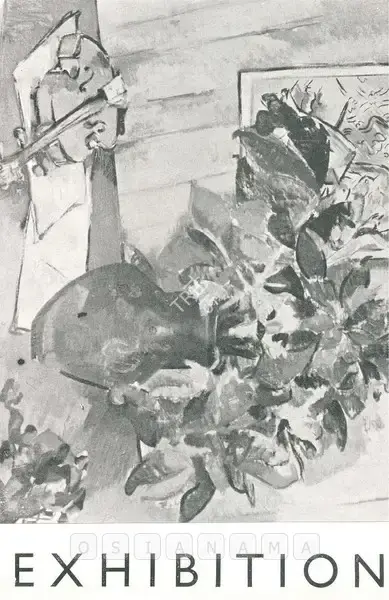
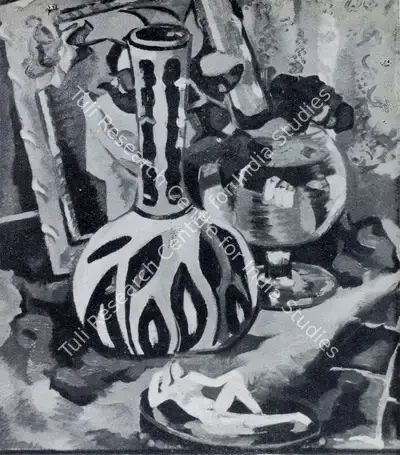
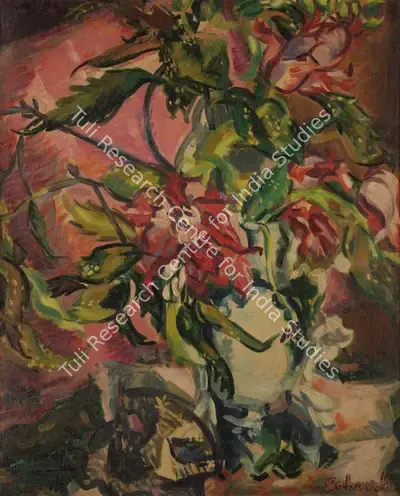
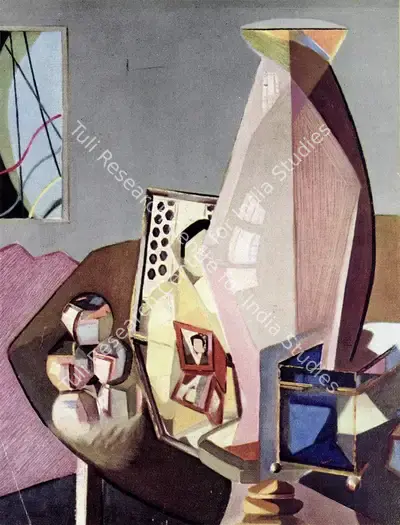
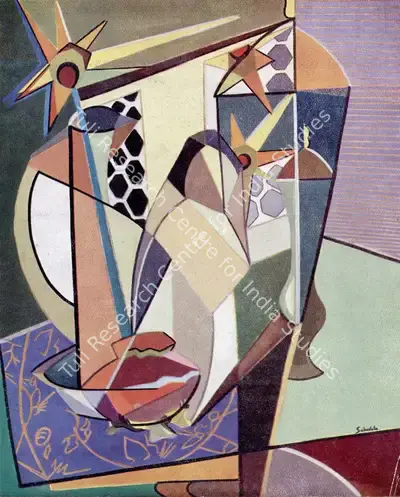
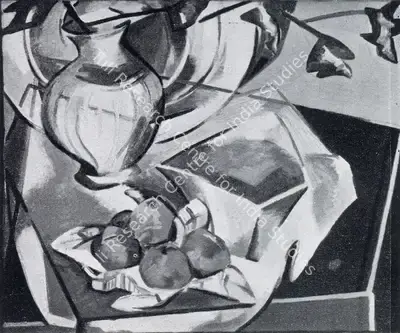
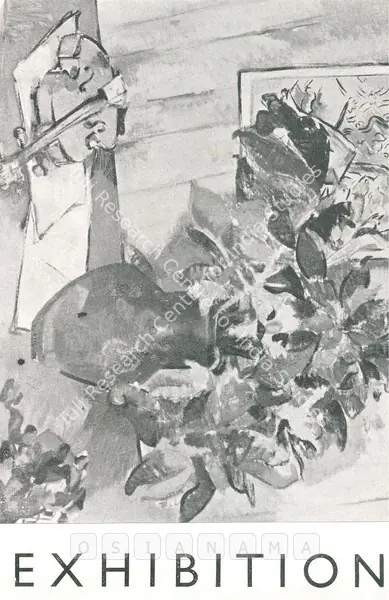
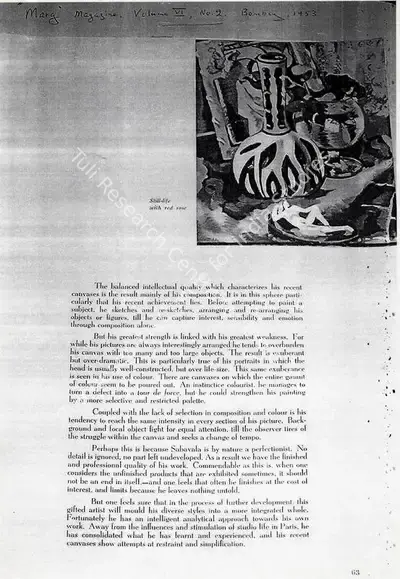
Through a series of still lifes done in the late 1940s and early 50s, Sabavala pays homage to the French schools of Painting. He had an easy access, owing to the globe-trotting from his early years, to European modernism. Being able to look closely the works of artists ranging from Henry Moore, Mathew Smith, Paul Gaugin, Graham Sutherland and Monet, Sabavala's choice of influence, his engagement with that selection and how he incorporated that painterly language in his development as an Indian painter is interesting to note. In Leaves....a Violin one can see a distinct influence of Matisse's odalisque and the violin calls to mind the guitars of Picasso, Braque and Gris (Note that the guitars and sometimes violins inspired a series of fractured, multi-perspectival, deconstructed imageries that marked a key transition from Analytic to Synthetic Cubism in such key works as Picasso's 1913 collage 'Guitar'). The slightly assymetrical and slant pitcher is reminiscent of Cezannes' post-impressionistic still lifes. In other still lifes such as the various flower studies,there is a conscious disposition of elements around a subject, a play with contrasting lights and a sensuousness of colour that harks one back to the works of European masters that Sabavala studied.
Sabavala and Shirin return to India after six years of having stayed in Europe. They spend the first year in a suite at the Taj Mahal Hotel. Together with Shirin, he mounts his first show in India at the Princes' Room of the Taj Mahal Hotel in April 1951. Shirin and Jehangir take upon themselves the task of overseeing the mechanics of holding up an exhibition. He had returned to India where the art scene was such: Amrita Shergil had already made her mark, while artists like Husain and N.S. Bendre were just beginning their careers. Groups emerging Post-Partition, like the Progressives of Bombay and the Shilpi Chakra were moving away from the pastoral romanticism of the earlier Bengal School. The Bombay painters would find their most influential guides and patrons in three exiled Austro-Hungarian connoisseurs: Walter Langhammer, art director of The Times of India, Rudolf von Leyden, art critic of The Times of India and Emmanuel Schlesinger, who owned a pharmaceuticals firm. Langhammer would hold several Sunday-morning meetings joined by Sabavala's contemporaries—Raza, Ara, Hussain, Souza. Sabavala would refrain—as he refrained from being part of any group affiliations—from participating in these gatherings. Shirin would remark:"You had to pioneer...The public was hesitant about art; to them art was just paper and pencil or colours. In those days every artist had to work hard to make the public interested." Gieve Patel had brilliantly posed the dilemma of an Indian painter in Post-Independence India in his essay 'To Pick Up a Brush' (in Contemporary Indian Art, 1986): "Post-Independence India had no role for the urban, contemporary artist, the man who would fabricate and comment upon the present, and who would not necessarily continue with folk and classical forms. The world would certainly have been chill for him, with the unexpressed, ubiquitous question: What is your work for? Who is it for?" It has taken the artist two or three decades to reply simply: 'It is for you. And me. And specific third-world tragedies gave a special edge to the chill. In universal deprivation, may one allow oneself the luxury to pick up a brush?"
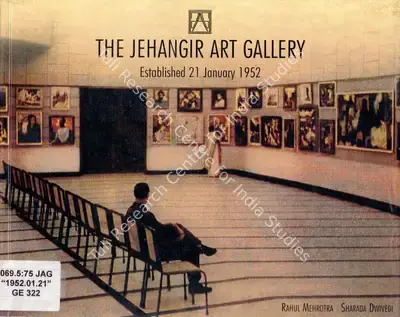
The Jehangir Art Gallery for modern art gets commissioned by Sabavala's uncle, Sir Cowasji Jehangir, 2nd Baronet. Sabavala emphasises the importance of a visual education for the masses. In order to disseminate visual knowledge and introduce the discourse of art appreciation for the common man in India, he joins critics like S.V.Vasudev, D.G.Nadkarni and Nissim Ezekiel and starts giving lectures through All India Radio. Already the debates and commentaries around arts and aesthetics were being cultivated among people by writers, critics, connoisseurs and educators such as S. V. Vasudev, Hermann Goetz, Nissim Ezekiel, Mulk Raj Anand (who founded MARG in 1946). Sabavala was one among influential artist-cum-educators who would establish a network of patrons and educators for the dissemination of Visual Arts. He would support firms like the Vakils to bring out books on Contemporary Art and painters and go on to struggle for the establishment of a branch of the National Gallery of Modern Art in Bombay throughout the 80s and 90s—something that would finally fructify in 1996.
The initial portraits like the ones done of Shirin and other sitters reveal a fondness for vibrant colours. Her vivid portraits rendered by him had made his friends call her a 'Spanish Beauty'. It is a springtime palette—sensuous colours that he would later discard, at one point even bleaching his canvases of all colour. But in the beginning of his art career, that is not the case. Here, they play a pivotal role and he had several influences for the same. He harboured immense admiration for Marcel Duchamp and Juan Gris: "I owe Gris a profound debt...the distinction of his colour harmonies, the monastic aloofness of his temperament, find in me a surge of sympathy and comprehension...I admire him (Duchamp) for the abundant joy of his pure colour, the tones fresh and gleaming, like so many jewels strewn in a velvet case. To him, I owe my own palette, which wants to sing with the greens and blues, the browns and ochres of the earth itself."
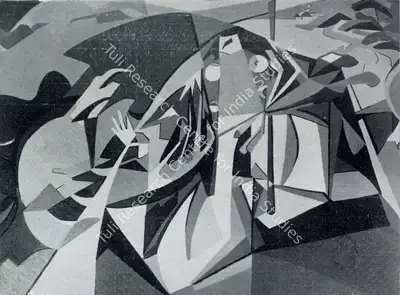
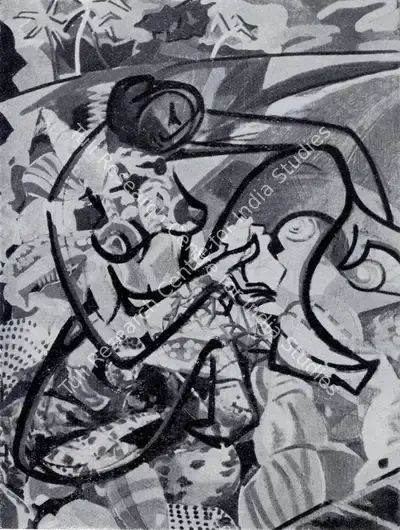
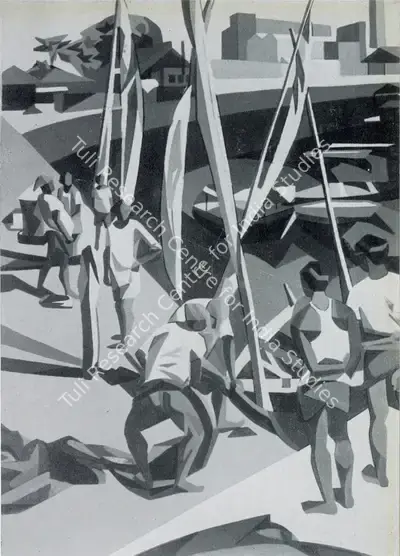
Experiments in Cubism commence. A lot of still lifes of the early 50s are rendered in a cubist manner. Andre Lhote's pedagogy is employed by Sabavala to render Indian objects. In a way, for Jehangir, the first encounter with his Indian surrounding takes place through the objects of day to day living, the "still life", in other words. Ranjit Hoskote remarks: "The cubist idiom is stretched in his paintings, in this period, to accommodate a growing conviction that the life of the senses is an important source of replenishment....while Cubism works against Europe's naturally hazy light, its formal effects are reinforced and even exaggerated by the piercing illuminations and pronounced shadows of India. The process of acculturation involved, for Sabavala, a "great deal of intellectualising: the analysis of planes, the passage of light. I became more sure of how I wanted my painting fractured and adopted a definite form, a daring, high-pitched and high-keyed palette."
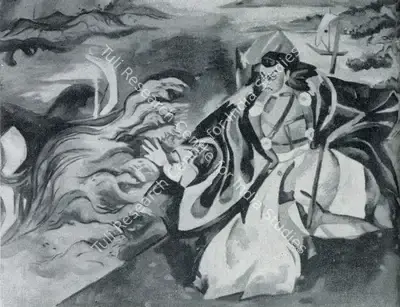
There was "a bit of virtuoso performance thrown in", Sabavala would exclaim,"a pleasure in what one could do, because one was excited by the technique." Starting from the mid 1950s, he would paint a series of subject matter from butterflies to human figures that Hoskote says "partook of a quaint Japanese touch, a tender japanisme that sometimes verges on the sentimental.Indeed some of these paintings—such as Benkei, The Warrior Priest I and II (1955) and Pause in Flight (1958)—celebrate the spectacular solemnity of the Kabuki drama."
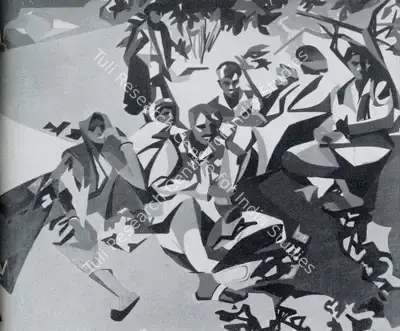
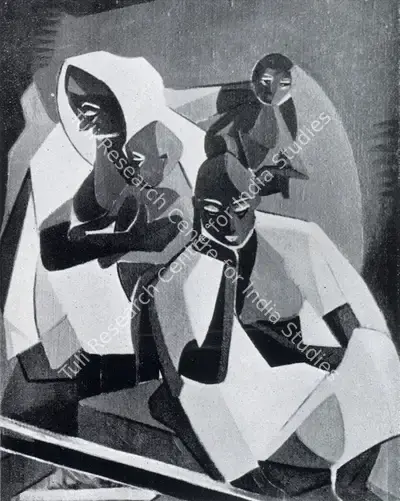
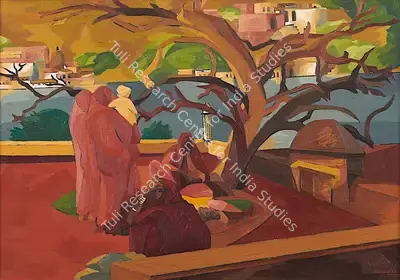
Through the 1950s there is manifest, in his works, the influence of India—its people, culture and geography. Being drawn as he was towards symbolism and motifs, he would go on to explore and depict through images the deeper themes underlying his paintings. This entailed navigating and striving to reconcile the fusion of an inherently Indian sensibility with a foreign medium. He went on to observe closely the people from each region he worked in, noting their typical poses and gestures, their attire, customs, and rituals, as well as the varied profiles of people in the local bazaars. In such paintings as A Village Gathering, Rajasthan(1956) he explores the Cubist idiom for a personal style whilst recording his impression of an Indian scene.
In Pavement Dwellers he paints in opaque impasto his subject without sentimentalising them. Sabavala was starting now to discover India. He talks of his fascination with India, its people, its landscape, its light and colour in the following excerpt: "It is entirely wrong to think of so many parts of India as blazing with colour; it is terribly tourist, terribly western and very naive. It is not so. Ours is a light that's filtered, because of the heat, the power of the sun, so that between you and the subject there is always a haze. You've got to reach out into the mountains, like the Nilgiris, or in Kashmir or go up to the Kumaons to get a wonderful shower of rain that washes everything clean and then you get the most marvellous, over-romantic, dangerous lights. But that is not in our (Maharashtra) region, which is hot and hazy. Look out anywhere. I mean today, for example, look out at your lights. There is very little colour. The colour has to be searched which suits me very well, again there is the analysis, I like it. To me it looks a sort of pale yellowy grey. Within that pale yellowy grey an exciting lot happens. That suits me.Then there's Rajasthan the desert areas, again I find myself basically much more drawn to arid regions, Jaislamer. Rajasthan, where there are ranges of ochre and amber. There the colour lies only in the people. I've really gone into this and it's fascinating. How come the desert regions in India have costumes that are so magnificent in their fabulous display of colour? Because the people are starved of colour. All around them is adobe, a Mexican sounding word, but it applies. They use cow-dung and mud and straw for the walls of their houses and huts. All this basically sits on the landscape so perfectly that it is difficult to tell one from the other. So they have a natural hunger for adornment. Naturally more with the women, but even the men— I mean they wear those huge silver bracelets, turbans that are blazing with colour, and the women are just fabulous and nowhere else is there this colour. They take pleasure in putting it all on themselves because around them, hardly any green, hardly any blue, you see. In the lush, rich regions of Kerala with the coconut palms and the sea or the mountains, colour is all around and there you find the people dressed either in all white or the usual nondescript clothing of anywhere. They don't need to adorn themselves."
At this juncture, a subconscious trove of imagery makes itself manifest: the crucifixion, the ship, the bird, the cataract, the peaks that turn, by a painterly sleight of hand, into cypresses further unfurling into sails.In such figures as The Madonna of the Holy Ghost, Two Women of Jaipur and Thrust and Pattern (all 1958), we see the first of those augurs who approach us from Sabavala's frames, making gestures of benediction, lamentation and questioning that can only half comprehend. With the academy just behind him, the conventions of genre were very important to Sabavala. He treated genre as a necessary measure, largely because it provided a provisional solution to the contradiction that he felt within him: he was obligated to reconcile the contrary demands of the Impressionist and the Cubist traditions.
A 1957 visit to Italy inspires him to paint the Crucifixion series (1958-59), as is apparent from the various diary entries from the time; he was especially enamoured by Perugino's Fresco of the Crucixion on the Via di Colonna and the Giottos in the Santa Croce. The patterns constructed in mathematical precision hark back to the ornate windows of early Renaissance. The architecture of intersecting and fractured planes, the wedges of light hint at Sabavala's earliest forays into cubism. The effect in these and other paintings of the Christ series is of a stained-glass window that Renaissance churches are replete with. The former still life configurations of the early 50s at this point give way to a newer configuration—that of stormy seas and sailboats. The cubist idiom would still dominate in his works but with an attempt, at the same time, to round off its rough edges and make the lines more fluid. Fascinated as he was by biblical themes, he once remarked, 'Pietà—an early depiction of the eternal Christian theme to which I have a close affinity, as with that of the Crucifixion, which I have often painted.'
It is interesting to note that in a country with an enormously vast coastline, few artists forayed into depicting the sea—as symbol of infinity, of mortality. Whereas ghats, rivers and mountains found their way in the Indian modernist's idiom amply. Sabavala's use of the sea, sailing boats and waves marks an interesting departure. In the late 1950s, birds and ships become a recurrent motif in Sabavala's ouvre:"The ship is an invitation to paradox: one remains stationary while being in motion on it, and so it presents itself as the most fitting rendition of Sabavala's underlying theme of passage between a here and an elsewhere that shift definition all the time. The bird, switching between the enclosure of gravity and the openness of flight, negotiates a dialectic freedom." Ramachandra Rao, writing in Sotheby's auction catalogue has very aptly observed: 'Sabavala strives to express his emotion by the juxtaposition of planes and the interplay of tones in a symmetrical architecture of many facets; he builds solidly with an almost mathematical precision, often cementing his structures by a strong binding line. From a representation of the objective reality, his natural progression has lain in the direction of abstract art, towards the exploration of chromatic orchestration, without the emotional incubus of the figure or anecdote. First, the geometrical stylisation of reality in patterned colours of deep resonance, as of stained glass; then, realisations of angular, inter-locked planes, independent of visual references; and, as of today, a quest for a chaste, almost monastic, simplicity of eliminative form, addressed to an intricate interplay of vibrant colour planes [...] He imposes on himself a meticulous discipline in the intellectual search for crystalline form, for its disposition into compositions of fastidious colour textures, under the constraint of Cubism; appearances, sail-boats and birds in flight, surrender their identities in near-abstract patterns of triangles and parabolas; in this manner, working out his own syllogism, he has the field all to himself, a private domain.'
Shirin and Jehangir's only daughter, Aafreed is born.
S. V. Vasudev in his analytical notes draws our attention to Sabavala's personal idiom developed from Cubism in 'Jugs in Consonance': "In his Cubist experiments, Sabavala has pursued his own deliberations relentlessly which have eventually contributed immeasurably to his arriving at a personal style both in figurative and land- scape compositions. Here, for instance, his preoccupation with a still-life is guided by three important factors-light, colour resonance and texture- not to mention the study of superimposed and interrelated planes and profiles."
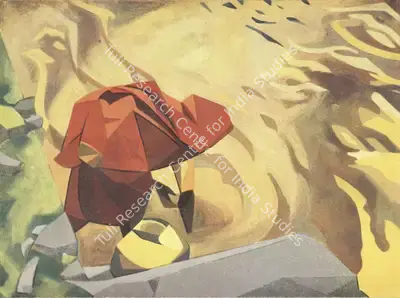
"I didn't fight India", Sabavala remarked, recognising his native country as a theatre of possibilities. Between 1959 and 1962, Sabavala got down to the brass tacks of liberating his paintings from the straitjacket of Cubist machinery. His tripartite objective in the late 1950s was first to render the spirit and symbolic nature of place; second, to edit and format his paintings in an aesthetically satsfying manner; and third, to communicate to his putative viewership the operatic sense of an identity negotioating with its ambience, expressing its findings in rich colour, exuberant motif, innovative strategies of design. The success of this tripartite objective is evident in so accomplished a work as Sanchi (1960). It is interesting to note that the dome of the Stupa is slightly tilted and this is a very unusual angle in which the stupa is painted. Evidently, a search for an image that is expressive of the painter's need becomes visible.
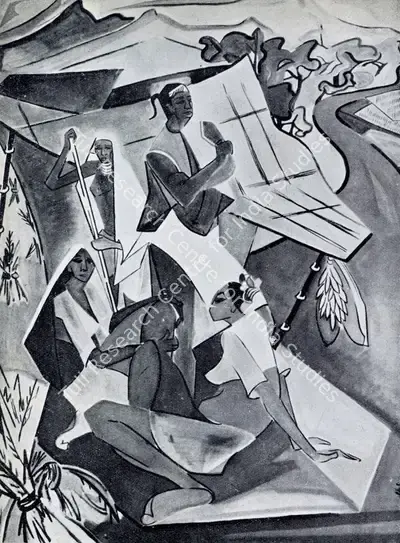
Rendered in a modernistic manner, this frieze's subject—a panel of musicians—suggests influence of an Indian tradition. And yet, it could be read also on a futuristic level in terms of the dynamism of the figure's movement.
His mentor, André Lhote passes away in 1962. A shift in Sabavala's work takes place from motif to image. A realisation soon sets in that he would have to transcend the techniques learned through his studies and fully harness the power of imagination to make a meaningful composition—a need, in other words, of an 'inner transformation'. 1962 marks another phase in his evolution, a kind of breakthrough: the palette begins to change—russets and golds, greys, blues, greens and browns, get pronounced and the passage of light gets modulated. Of this stage, Sabavala notes: "It is my aim to haunt by the use of the broken tone, the drawing too, began to grow looser, more elusive." "The key transition from genre to theme", recalled Hoskote, "from motif to image, also meant that Sabavala now renounced the comfort of the well-made picture, preferring to take greater risks…In the early 60s, the puzzle painting and the detail-crammed miniature would both yield, in turn, before the meditative absorption in a central image, an image that had acquired a sharpness of edge and a robustness of definition. This formal project attained its consummation through paintings like Golden Flight (1963), in which a burnished light explodes in transverse fin of bronze and blue; birds, clouds and banks of suspended light fuse into an arresting image of lightness, release and freedom."
Pria Devi in the monograph published by Lalit Kala Akademi analyses this painting like this: "An elegant painting from 1962, and near-abstract. Fishing-craft lie so disposed in their own shadow as to form a prow arrowing in from left to upper right and crossed by a transverse of light to a dark foreground tilt. The body of the painting is in ochres and soft cadmium yellow. Note the use made of the Feininger "extensions" for the first time as if light were to bounce off a solid into a semi-haze. This is to be explored till mid- decade, Note, too, the angular spatulate texture to the impasto."
Cubism starts to appear disjointed and out of touch from the world in which he tries to indroduce it—the roots of Cubism lay in Europe after all and it soon starts to appear as a western import. Sabavala starts receiving critique from reviewers regarding the same. He would soon realise he could no longer use it to fully express his needs. The expatriate Hungarian archeologist and art historian Charles Fabri goes on to pose the question to Sabavala: "Was Sabavala satisfied with himself? How long would he continue in a minor, sub-Cubist key? And where will you go from here?" Nilima Sheikh's critique of his use of Cubism in Vrischik (March 1973) directs one to the source of his dilemma: "There is absolutely no harm in subscribing to the devices of Western art or traditional Indian painting because awareness of the two is modern artist's make up. But whether they guarantee the same conviction in a changed environment is a problem the modern painter here is constantly faced with. The problem remains the same when Ravi Varma attempted to use the British academic framework to narrate Indian legends and when a painter like Jehangir Sabavala tries to impose the devices of Cubism on pastoral scenes...."
Gets inspired by the work of Lyonel Feininger's glissando Cubism. Starts softening his paintings and depicts light in a more indispensable manner. Sighting Feininger as an inspiration, he comments: "Through Feininger's pure, precise and yet very delicate and personal renderings of cloud and boat and sea, I discovered the joys of extending form into the beauty and clarity of light. I became interested in the source of light, its direction, its effect. Through these experiments, gradually, my work changed." Details give way to simplified form and restrained diagram, the subject mass becomes large and borders thicken. His vibibrant palette gave way to muted, earthy tones, and his geometry became looser and more expansive. Adil Jussawala reflecting on Sabavala's use of light writes, "The bleached light Sabavala presents us so frequently is the Indian light, honestly recorded"
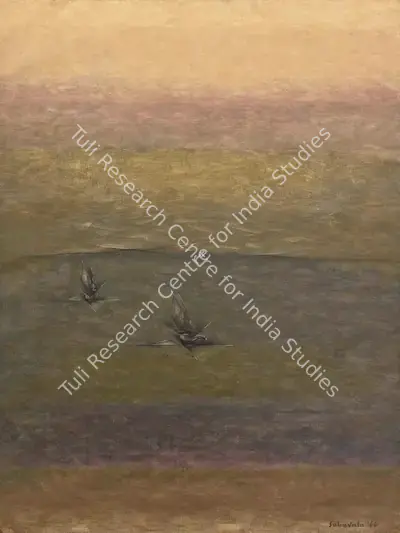
The figure starts to recede and landscape emerges; briefly as he will return to the landscapes again. The Close of Day marks an important shift in his pictorial language—we can see that the figure is being left behind giving way to a shimmering sunset in a sea where three boats are anchored. In a statement written out to the American art critic George Butcher, he would say, almost in a declamatory manner: "No longer am I satisfied with the juxtaposition of planes, the search for rare colour, the almost total denigration of the unpremeditated. It is the intangible which is now my goal. Space and light, and an element of mystery begin to permeate my canvases. Emotions seek a new release in what I hope will become a permanent synthesis of heart and mind."
Works like Icarus (1965) and Journey of the Magi (1963) reveal his focus on the intense, charged scenarios imagined within the realms of religion and mythology. Icarus is a direct reference, perhaps even foreshadowing the two most omnipresent themes in Sabavala's works that were inaugurated in the early years—flight and mythology. According to the Greek myth, while attempting to escape the confinement of King Minos on the island of Crete, Icarus, exhilarated by the thrill of flight, ignores his father's warnings, flies too close to the sun, and ultimately plummets into the sea and drowns. Narrated otherwise as a cautionary tale about the dangers of over-reaching ambitiousness, youthful rebellion and self-destruction, Icarus fascinated Sabavala who was himself a rather disciplined and composed artist—not sans ambition but not reckless and self-destructive either.
Journey of Magi is about the pilgrimage—mapping the fortune of three wise men travelling from their kingdom to pay homage to infant Jesus Christ as the king of the Jews. The motif of three wise men would become a recurring theme in Sabavala's later works. He would remark later on how: "Somewhere along the way, I want to draw the viewer into my myths, my legends. The artist must ensnare you into his web, like a spider."
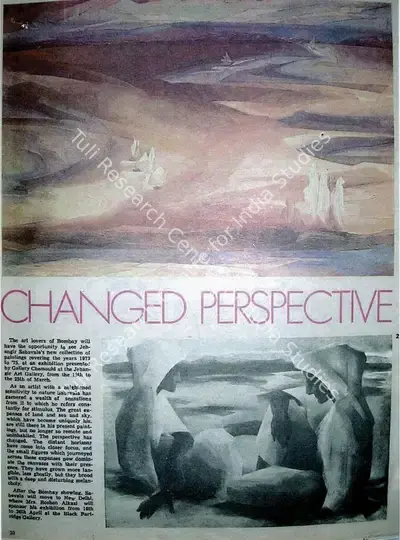
Ranjit Hoskote commemorates In the World's Afterlight (1966)as one of the 'key paintings' in his ouvre, wherein a "panoramic view of multiple horizons rises to accompany the sun as it vanishes in a great, golden twilight. The pilgrim figures gathered near a lake, perhaps to pray at dusk, are the precursors of other such questing figures, whose advent would soon impart a distinctive mystical cast to Sabavala's paintings." Of his preoccupation with landscape, Sabavala remarked: "I discovered the suitability of landscape first, almost by willful accident. For me, it was liberation, for the first time, from the various disciplines and schools of painting which were my equipment. I felt instantly at home with a scene that could be moulded into whatever form that I wished it to take. This eventually developed into my mountain/cloud/sea/dune forms. These became distinctly mine and not as depicted by anyone else. So that the idiom began to be personalised and now is extensively so." (5 May 1996)
One of the first critical monographs under the Sadanga Series on the artist gets published by the Vakils, Bombay. S.V. Vasudev writes introduction and critical notes for the same.
While talking about the landscapes of the 1960s and 70s, Sabavala reveals that it is the soil of India that moors his paintings: "I seem more drawn to the sea and sky of the western seaboard and to the ridges and dunes of our desert areas. To the arid wastes of Rajasthan where all is abode-coloured, and land and sky merge into one, but no focal point is ever lost." (5 February 1996) Sabavala's major artistic breakthrough comes in the mid-1960s, when he starts questioning the value of his earlier, carefully crafted style, which Hoskote had called 'tropicalized Cubism.' This shift allows emotions and energies that had been dormant in him for years to surface. His structured images give way to a more visionary approach, as his childhood memories of places like the Alpine lakes, the Deccan plateau, the Tungabhadra River, and the southern seas get transformed into symbolic, spiritual landscapes in the paintings from the 1960s and 1970s.
In the late 1960s, one can see Sabavala's frames being preoccupied with pilgrims traversing terrains of caves, waterfalls, abysses, crags and further into a receding horizons. His figures appear almost indistinguishable from the elements of nature that they're present in—rocks, trees and seas. These phantasmagoric, more-spirit-than-flesh figures had already made their apprearance in his paintings by 1963, but they were to stay and evolve further hereonwards. The Nuns (1965) and Vespers (1968) are marked by Hoskote as paintings that "symbolise the human consciousness wavering on the brink of the unknown: climbing the winding stairs of ruined churches, the brown hairshirt vestments of their self-mortifcation pointed up by off-white coifs, these initiates have turned into sculptures themselves. Lamp and book in hand, they wrap seclusion and darkness about their bodies, pushing forward into the cavern where they will waver before leaping into the darkness of faith."
D. G. Nadakarni, in a 1969 exhibition catalogue writes of Sabavala, that the artist under review "belongs neither to those pursuing so-called indigenous imagery with an already played-out folk origin nor to the unambiguously westernised, sometimes self-consciously experimental avant-garde... It is essential to understand that (Sabavala's) art is as much Indian as the now traditional, folk- motivated art with which western gallery-goers seem to be familiar. The difference is that Sabavala's work travels beneath the surface and catches visually the spirit of this ancient mass of land called India. It is not surprising that, in effect, it projects a universally valid image of nature itself."
Between 1969 and 1975, Sabavala loses his mother and Shirin loses both her parents, her sister, Kamal Wood and her brother-in-law, Evelyn Wood. The figures of this time almost act as a premonition to the personal loss. The paintings of the early 1970s are frequented by pilgrims who are often accompanied by disembodied figures such as sibyls and wraiths. Tapping into biblical themes, he paints several works wherein he sets down his prophets and pilgrims. In The Flight into Egypt trilogy (1971), he outines the themes of dislocation—of a desolation borne out of exile. The theme of diaspora would make itself especially manifest in a painting such as The Lost Tribe in 1975. Reflecting upon his own diasporic heritage, Sabavala comments: "Over the years, I have found myself irresistibly drawn to the still, solitary world of the bare landscape, within which man, if present, is a notation, a lost fugitive or a pilgrim." That "the ethereally visualised form fits more aptly into my biblical landscapes. It strikes me as strange that I, who have sought to capture the weight and volume of the human figure in my studies of men and women in the studios of London and Paris, am now satisfied with creating a shimmering creature—part flesh, part spirit."
There is a harkening back to the history and legacy of Sabavala's Persian ancestors who fled persecution and found refuge in India: bearing suffering yet driven by resilience, the hooded, faceless figures undertaking a challenging journey through these mirage-filled highlands. Reflecting on his diasporic heritage and the stories he had reimagined from it, Sabavala became convinced that, despite the triumphs of technology, humanity remains utterly insignificant in the grand scheme of nature. Like most creative minds, Sabavala had a fascination with death as well: 'I used to be afraid of the Parsee funeral rites. They are so forbidding. There is nothing in it that makes death seem less terrible for the living. The language, too ancient for us to remember, the white robes of the priests, the band across the mouth, the fire... I understand it better now, and appreciate it in fact. There is a kind of comfort, and a preparation...' A critic once asked of Shirin, "Why is there so much loneliness in Jehangir's paintings?" "There is much less of that now, isn't there", asks Jehangir.
A kind of spiritual loss of a home is suggested by the pilgrims' anonymous faces that practically disappear into the endless landscape. The choice of tone implies that the figure and the landscape are interwoven, creating an immortal human that is unaffected by war, death, displacement, and the whims of society.
By the mid 1970s, Shirin had started to lean towards the yogic system and eventually became the President of the Bihar School of Yoga's Bombay chapter. Periodic residence at the ashrama headquartered in the Munger district of Bihar would influence some of his protagonists in his paintings such as The Lost Tribe (1975) and Sorrowing Men (1974). In The Lost Tribe, the exiles come together on a barren, rocky plain, beneath a sky filled with ominous, predatory birds. The warmth among them emerges from their collective struggle, with their acts of sharing and empathy forging a sense of unity. Through his allegorical approach, Sabavala highlights the persistence of the human spirit in the face of despair. This enduring strength takes many shapes in his work— sometimes as a serene lake in the hills, sometimes as a cloud lit by sunlight, and sometimes as a group of wanderers— but its core, vital significance remains constant. Sabavala would bring about the mutation of the body and comment how: "It was surprising that I, who had levered the weight and volume of the human figure in the studios of London and Paris, should have turned away from painting man as the solid, carnal creature that he really is. I began to create apparitions that were more spirit than flesh."
Questions are raised by critics and viewers about the politics of the artist, with one viewer confronting him with "Does nothing trouble you?" New groups such as The Baroda Group consisting of Gulammohammed Sheikh, Bhupen Khakhar, Gieve Patel and Vivan Sundararam and the Group 1890 spearheded by J. Swaninathan emerge with a new avant-garde spirit denouncing the previous generation as a generation of self-indulgent, apolitical image-makers. Ranjit Hoskote makes a case for Sabavala against this critique by establshing Sabavala as someone whose "relationship to the local and immediate was not informed by a taste for political engagement. It is not, fundamentally, in Sabavala's nature to be a chauvinist for any cause or region; he regards art as its own continent..." When critqued for his own lack of 'social' content, Sabavala would remark: 'Not all the great works of art which have withstood the test of time have social content...I could twist things. Someone in fact asked me to do just that, to illustrate drought or some such tragedy—but then, you'd be asking the wrong man.The greatest paintings have given joy, visual beauty, have stimulated and excited. There have been artists who have painted great social themes —Daumier, Goya, Kirchner—but they didn't do it to be popular. If you are a propogandist, you must be so on a grand scale— like the Mexicans. Yet Rivera rose to greater heights when he was not painting social themes." While it is not entirely pertinent for an artist to be crusading for a political cause, questions about the integrity of an artist are bound to be raised by critics and contemporaries. For someone like Sabavala, his sheltered upbringing would make him look at India as an outsider—he was both a native as well as a foreigner to the socio-political realities of the country. An oriental occident of sorts. The ability to draw upon the spiritual and sublime elements again is a privilege accorded to someone with no material constraints, someone who could travel the world and engage with its varied experiences. Sabavala's journey has been marked by a triumph of independence and self-reflection—a steady evolution of a pictorial language on his own terms, and yet, as Pria Devi aptly described, he was someone who began 'in the mid-morning of Indian modernism.'
Receives the Padma Shri by the President of India
The Landlocked Sea (1979) for Sabavala, was the culmination of a direction that he had pursued since 1965. Painted at the end of the decade of 1970s, it became emblematic of a certain way of painting landscapes that Sabavala would let go in the 1980s. In a letter addressed to his biographer, Ranjit Hoskote, Sabavala would make it clear : "I have been working (1981), quite how or how well I do not know...I have stopped painting this way (referring to The Landlocked Sea)...The time seems ripe and the moment opportune to explore other realms of one's being—if they exist. The known path acts as a catalyst to the adventures that lie ahead, so that each new effort becomes a renewed experience and not a remembered one. The present experiments involve me with 'earthlings' as Shirin justifiably says. They seem to want to take over and are monumental within the canvas. My beloved landscapes recede- and I muse let them go."
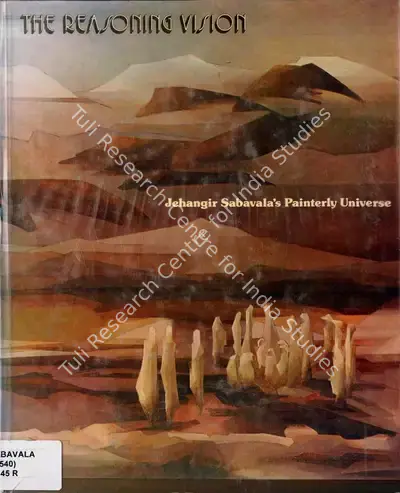
The book 'Reasoning Vision: Jehangir Sabavala's Painterly Universe' written by Dilip Chitre gets published. Naturally skeptical of religiosity and ritualism,Sabavala remarked in a dialogue with A. S. Raman in 'God versus the Avant Garde', The Illustrated Weekly of India, 1981, that "the pace and measure of religion is too slow and our turn of mind too intellectual, too demanding of proofs, to be satisfied by religious doctrine and hierarchy." Despite straying away from fundamentalism, he would harbour a complex relationship with religion- vacillating between intrigue and skepticism. His figures would unmistakably be inspired by the sanyasi figures of Munger. The protagonists of such paintings as The Sorrowing Men from 1974 and The Disciples become cues for figures in his later paintings. In The Disciples, three monks move with a sense of stillness, each immersed in his own quiet, inner peace. In both paintings, the figures could be yogis, Buddhists, Essenes, or even beings from a future world. Sabavala's portrayal embodies a northern ideal, carrying with it the serenity of a legendary Tibetan monastery, the tension of lands vulnerable to Hun and Mongol invasions, or the enduring strength of the mountainous frontier between the Pamir highlands and peninsular India.
In the 1980s, Sabavala inaugurates haunting images later known to be his "Purdah Series", offering a raw and emotional portrayal of the veiled figure. Sabavala says: "I find the draped and cowled figure very interesting from a technical point of view: it provides volume, bulk- elements to play with. I have an instinctive attraction towards the veiled. My temperament leads me to investigate into what is concealed."
Purdah II (1983) acts as homage to the clothed body that preserves its independence from the gaze. Six women in burqas form a chorus that confronts the viewer with a wall of filigreed gazes; a seventh woman turns away, her back to our wondering eyes. Ranjit Hoskote draws an interesting parallel between Sabavala's 'purdah women' bringing back to mind Cartier-Bresson's exquisite photographs of Kashmiri Muslim women taken in 1947. The figures almost mythic in their power and yet portrayed in everyday settings; the eye rests on their pleated robes and veils, ther gestures of prayer or communication. It is possible that the memory of this suite of images, which Sabavala admires, informed the 'Purdah' series. For an artist who, time and again, asserted that he did not mean to shock, was not a 'social' artist and who was firm in his beliefs despite the verbal outpourings of critics, doing a series such as the Purdah is an interesting departure.
The figure returns to the canvas; archetypes develop. Over the decade from 1983 to 1993, the figure—long confined to the margins of his visionary landscape— makes a return to Sabavala's work: "I had had enough of etherealisation, I wanted to get back to the body, to restate the recognisably human bulk and volume that were my original point of departure. Further, "By training and temperament, I find the classic figure congenial. I have a problem with the contemprary figure, and, therefore, my figures are to a great extent archetypal." Henceforth, Sabavala's figures would become muscular rather than spirit-like as they tended to be earlier. They would occupy the picture space squarely and draped in robes: monks, purdah-clad women, resting nomads. Of course, landscape and nature never left his canvas.
A major critical monograph on him, written by Pria Devi, is published by the Lalit Kala Akademi.
By the late 1980s, the predatory clouds dominating Sabavala's 1970s paintings had transformed into powerful bird-like figures of prey— eagles, vultures, hawks, and kestrels inspired by his numerous travels.One wonders what could these bird-forms represent? Varied meanings for different individuals within the depths of the mind. Like his pilgrims, birds too could be imagined as idealised archetypes. In The Predator (1987) Sabavala skillfully merges a striking foreground with a vast, receding background. The great bird, sharply in focus, commands the viewer's attention, sculptural in its dynamic movement, while the calm expanse of distant landscapes peeks through the storm of its wings, reminiscent of Hokusai's waves. Holding a fish in its beak, the predator embodies death as a natural, inevitable part of life's rhythm, not as a force of brutality, but as a majestic, ancient actor in an instinct-driven, primordial theater. The 1985 painting Bird Forms was in a sense the starting point of this series where birds can be seen gliding through the air- a theme that occurs again and again in his works: "I was, and continue to be, fascinated by the flights of birds crossing the skies, radiating their gentle luminosty."
In an interview given to the Eve's Weekly in the summer of 1988, Sabavala remarked how he is "not a social artist". He would explain, with respect to what influences/affects his paintings and what response he sets out to evoke in a viewer: "I don't paint the drought, for example. Tragedies and sorrows in the country must be absorbed by you as a person before being represented on canvas; that, too not consciously but within your work. Viewers respond when they dream through my work. I have my dreams; I put them down; after that it is 'IT and YOU'; if there is a response, a dream, then there is an unspoken dialogue between the painter and you; it is then and only then that the painter has achieved what he has set out to do." Some paintings would unmistakably reflect imagery that would remind the viewer of contemporary events, in Figure on a Windswept Beach (1988), as Teresa Viju James describes: "A viewer is not sure whether it is a man or a woman; it was painted before Roop Kanwar was forced to sit on the funeral pyre; yet there is no escaping the fact that many women who see it will connect it in the subconscious with Roop Kanwar or with the hundreds of female foetuses that are thrown out into the hospital garbage can."
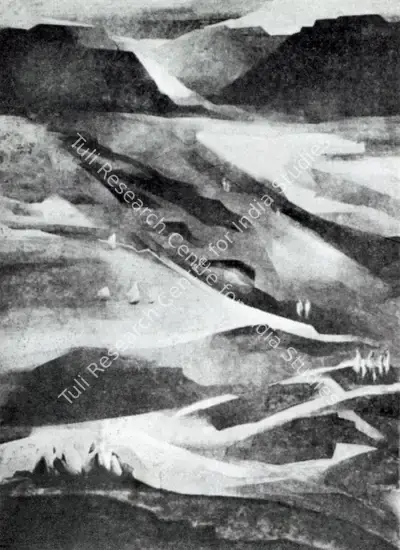
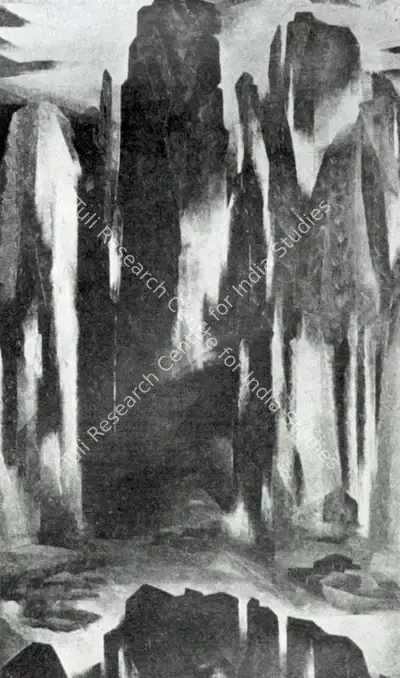
Sabavala's early 1990s paintings frequently depict a rugged, stylised landscapes, drawing inspiration from regions like Central Asia, Iran, and Afghanistan—places that seem frozen in an untouched, pre-modern state. These scenes are populated with still lakes, unmoving rivers, and crystalline cataracts nestled between jagged mountain ranges. Yet, Sabavala's art also suggests that the truest experience of the local and immediate occurs when it arises naturally, without being forced. In his work, the colours of the West Coast and the Deccan plateau, which have long been part of his artistic language, subtly emerge, blending into a pearlescent lake that rests silently among the ochre, sienna, and blue hills, their peaks cutting through the sky. This motif of stillness and precision continues to resonate in Sabavala's Trapped Lakes series and its associated works from the 1990s.
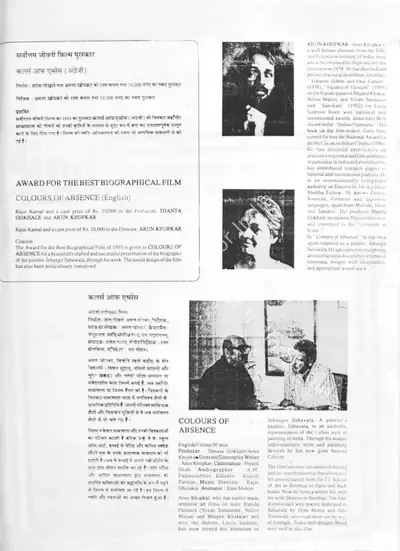
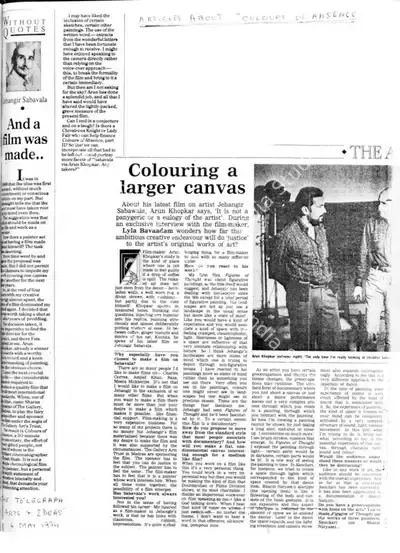
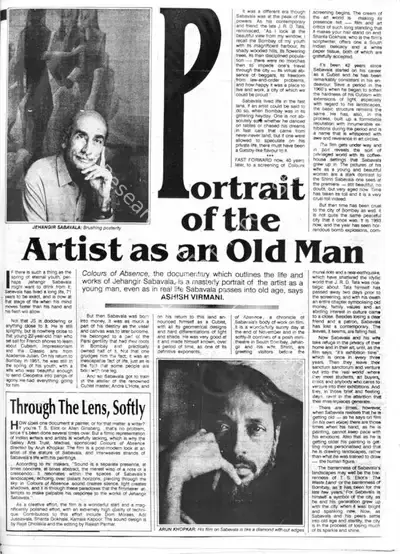
The film "Colours of Absence", directed by Arun Khopkar, based on his life and work gets released in 1993. It is deliberately not shot in the usual documentary style about the life and works of a painter. Instead, the film is structured in a way that mirrors his response to the paintings, where subtle changes of time create a whole new way of "seeing" with the help of cinematographer Piyush Shah. Early in the film, you find the young Jehangir irised in, emerging out of nostalgic, sepia tinted family portraits. You see him selecting his colours, his fingers turning over the pages of meticulously taken notes and using his brush on a couple of occasions. Arched, ornate mirrors reflect his elegantly handsome person as he is getting ready for an opening, and the muted light subtly draws attention to the mellow beauty of antique furniture and the fastidious tastefulness of the Sabavala home. These are teasingly formal glimpses of the man, leaving one hungry for more extensive shows us clearly self-portraits, the painter's point of view cries out for expression. An imposed aesthetic pattern can at times get stifling for all its evocative beauty. For Khopkar, the purpose of the film is to "document Jehangir's life and work. But it is not a panegyric or a eulogy of the artist. If at points I feel critical of his work I'll incorporate it in the flm. I'll have to be fair to myself as well as to the artist."
A trip to Kumaon taken in the late 1980s inspires a series of paintings based on the region located at the foothills of the Himalayas. Lamenting the rapid destruction of nature by man and nature preserving itself, Sabavala wrote in a letter addressed to Richard Lannoy describing how Kumaon's "air is scented and the meadows just beginning to be flower-strewn...and those rare moments when Nanda Devi or Maiktoli or the lovely Trisul enigmatically cast their veils aside and reveal themselves ice-clad, towering and very mysterious- turning the horizon into a magical Far-Eastern "wash fantasy". In Kumaon Skies, he connects one with the exhilaration of the crisp mountain air, the scent of the pine forests, and the mountains themselves. Through the expansive sky across the range, he tracks the unpredictable flight of migratory birds- a motif ubiquitous in his ouvre.
In 1979, Sabavala had described his skies thus; "My skies are filled with the passage of great clouds, the warnings of strange lights, the wheeling flights of birds against vast expanses."
The figures of the 1990s bestow upon Sabavala what may well be read as victims or targets, observes Ranjit Hoskote: "We meet an aged couple who recall to mind Dhritarashtra and Gandhari, the emperor and empress who renounced their throne to wander the forest.We encounter monks in the orange robes of renunciation, who move forward with an apparent sense of purpose, yet are haunted by an air of having been used as puppets by history. We chance upon the anchorite, almost naked, who emerges from the temporary tomb of an anthill into a changed world; and the three fighermen who propitiate the dull, suppurating waters of the bay of bengal off the Adyar Beach in Madras. And in The Conspirators (1997), we have a reprise: a tightly woven group of figures participating in a ritual of secrecy and silence, and who seem to be descendants in a lineage that begins with the magi and the nuns of twenty years before."
Through Mirror Image (1997), Sabavala returns to the series of self-portraits done since the late 1940s—a sort of inner reflection of the artist's mind. Through these he lifts the veil of the reserve he typically maintains between his personality and his work- revealing his own inner self, the hidden forces beneath his exterior, shaped by bone structure, muscle, and skin. However, these moments of personal revelation are rare, as Sabavala was a deeply private individual. This kind of reluctance to expose himself to others, except when necessary, combined with his genuine warmth toward those he engages with, sheds light on why Sabavala gave up his early ambition of pursuing a career in theatre. His interest in theatre, however, did not fade; it found new expressions in his paintings and continues to influence his work into the 1990s. Whether through the choice of costumes, the posture of figures, the flow of fabric and water, or the rituals of recognition and revelation enacted by his subjects, Sabavala's passion for theatre remains an enduring theme. The self-portrait, in this sense, serves as both the most intimate and the most public form of self-dramatization.
The Cowasjee Jehangir Hall gets converted into The National Gallery of Modern Art after efforts by several artists- including, but not only-Jehangir Sabavala, the eminent sculptor Piloo Pochkhanawala and the gallerist and collector Kekoo Gandhy for the display of modern and contemporary art. The website of the NGMA describes the construction like this: "Delhi-based architect Romy Khosla's design involved constructing a structure within a structure to encase five-exhibition galleries, one leading to another through stairway, a lecture auditorium, a library, cafeteria, office and storage space for a permanent collection as well as travelling shows. The renovation has taken 12 years and has costed Rs. 3.5 crores but at the end of it all Mumbai has an exhibition space which meets international standards for lighting, humidity and temperature control." In a letter addressed to his biographer, Sabavala eloquently elaborated on his love for, and the efforts involved in setting up this space: "I dutifully continue with committee work as certain things have got to be done. For example, the preservation of Bombay's architectural heritage. The city has formed a very active Heritage Society that has categorised 600 buildings under three headings, which cannot be torn down torn down under a new law. A worthy attempt to preserve the neo-Gothic, the Colonial and the Art Deco buildings, not forgetting the Indo-Saracenic. Some of us have also battled for the last ten years to give the city a small, but composite, museum of modern art. Now the Cowasji Jehangir Hall, built in 1911 by Wittet—opposite the Regal Cinema—has at last been converted into the Bombay branch of the National Gallery of Modern Art, New Delhi. It has taken four crores to revamp the whole building, whilst preserving the facade in its entirety. Built by my grandfather it was donated to the city as a public hall. I have been on the Monitoring Committee for those 10 years, and now we begin to see day light. We got close to attaining our objective when suddenly matters stalled for over two years. The newspapers bave been justifiably attacking the unnatural lull and I am constantly waylaid by the press for interviews on a 'delicate' subject. The city is in no mood to wait much longer. Just today I heard the good news. It opens to the public in December 1996. It is meant to house national and international shows of quality. Completely air conditioned and with the necessary equipment to suit international standards, we hope to draw exhibitions from the West to Bombay. It has been a terrible struggle, and I am one of the few members of the original committee who seems to have survived the fray. Bombay will have its own museum of modern art—at long last."
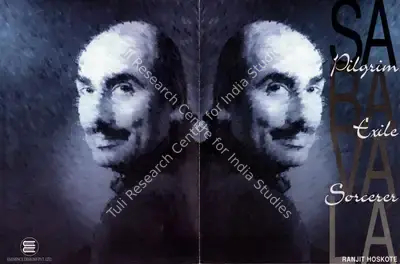
The major biography on the artist "Pilgrim, Exile, Sorcerer: The Painterly Evolution of Jehangir Sabavala" written by Ranjit Hoskote gets published. Upon the publication of his biography, Sabavala takes a sort of hiatus; he finds himself pondering over, after the documentation of a supposed 'painterly evolution', what awaited him further: "It was a big crest, and after that, as after all crests, there came a trough...Where does one go now, I thought to myself, and what does one do next?"
Sabavala openly and admittedly used the human figure as a symbolic or archetypal presence— whether as a seeker, a protector, or a pastoral guardian angel— situated within a landscape that enhances and deepens its emotional tone. He had done the first in the series of The Star That Beckons in 1968 wherein a traveller is seen gazing ahead at a vast expanse that lies ahead of him- as if signaling the beginning of an allegorical tale. Themes of a pilgrim in a desolate dreamscape had surfaced. Now, this tale is taken forward with The Star That Beckons II and III. A figure of a woman is seen with her arms raised up in a prayer-like gesture towards a bright star- longing to dissolve in the infinite. There is evident, in it, a spiritual quality harkening back to the transcendental desire for the Formless being, the light, of the Bhakti and Sufi traditions as well as the Biblical lore which Sabavala often referred to.
"How does one fructify", laments Sabavala, "when one is constantly being taken away from oneself?" By the late 1990s, Sabavala acquires both critical acclaim as well as commercial success. In the stronger, rougher market for art that the mid-1990s produced, the demand for paintings has grown insistent: the artist is dragged into a web of dealers, gallery owners, commission agents, auction managers; the doorbell and the telephone become objects of dismay. In The Pavilion (2000), the artist evokes an island retreat, the very embodiment of that serene solitude which he can no longer savour, given the world's incursions and irruptions into his life. Sincere and disciplined, he worked on his own accord, his own pace: "I can't paint at a great pace as artists do. "Churning" out canvases is not my style- but good luck to those who can do it". Not having reached a dreaded limbo from where a point of return would start to seem impossible, he reflects: "I am now beginning to see so much. Not technique, which you pick up along the way—this is not mock humble! Don't get me wrong...Sometimes success does that to creative people. The painting sells, you have your place in the sun, the media hype, the build up. So who cares? It happens the world over. On the other hand you could feel " I am fighting, I have a chance, even at this age, to be better".
He declares his practice, described earlier as a kind of sadhana, as that which grows personalised: "Painting grows....more difficult…Movements, styles, the topical moments, all lose out to the attempt to reach deeper levels of interpretation. Horizons widen and recede, and I am the pilgrim, on a long and arduous journey of joy and sorrow, moving towards unknown vistas."
Sabavala's relationship with colour and landscape could not be any well understood than by looking at his treatment of his visual plane with an almost dramatic use of colour; tones that seem ethereal. He had declared, long back, his principle of colour: "Yes, I seek to haunt by the use of the broken tone- a moss green rather than a pure green, russet and brown and gold rather than a primary red or yellow."
He weaves together imagery of stars, sails, and nested figures into visual odes to different times of day and night, evoking both aubades and nocturnes. The passage of time between day and night is explored further in the 2002 series Casuarina Line I-III, where he revisits the same rocky beach landscape under the moonlight, at sunset, and at night. This body of work revisits themes Sabavala had previously explored, and yet, each treatment feels remarkably fresh. In an unusual move for him, Sabavala exposes the structure of his compositions, making it the central focus of the pieces. The paintings become a demonstration of layered bands or stacked panels, formats drawn from tradition. He adopts an architect's technique of the exploded view and incorporates photographic methods, such as close-up and aerial perspectives, to redefine both his subjects and his artistic form.
The Sorcerer (2003)represents the intimate yet operatic, sumptuous yet austere figure that has stepped into Sabavala's frames with repeated success since the mid-1980s. This gallery of visitants arrived robed in radiance and mystery: fiery angels, emissaries from other worlds, augurs who emerge from the sea or descend from the sky. These composite figures are seen to advantage in the 'Strangers' series of the early 1990s. Sorcerer especially represents an allegory, almost a self-portrait- this portrayal of the fable-weaver and his enchantment signals a notable evolution of latent imagery: the sorcerer harks back to the figures from Sabavala's japonisme phase in the 1950s, with his appearance merging elements of Kabuki theater and influences from Aubrey Beardsley. Sabavala wrote about these visitants: "They come from elsewhere, first felt, then seen in the mind's eye, and lastly caught on canvas. Their quality is androgynous, faintly surreal. To me, they disturb by a sense of witchery- from here, the realm of the sorcerer is not so far away."
In terms of form, Sabavala is concerned with beauty, with sublime. He claims, in an almost enraptured manner, to be drawn by Nature: "I find myself enthralled by Nature. The sun, the moon, the stars- "heavenly alchemy"—it is in the region of the beyond that I find myself free to dream and build a world of mystery and beauty. Both qualities—mystery and beauty—are essential to me. I will not be unravelled blatantly. I will not pour out my heart onto a canvas in a mess of gore and savagery."
Long back Sabavala had remarked "Shirin is the believer, I the sceptic...I cannot surrender myself before a guru, or expose my emotions nakedly to another's scrutiny. So the life of the acolyte is not for me. But, this notwithstanding, I cherish the time I have spent at the ashrama in Munger, with its discipline and tranquility, its sense of being outside of time." Munger Skies (2004) comes out of the several visitations of his in Munger.
Hoskote, Sabavala's primary biographer concluded his body of work as one where "...a succession of phases marking his career—a classical attitude towards experience, embracing the value of order, lucidity and serenity, a predilection that he expresses through his exploration and transcendence of the formal genres of academic painting. The still life, the human figure and the landscape have been the modes of discovery by which Sabavala has approached the external world of sensations; undergoing mutation, these have served as the idioms of construction through which he has developed an inner universe, where he invokes flowers that blaze like suns; visionary landscapes in which the domain of time yields before that of eternity; prophetic figures that seem to be visitants from other worlds; and massed group of figures, their passage resonant with echoes of a lost Arcadian past." Of his own evolution he admits that: "the changes in my paintings have been subtle, I think there has been a progression but there are not sort of revolutionary steps taken so that from one exhibition to the next I give my public surpise- no, I don't because that's not really my temperament, it's really been a steady growth"
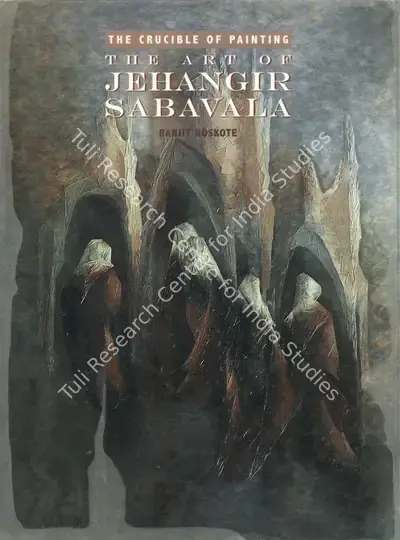
A major retrospective on Sabavala is held by the NGMA, coinciding with another book by Ranjit Hoskote titled 'The Crucible of Painting: The Art of Jehangir Sabavala'.
Through the act of painting, Sabavala would contemplate deeper meaning(s) of life: "Can one aspire to wisdom? To work off the hysteria, the anxieties, the ambitions, to be worn smooth by the river like pebbles in the Ganga?" Hoskote would call it a state of being "rounded off as a human being, of having developed a quiet inward strength. Having treated life as an experience of learning" In 2011, Sabavala breathed his last.
Born in an affluent Parsi family whose history was intertwined with the history of Bombay, Jehangir Sabavala was among the first generation of post-colonial artists in India. Sabavala strayed away from any group affiliations that were prominent during his time and developed his pictorial language that was inspired and shaped by his art school training, his international travels and the cubist pedagogy imparted by his mentor Andre Lhote. His closeness to nature results in vivid and serene landscapes that are often desolate and sometimes populated by the figures of magicians, sorcerers and ascetics.
Born: 23 August 1922, Bombay, Maharashtra, India Died: 2 September 2011, Mumbai, Maharashtra, India Spouse: Shirin Sabavala (1924 - 2017), m. 1948 Parents: Ardeshir Pestonjee Sabavala (1890 - 1955), Meherbai Sabavala (1891 - 1970) Siblings: Sharokh Sabavala Children: Aafreed Sabavala (1959) Grandparent: Sir Jehangir Cowasjee Jehangir (16 February 1879 - 17 Oct 1962) Ancestors: Hirji Jivanji, Sir Cowasjee Jehangir Readymoney (24 May 1812 - 19 July 1878)

Chronicled Highlights 26

Jehangir Sabavala
1922Born
Jehangir Sabavala

Jehangir Sabavala was born in 1922 in Bombay, Maharashtra, India.
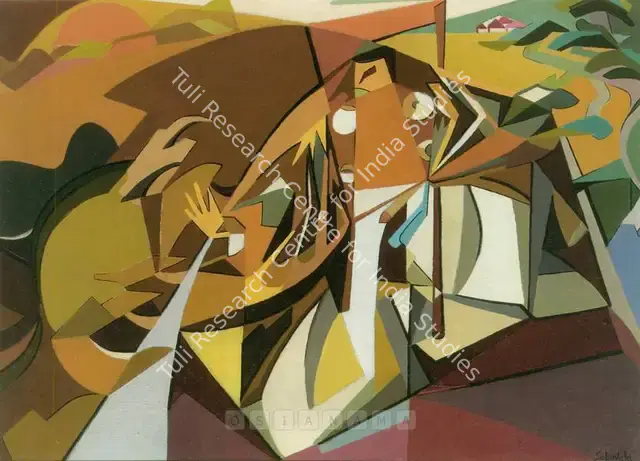
Sabavala, Jehangir (Artist). Benkei II. Oil on canvas, 1955 | Painting  | 00877738
Sabavala, Jehangir (Artist). Benkei II. Oil on canvas, 1955 | Painting | 00877738

In 2000, the artist achieved a new high in the auction market with the sale of Benkei II (1955), offered in the Indian Miniatures The Travel Sale - India and The Far East Modern and Contemporary South Asian Paintings by Sotheby's, which concluded on 08 June 2000 at London, achieving a sale price of ₹8,94,768 ($19,981). This record marked a defining moment in the artist's market history, reflecting both the significance of the artwork and its reception within the broader art world.
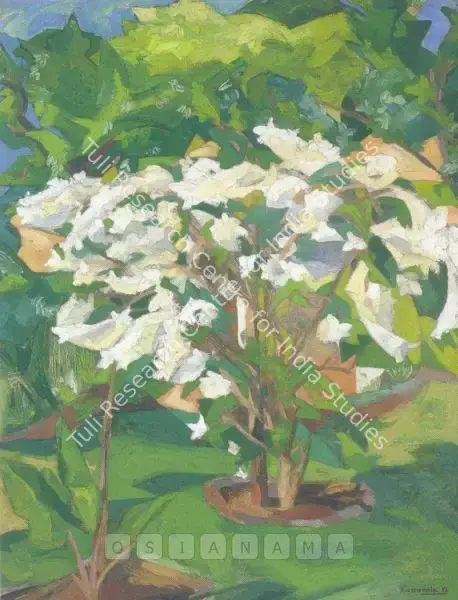
Sabavala, Jehangir (Artist). White Bougainvillaea. Oil on board, 1956 | Painting | FineArts | 00600606

In 2004, the artist achieved a new high in the auction market with the sale of White Bougainvillaea (1956), offered in the Indian and Southeast Asian Art: Including 20th Century Indian Paintings by Christie's, which concluded on 23 September 2004 at New York, achieving a sale price of ₹30,19,407 ($65,725). This record marked a defining moment in the artist's market history, reflecting both the significance of the artwork and its reception within the broader art world.
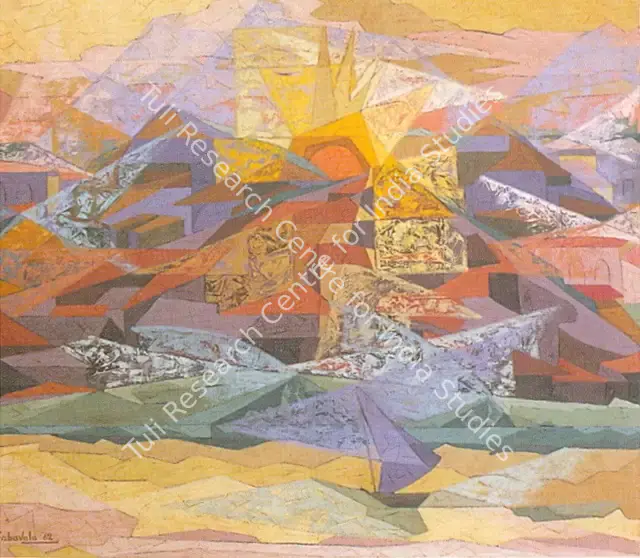
Sabavala, Jehangir (Artist). Evenfall. Oil on canvas, 1962 | Painting | FineArts | 00371259

In 1995, the artist achieved a new high in the auction market with the sale of Evenfall (1962), offered in the Islamic and Indian Art by Sotheby's, which concluded on 27 April 1995 at London, achieving a sale price of ₹1,86,171 ($5,931). This record marked a defining moment in the artist's market history, reflecting both the significance of the artwork and its reception within the broader art world.
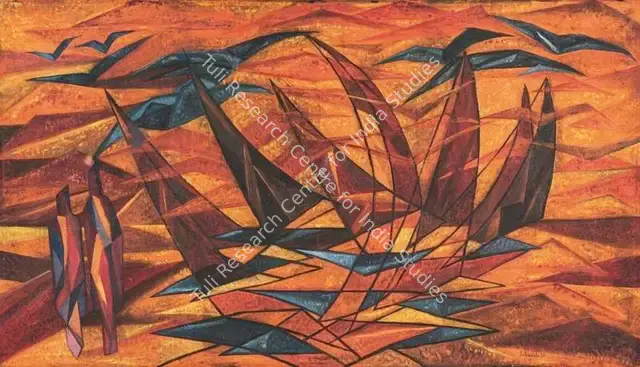
Sabavala, Jehangir (Artist). Untitled. Oil on canvas, 1962 | Painting | FineArts | 00416092

Between 1961 and 1964, Sabavala attempted to break away from the suffocating formality of Synthetic Cubism; and in this, he found a remedial alternative in the work of Lyonel Feininger, who had died in 1956. Moving gradually from Lhote’s austerity of line to Feininger’s glissando Cubism, he softened his paintings; the indispensable presence of illumination became his subject: “Through Feininger’s pure, precise and yet very delicate and personal renderings of cloud and boat and sea, I discovered the joys of extending form into the beauty and clarity of ligHe.”
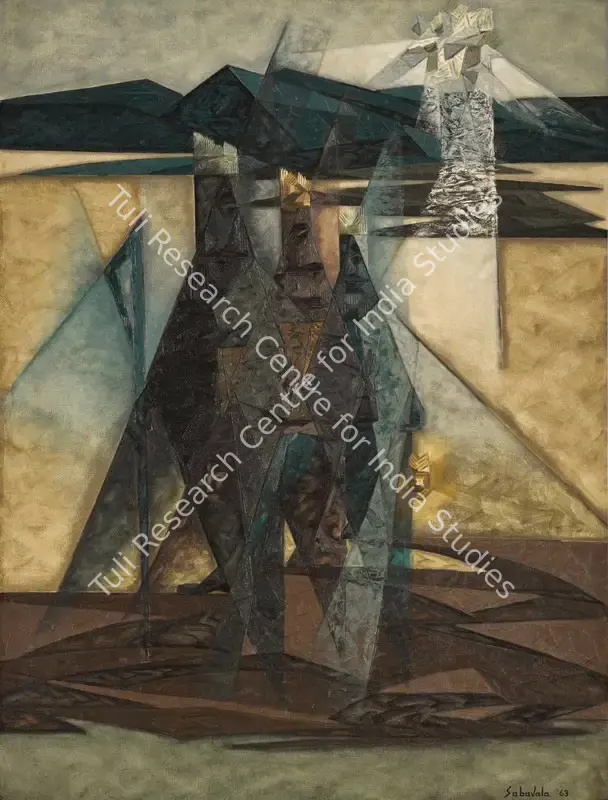
Sabavala, Jehangir (Artist). The Journey of the Magi. Oil on canvas, 1963 | Painting | EconomicsArt | 00869584

In 2025, the artist achieved a new high in the auction market with the sale of The Journey of the Magi (1963), offered in the Modern & Contemporary South Asian Art by Sotheby's, which concluded on 17 March 2025 at New York, achieving a sale price of ₹23,72,89,328 ($2,734,000). This record marked a defining moment in the artist's market history, reflecting both the significance of the artwork and its reception within the broader art world.
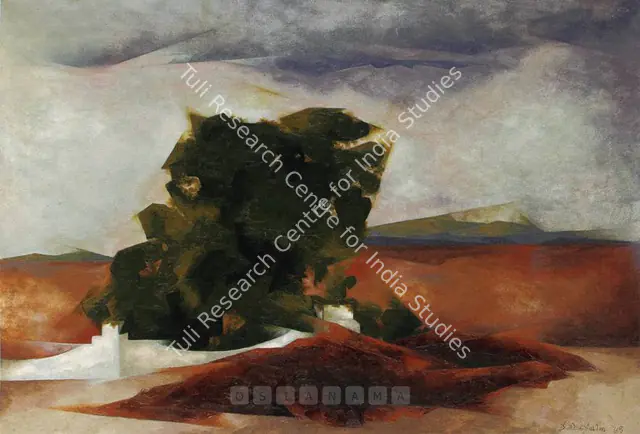
Sabavala, Jehangir (Artist). The Tree. Oil on Canvas, 1965 | Painting  | 00880715
Sabavala, Jehangir (Artist). The Tree. Oil on Canvas, 1965 | Painting | 00880715

In 2006, the artist achieved a new high in the auction market with the sale of The Tree (1965), offered in the International Modern & Contemporary Art: Including Arab Indian, Iranian and Western Art by Christie's, which concluded on 24 May 2006 at Dubai, achieving a sale price of ₹54,87,600 ($120,000). This record marked a defining moment in the artist's market history, reflecting both the significance of the artwork and its reception within the broader art world.
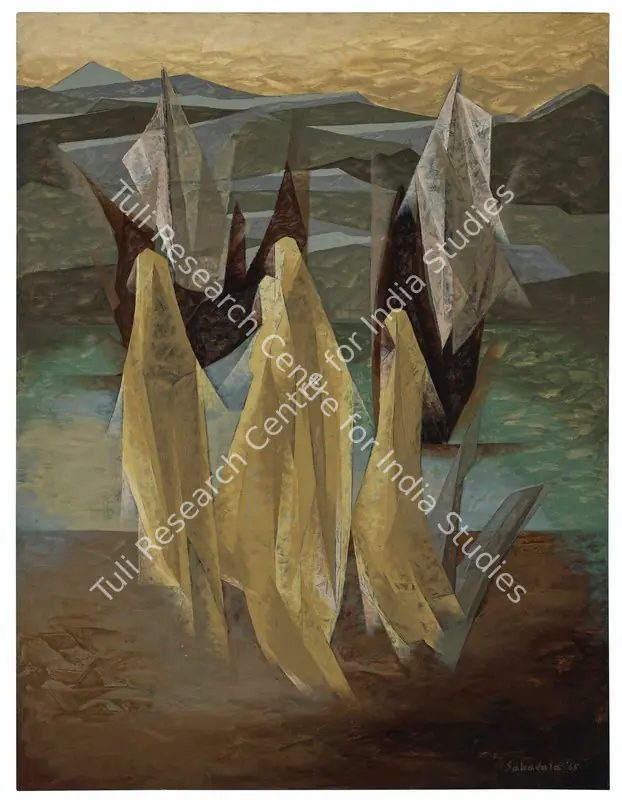
Sabavala, Jehangir (Artist). The Embarkation. Oil on canvas, 1965 | Painting | FineArts | 00546832

In 2021, the artist achieved a new high in the auction market with the sale of The Embarkation (1965), offered in the South Asian Modern + Contemporary Art by Christie's, which concluded on 22 September 2021 at New York, achieving a sale price of ₹11,73,46,134 ($1,590,000). This record marked a defining moment in the artist's market history, reflecting both the significance of the artwork and its reception within the broader art world.
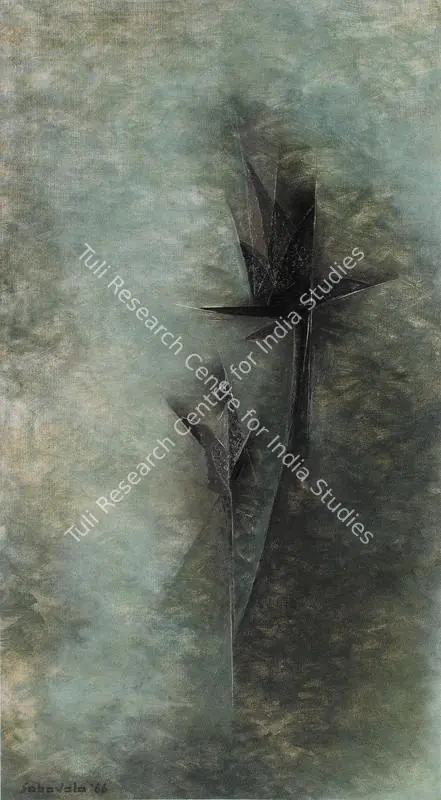
Sabavala, Jehangir (Artist). Black Lilies. Oil on canvas, 1966 | Painting | FineArts | 00599183

In 2005, the artist achieved a new high in the auction market with the sale of Black Lilies (1966), offered in the Winter Online Auction: Modern and Contemporary Indian Art by Saffronart, which concluded on 08 December 2005 at Online, achieving a sale price of ₹35,09,000 ($75,739). This record marked a defining moment in the artist's market history, reflecting both the significance of the artwork and its reception within the broader art world.
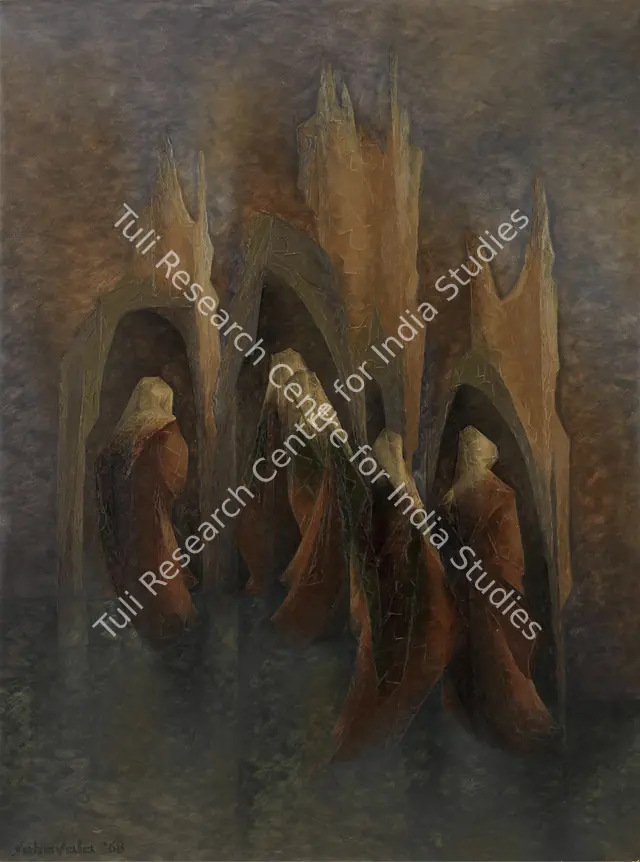
Sabavala, Jehangir (Artist). Vespers I. Oil on canvas, 1968 | Painting | FineArts | 00900049

In 2012, the artist achieved a new high in the auction market with the sale of Vespers I (1968), offered in the Modern and Contemporary South Asian Art by Bonhams, which concluded on 07 June 2012 at London, achieving a sale price of ₹2,15,82,446 ($391,373). This record marked a defining moment in the artist's market history, reflecting both the significance of the artwork and its reception within the broader art world.
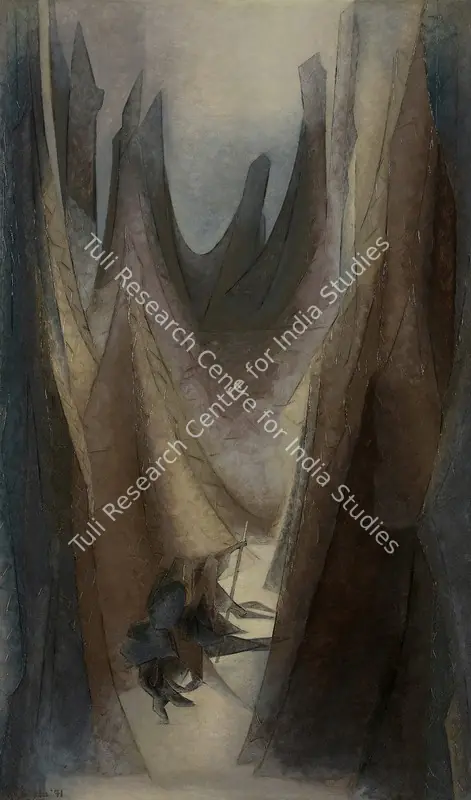
Sabavala, Jehangir (Artist). The Flight Into Egypt - I. Oil on canvas, 1971 | Painting | FineArts | 00646549

In 2014, the artist achieved a new high in the auction market with the sale of The Flight Into Egypt - I (1971), offered in the Live Auction: Modern Indian Art by Saffronart, which concluded on 04 September 2014 at New Delhi, achieving a sale price of ₹3,00,00,000 ($496,245.08). This record marked a defining moment in the artist's market history, reflecting both the significance of the artwork and its reception within the broader art world.
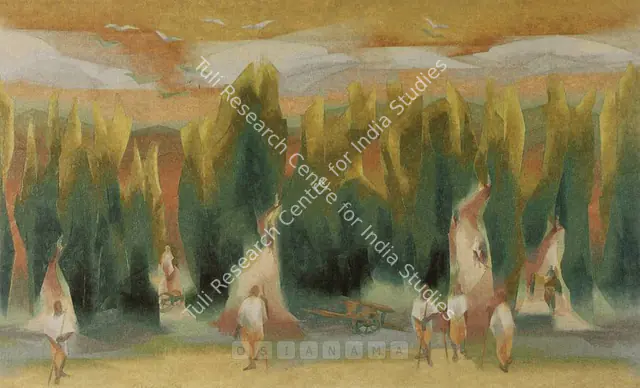
Sabavala, Jehangir (Artist). Off Tree And Tree. Oil on canvas, 1978 | Painting | FineArts | 00597918

In 2005, the artist achieved a new high in the auction market with the sale of Off Tree And Tree (1978), offered in the Modern and Contemporary Paintings by Nine Masters: Spring Online Auction by Saffronart, which concluded on 02 March 2005 at Online, achieving a sale price of ₹32,31,265 ($73,942). This record marked a defining moment in the artist's market history, reflecting both the significance of the artwork and its reception within the broader art world.
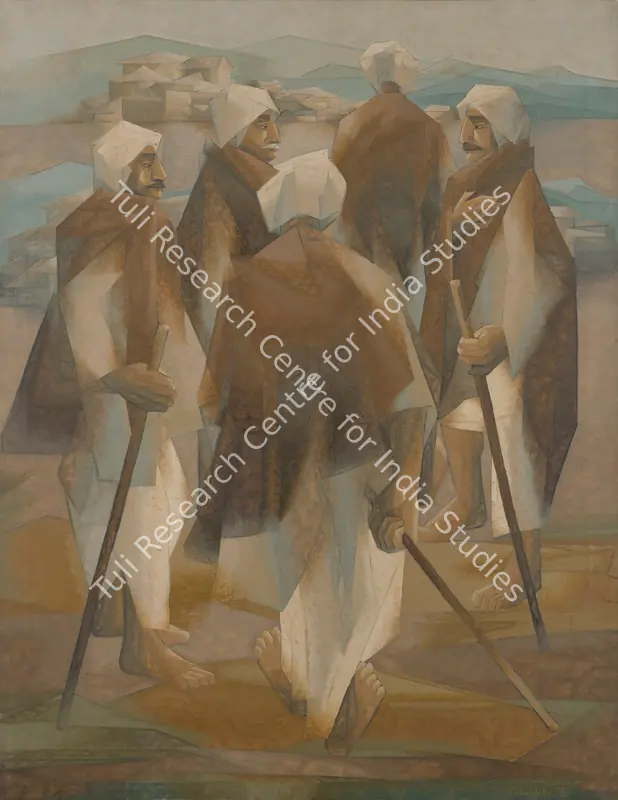
Sabavala, Jehangir (Artist). The Peasants. Oil on canvas, 1981 | Painting  | 00867649
Sabavala, Jehangir (Artist). The Peasants. Oil on canvas, 1981 | Painting | 00867649

In 2020, the artist achieved a new high in the auction market with the sale of The Peasants (1981), offered in the South Asian Modern + Contemporary Art by Christie's, which concluded on 23 September 2020 at New York, achieving a sale price of ₹7,11,23,971.8 ($966,000). This record marked a defining moment in the artist's market history, reflecting both the significance of the artwork and its reception within the broader art world.
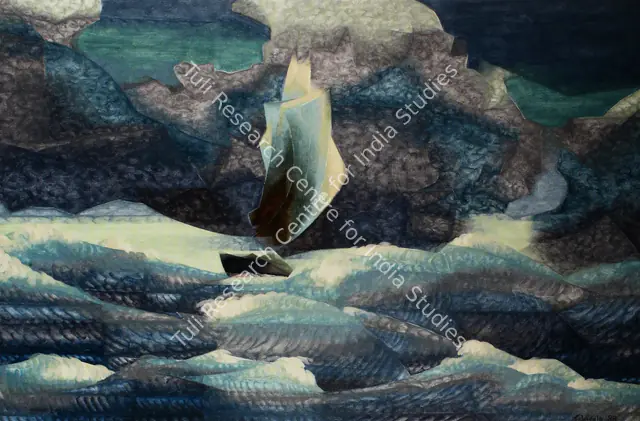
Sabavala, Jehangir (Artist). Storm III. Oil on canvas, 1988 | Painting | FineArts | 00897198

In 2007, the artist achieved a new high in the auction market with the sale of Storm III (1988), offered in the Indian Art: Including Miniatures and Modern Paintings by Sotheby's, which concluded on 22 March 2007 at New York, achieving a sale price of ₹1,15,26,240 ($264,000). This record marked a defining moment in the artist's market history, reflecting both the significance of the artwork and its reception within the broader art world.
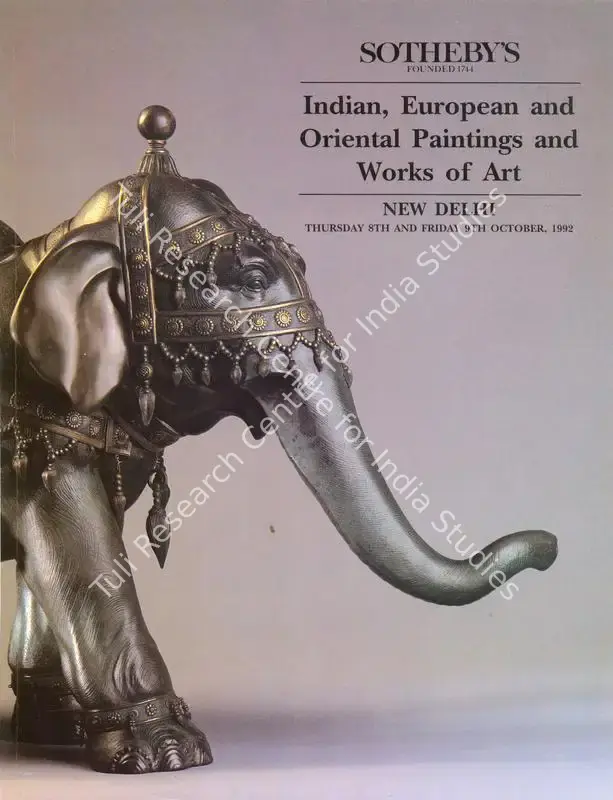
Sotheby's (Auction House). Indian European and Oriental Paintings and Works of Art. 09 October 1992, New Delhi | Auction Catalogue | EconomicsArt | 00861838
1 / 2
Sotheby's (Auction House). Indian European and Oriental Paintings and Works of Art. 09 October 1992, New Delhi | Auction Catalogue | EconomicsArt | 00861838

On 09 October 1992, made their debut in the Indian public auction market when Of Cliff and Fall-V was presented as Lot in Indian European and Oriental Paintings and Works of Art, conducted by Sotheby's in New Delhi, India. This auction marked the artist's first recorded appearance in the public auction market, establishing the earliest chapter of their auction history.
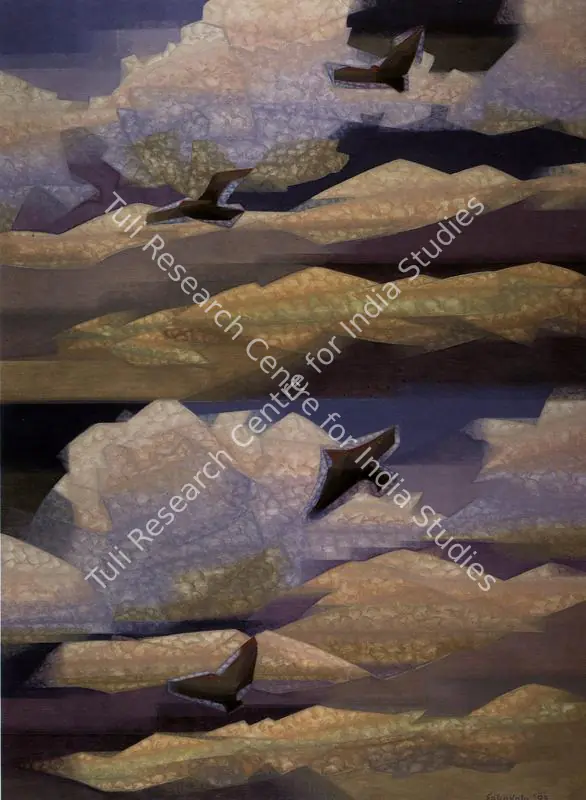
Sabavala, Jehangir (Artist). Kumaon Sky. Oil on canvas, 1993 | Painting | FineArts | 00371905

In 1995, the artist achieved a new high in the auction market with the sale of Kumaon Sky (1993), offered in the Indian Contemporary Paintings: Islamic Works of Art and Indian, Himalaya and South-East Asian Art by Christie's, which concluded on 16 October 1995 at London, achieving a sale price of ₹3,00,288 ($8,757). This record marked a defining moment in the artist's market history, reflecting both the significance of the artwork and its reception within the broader art world.
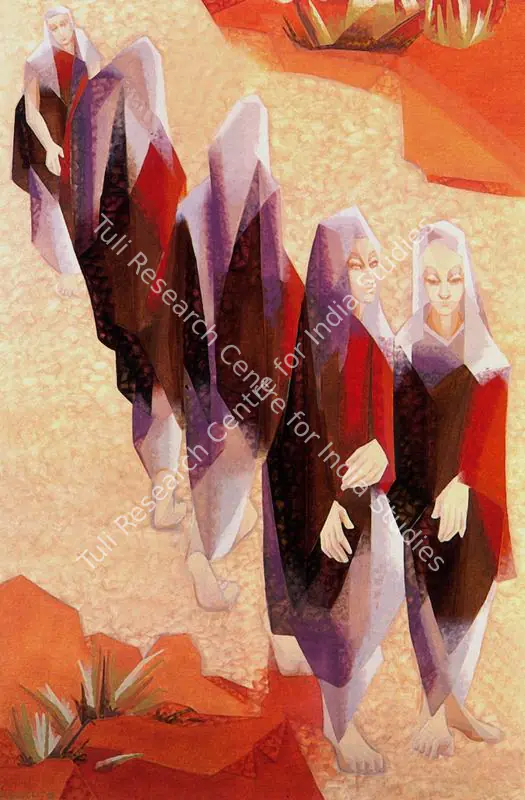
Sabavala, Jehangir (Artist). Pilgrimage II. Oil on canvas, 1996 | Painting | FineArts | 00374579

In 1997, the artist achieved a new high in the auction market with the sale of Pilgrimage II (1996), offered in the Indian Contemporary Art by Christie's, which concluded on 04 June 1997 at London, achieving a sale price of ₹4,03,892 ($11,290). This record marked a defining moment in the artist's market history, reflecting both the significance of the artwork and its reception within the broader art world.
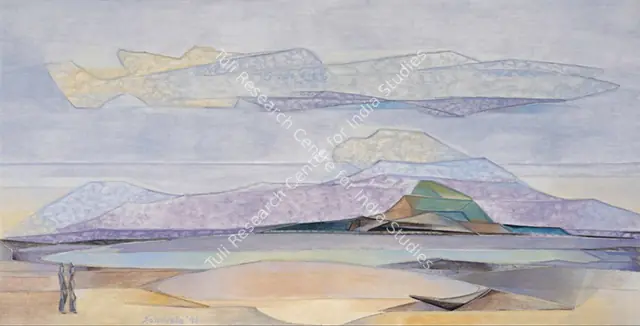
Sabavala, Jehangir (Artist). Untitled. Oil on canvas, 1998 | Painting  | 00868941
Sabavala, Jehangir (Artist). Untitled. Oil on canvas, 1998 | Painting | 00868941

In 2024, the artist achieved a new high in the auction market with the sale of Untitled (1998), offered in the Historic Masterpieces by Asta Guru, which concluded on 16 December 2024 at Mumbai, achieving a sale price of ₹15,81,95,955 ($1,864,948.74). This record marked a defining moment in the artist's market history, reflecting both the significance of the artwork and its reception within the broader art world.
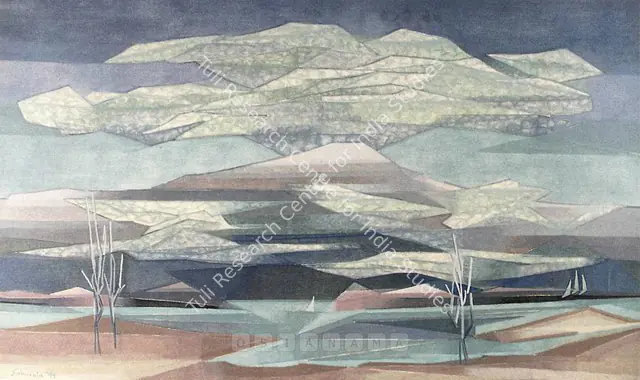
Sabavala, Jehangir (Artist). Silent Volcano. Oil on canvas, 1999 | Painting | FineArts | 00599529

In 2003, the artist achieved a new high in the auction market with the sale of Silent Volcano (1999), offered in the Saffronart Online Auction: Modern Indian Paintings by Saffronart, which concluded on 08 May 2003 at Online, achieving a sale price of ₹11,94,270 ($25,270). This record marked a defining moment in the artist's market history, reflecting both the significance of the artwork and its reception within the broader art world.
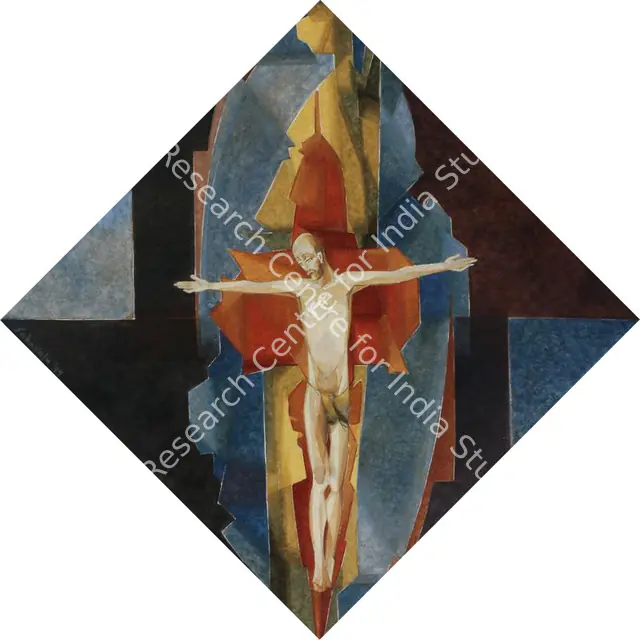
Sabavala, Jehangir (Artist). Crucifixion. Oil on canvas, 1999 | Painting  | 00881287
Sabavala, Jehangir (Artist). Crucifixion. Oil on canvas, 1999 | Painting | 00881287

In 2006, the artist achieved a new high in the auction market with the sale of Crucifixion (1999), offered in the Indian Art: Including Miniatures and Modern Indian Paintings by Sotheby's, which concluded on 19 September 2006 at New York, achieving a sale price of ₹66,39,840 ($144,000). This record marked a defining moment in the artist's market history, reflecting both the significance of the artwork and its reception within the broader art world.
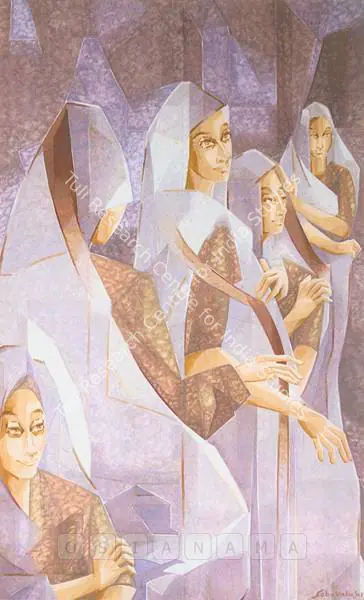
Sabavala, Jehangir (Artist). Women In Grey. Oil on canvas, 2001 | Painting | FineArts | 00597637

In 2004, the artist achieved a new high in the auction market with the sale of Women In Grey (2001), offered in the Modern Indian Paintings: Winter Online Auction by Saffronart, which concluded on 02 December 2004 at Online, achieving a sale price of ₹29,50,875 ($66,732). This record marked a defining moment in the artist's market history, reflecting both the significance of the artwork and its reception within the broader art world.
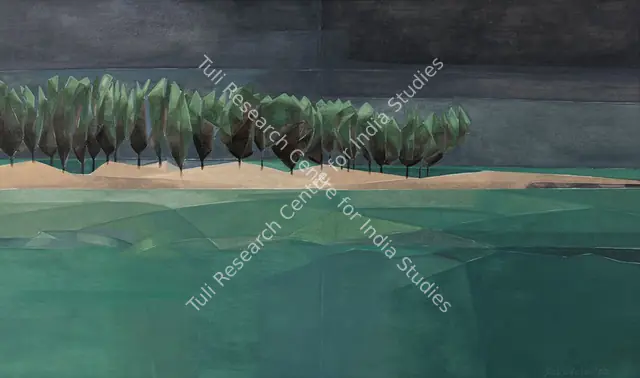
Sabavala, Jehangir (Artist). The Casuarina Line I. Acrylic on canvas, 2002 | Painting | FineArts | 00755731

In 2010, the artist achieved a new high in the auction market with the sale of The Casuarina Line I (2002), offered in the Modern & Contemporary Indian Art: Summer Online Auction by Saffronart, which concluded on 17 June 2010 at Online, achieving a sale price of ₹1,68,70,500 ($362,806). This record marked a defining moment in the artist's market history, reflecting both the significance of the artwork and its reception within the broader art world.
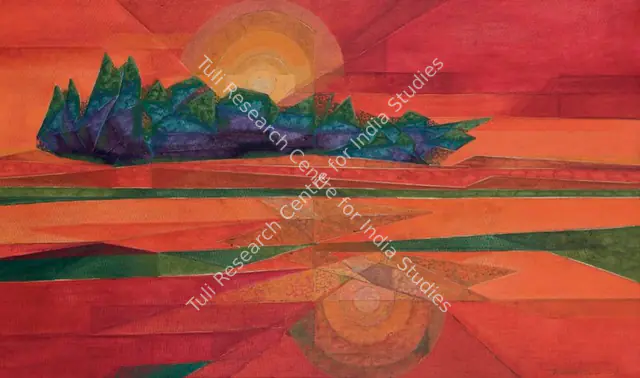
Sabavala, Jehangir (Artist). The Casuarina Line II. Oil on canvas, 2002 | Painting | FineArts | 00333328

In 2015, the artist achieved a new high in the auction market with the sale of The Casuarina Line II (2002), offered in the The India Sale by Christie's, which concluded on 15 December 2015 at Mumbai, achieving a sale price of ₹4,82,25,000 ($719,309.11). This record marked a defining moment in the artist's market history, reflecting both the significance of the artwork and its reception within the broader art world.
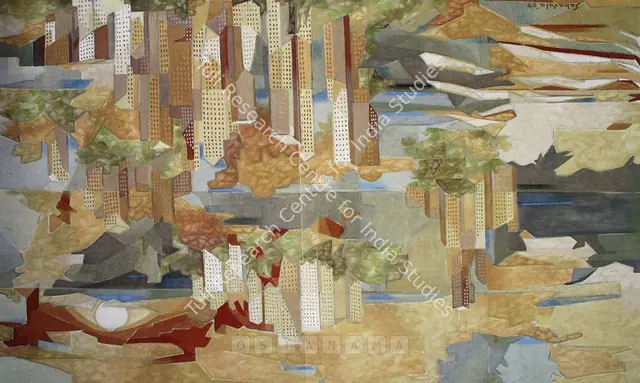
Sabavala, Jehangir (Artist). Untitled (The City - IV). Oil on canvas, 2004 | Painting  | 00881850
Sabavala, Jehangir (Artist). Untitled (The City - IV). Oil on canvas, 2004 | Painting | 00881850

In 2006, the artist achieved a new high in the auction market with the sale of Untitled (The City - IV) (2004), offered in the Modern Indian Art: Winter Online Auction by Saffronart, which concluded on 07 December 2006 at Online, achieving a sale price of ₹95,78,250 ($214,470). This record marked a defining moment in the artist's market history, reflecting both the significance of the artwork and its reception within the broader art world.
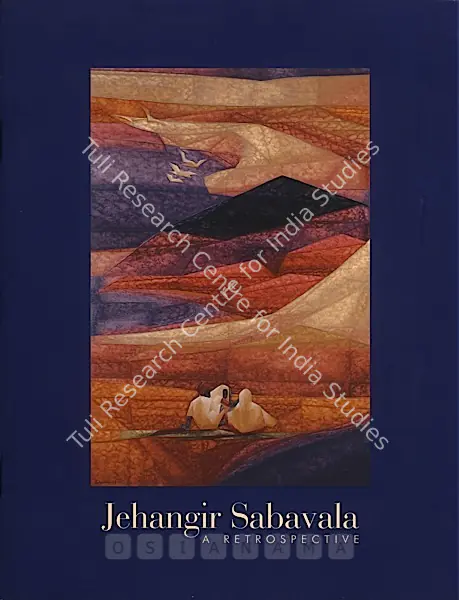
Sabavala, Jehangir (Artist). Jehangir Sabavala - A Retrospective. Mumbai: National Gallery of Modern Art, 2005 | Solo Exhibition Catalogue  | 00882699
Sabavala, Jehangir (Artist). Jehangir Sabavala - A Retrospective. Mumbai: National Gallery of Modern Art, 2005 | Solo Exhibition Catalogue | 00882699

In 2005, Jehangir Sabavala A Retrospective marked a major milestone in the exhibition history of Jehangir Sabavala, offering a retrospective survey of the artist's artistic production
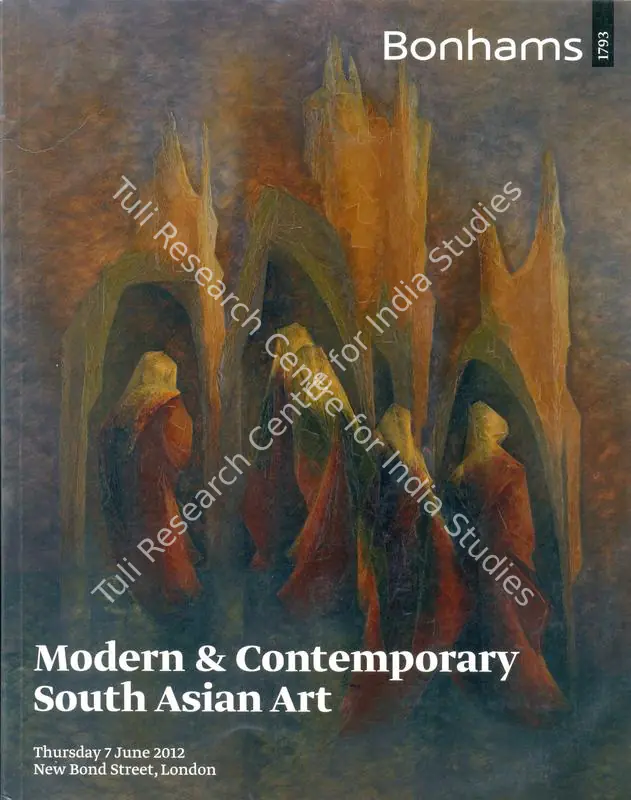
Bonhams (Auction House). Modern and Contemporary South Asian Art. 07 June 2012, London | Auction Catalogue | EconomicsArt | 00862118

In 2012, an artwork by Jehangir Sabavala was featured on the cover of Bonhams: Modern and Contemporary South Asian Art (June 2012, London), marking a documented highlight in the artist's public and auction market visibility.
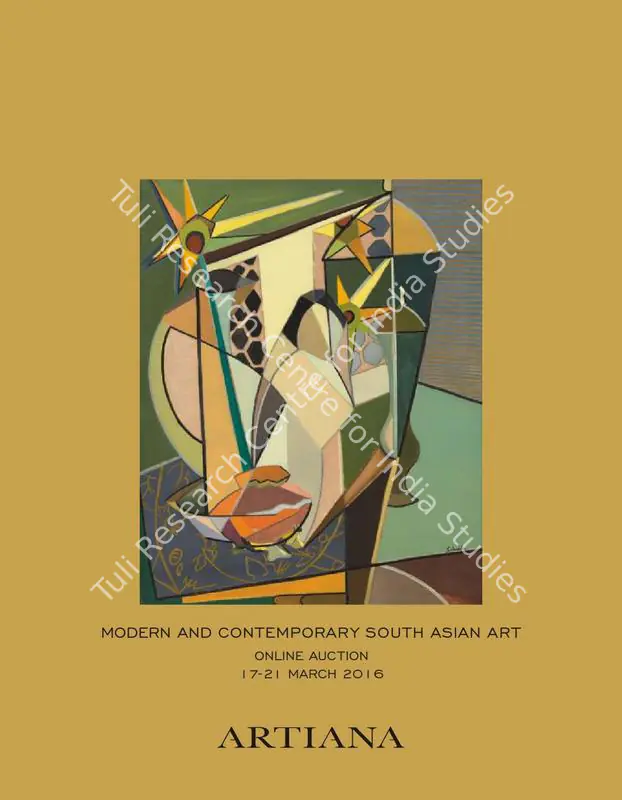
Artiana (Auction House). Modern and Contemporary South Asian Art. 21 March 2016, Online | Auction Catalogue | EconomicsArt | 00862225

In 2016, an artwork by Jehangir Sabavala was featured on the cover of Artiana: Modern and Contemporary South Asian Art (March 2016, London), marking a documented highlight in the artist's public and auction market visibility.

Economics of Art

20 of 50
This section showcases auction lots that achieved record-high sale prices, tracked by the date each record was set based on the artist's historical auction data.

Record-high lots23

Public Auction Market (1987–2026) | Select Indicators

  1. Annual Auction Sale Turnover
  2. Average Sale Price Per Lot
  3. Square Inch Rate Trend

Annual Auction Sale Turnover

This indicator tracks the Total Annual Auction Sales value of Jehangir Sabavala’s artworks, beginning in 1987 through to the present.
It aggregates all sales across global auction houses into yearly totals.

Analysis reflected in the chart:
The turnover graph highlights periods of strong growth, moments of market correction, and resilience during downturns. Peaks often align with landmark works coming to public auction, while troughs may indicate reduced supply or weaker demand. Over time, the curve illustrates the overall trajectory of Jehangir Sabavala’s public auction market presence.

Average Sale Price Per Lot

This measure calculates the Average Sale Price of all lots by Jehangir Sabavala sold each year.
It smooths out fluctuations caused by the quantity of works offered and focuses on the Average Sale Price level per artwork.

Analysis reflected in the chart:
Rising average sale prices indicate growing collector confidence and a stronger willingness to pay higher amounts per work. Assuming the mix of mediums remains relatively stable over time, the proportion of works on paper typically priced lower than works on canvas adds important context to understanding these market movements.

Square Inch Rate Trend

The Square Inch Rate normalizes prices by the size of each artwork, showing the average sale value per square inch over time.
This allows fair comparisons between smaller works and larger canvases.

Analysis reflected in the chart:
The Square Inch Rate shown in the graph combines various medium types such as canvas, paper, board, and others. Historically, works on canvas and board have broadly commanded higher prices compared to works on paper.

  1. 1977

    1. Padmashree

      Government of India

  2. 1993

    1. Citation

      Art Society of India, Mumbai, India

  3. 2000

    1. Citation

      National Gallery of Modern Art, Mumbai, India

  4. 2001

    1. Kala Ratna

      All India Fine Arts & Crafts Society (AIFACS), New Delhi, India

  5. 2004

    1. Kala Ratna

      Lalit Kala Akademi

Research Centre
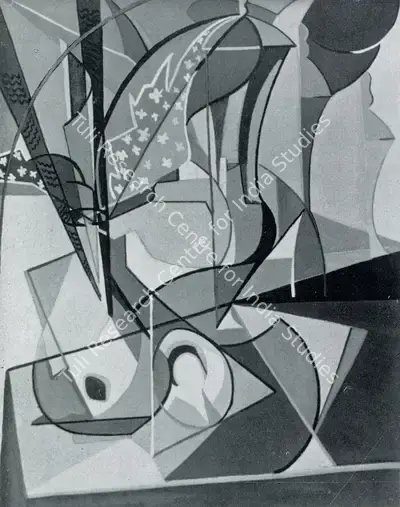
Jehangir Sabavala (Artist), The Chequered Shade, Painting
Sabavala, Jehangir (Artist). The Chequered Shade, n.d. | Painting
View full record
Jehangir Sabavala (Artist), The Shadowed Strand, Painting
Sabavala, Jehangir (Artist). The Shadowed Strand, n.d. | Painting
View full record
Jehangir Sabavala (Artist), Still Life with Speckled Leaves, Painting
Sabavala, Jehangir (Artist). Still Life with Speckled Leaves, n.d. | Painting
View full record
Jehangir Sabavala (Artist), Benkei, The Warrior-Priest II, Painting
Sabavala, Jehangir (Artist). Benkei, The Warrior-Priest II, n.d. | Painting
View full record
Jehangir Sabavala (Artist), Of Cliff and Fall, Painting
Sabavala, Jehangir (Artist). Of Cliff and Fall, n.d. | Painting
View full record
Jehangir Sabavala (Artist), Benkei, The Warrior-Priest I, Painting
Sabavala, Jehangir (Artist). Benkei, The Warrior-Priest I, n.d. | Painting
View full record
Jehangir Sabavala (Artist), Still-life with Red Rose, Painting
Sabavala, Jehangir (Artist). Still-life with Red Rose, n.d. | Painting
View full record
Jehangir Sabavala (Artist), Untitled, Painting
Sabavala, Jehangir (Artist). Untitled, n.d. | Painting
View full record
Jehangir Sabavala (Artist), Untitled, Painting
Sabavala, Jehangir (Artist). Untitled, n.d. | Painting
View full record
Jehangir Sabavala (Artist), They Sit and Wait, Painting
Sabavala, Jehangir (Artist). They Sit and Wait, n.d. | Painting
View full record
Jehangir Sabavala (Artist), The Golden Pool, Painting
Sabavala, Jehangir (Artist). The Golden Pool, n.d. | Painting
View full record
Jehangir Sabavala (Artist), Seashell and Dream, Painting
Sabavala, Jehangir (Artist). Seashell and Dream, n.d. | Painting
View full record
Jehangir Sabavala (Artist), Objects Composed, Painting
Sabavala, Jehangir (Artist). Objects Composed, n.d. | Painting
View full record
Jehangir Sabavala (Artist), Koli-Bunder, Painting
Sabavala, Jehangir (Artist). Koli-Bunder, n.d. | Painting
View full record
Jehangir Sabavala (Artist), Venetian Reverie, Painting
Sabavala, Jehangir (Artist). Venetian Reverie, n.d. | Painting
View full record
Jehangir Sabavala (Artist), Seated Nude Ii, Painting
Sabavala, Jehangir (Artist). Seated Nude Ii, n.d. | Painting
View full record
Jehangir Sabavala (Artist), A Blue Lake, A Leafless Tree, Painting
Sabavala, Jehangir (Artist). A Blue Lake, A Leafless Tree, n.d. | Painting
View full record
Jehangir Sabavala (Artist), Self Portrait, Painting
Sabavala, Jehangir (Artist). Self Portrait, n.d. | Painting
View full record
Jehangir Sabavala (Artist), Adibasis, Painting
Sabavala, Jehangir (Artist). Adibasis, n.d. | Painting
View full record
Jehangir Sabavala (Artist), White Pottery, Painting
Sabavala, Jehangir (Artist). White Pottery, n.d. | Painting
View full record
20 of 1,176
Mira Savara (Writer), His canvas speaks, Newspaper Clipping
Savara, Mira (Writer). His canvas speaks, n.d. | Newspaper Clipping | 00728268
View full record
Changed perspective, Newspaper Clipping
Changed perspective, n.d. | Newspaper Clipping | 00728329
View full record
Geeti Muzaffar Ali (Writer), The Recent work of Jehangir Sabavala, Newspaper Clipping
Ali, Geeti Muzaffar (Writer). The Recent work of Jehangir Sabavala, n.d. | Newspaper Clipping | 00728351
View full record
Untitled, Newspaper Clipping
Untitled, n.d. | Newspaper Clipping | 00728343
View full record
A Wasted vision, Newspaper Clipping
A Wasted vision, n.d. | Newspaper Clipping | 00728344
View full record
Jehangir Sabavala, Newspaper Clipping
Jehangir Sabavala, n.d. | Newspaper Clipping | 00728352
View full record
Jehangir Sabavala (Writer), A Painter's Alchemy, Newspaper Clipping
Sabavala, Jehangir (Writer) and Kamala Kapoor (Text by). A Painter's Alchemy, n.d. | Newspaper Clipping | 00728261
View full record
Kamala Kapoor (Writer), Untitled, Newspaper Clipping
Kapoor, Kamala (Writer). Untitled, n.d. | Newspaper Clipping | 00728346
View full record
Jehangir Sabavala, Newspaper Clipping
Jehangir Sabavala, n.d. | Newspaper Clipping | 00728322
View full record
Jehangir Sabavala (Writer), Haunting colours of a classicist, Newspaper Clipping
Sabavala, Jehangir (Writer). Haunting colours of a classicist, n.d. | Newspaper Clipping | 00728372
View full record
The Art of Jehangir Sabavala, Newspaper Clipping
The Art of Jehangir Sabavala, n.d. | Newspaper Clipping | 00728361
View full record
Jehangir Sabavala, Newspaper Clipping
Jehangir Sabavala, n.d. | Newspaper Clipping | 00728359
View full record
Untitled, Newspaper Clipping
Untitled, n.d. | Newspaper Clipping | 00728640
View full record
Lyla Bavaadam (Writer), Colouring a larger canvas, Newspaper Clipping
Bavaadam, Lyla (Writer). Colouring a larger canvas, n.d. | Newspaper Clipping | 00728602
View full record
Ashish Vrmani (Writer), Portrait of the Artist as an Old Man, Newspaper Clipping
Virmani, Ashish (Writer). Portrait of the Artist as an Old Man, n.d. | Newspaper Clipping | 00728613
View full record
Reproduction albums in colors, 1950, Newspaper Clipping
Reproduction albums in colors, 01 May 1950 | Newspaper Clipping | 00728349
View full record
Jehangir Sabavala (Writer), At the independent national show, 1950, Newspaper Clipping
Sabavala, Jehangir (Writer). At the independent national show, 01 July 1950 | Newspaper Clipping | 00728345
View full record
Jehangir Sabavala (Artist), Jehangir Sabavala, 1951, Solo Exhibition Invitation
Sabavala, Jehangir (Artist) and Karl J. Khandalawalla (Organiser). Jehangir Sabavala, 1951 | Solo Exhibition Invitation | 00859858
View full record
Jehangir Sabavala (Artist), Jehangir Sabavala, 1951, Solo Exhibition Catalogue
Sabavala, Jehangir (Artist). Jehangir Sabavala, 1951 | Solo Exhibition Catalogue | 00172360
View full record
Untitled, 1953, Newspaper Clipping
Untitled, 1953 | Newspaper Clipping | 00728520
View full record
20 of 808
Jehangir Sabavala (Artist), The Shadowed Strand, Painting
Sabavala, Jehangir (Artist). The Shadowed Strand, n.d. | Painting
View full record
Jehangir Sabavala (Artist), Of Cliff and Fall, Painting
Sabavala, Jehangir (Artist). Of Cliff and Fall, n.d. | Painting
View full record
Jehangir Sabavala (Artist), White Pottery, Painting
Sabavala, Jehangir (Artist). White Pottery, n.d. | Painting
View full record
Jehangir Sabavala (Artist), Seashell and Dream, Painting
Sabavala, Jehangir (Artist). Seashell and Dream, n.d. | Painting
View full record
Jehangir Sabavala (Artist), Adibasis, Painting
Sabavala, Jehangir (Artist). Adibasis, n.d. | Painting
View full record
Jehangir Sabavala (Artist), Untitled, Painting
Sabavala, Jehangir (Artist). Untitled, n.d. | Painting
View full record
Jehangir Sabavala (Artist), They Sit and Wait, Painting
Sabavala, Jehangir (Artist). They Sit and Wait, n.d. | Painting
View full record
Jehangir Sabavala (Artist), Self Portrait, Painting
Sabavala, Jehangir (Artist). Self Portrait, n.d. | Painting
View full record
Jehangir Sabavala (Artist), Still-life with Red Rose, Painting
Sabavala, Jehangir (Artist). Still-life with Red Rose, n.d. | Painting
View full record
Jehangir Sabavala (Artist), Still Life with Speckled Leaves, Painting
Sabavala, Jehangir (Artist). Still Life with Speckled Leaves, n.d. | Painting
View full record
Jehangir Sabavala (Artist), The Chequered Shade, Painting
Sabavala, Jehangir (Artist). The Chequered Shade, n.d. | Painting
View full record
Jehangir Sabavala (Artist), Koli-Bunder, Painting
Sabavala, Jehangir (Artist). Koli-Bunder, n.d. | Painting
View full record
Jehangir Sabavala (Artist), Benkei, The Warrior-Priest I, Painting
Sabavala, Jehangir (Artist). Benkei, The Warrior-Priest I, n.d. | Painting
View full record
Jehangir Sabavala (Artist), Benkei, The Warrior-Priest II, Painting
Sabavala, Jehangir (Artist). Benkei, The Warrior-Priest II, n.d. | Painting
View full record
Jehangir Sabavala (Artist), The Golden Pool, Painting
Sabavala, Jehangir (Artist). The Golden Pool, n.d. | Painting
View full record
Jehangir Sabavala (Artist), Objects Composed, Painting
Sabavala, Jehangir (Artist). Objects Composed, n.d. | Painting
View full record
Jehangir Sabavala (Artist), Venetian Reverie, Painting
Sabavala, Jehangir (Artist). Venetian Reverie, n.d. | Painting
View full record
Jehangir Sabavala (Artist), Untitled, Painting
Sabavala, Jehangir (Artist). Untitled, n.d. | Painting
View full record
Jehangir Sabavala (Artist), A Blue Lake, A Leafless Tree, Painting
Sabavala, Jehangir (Artist). A Blue Lake, A Leafless Tree, n.d. | Painting
View full record
Jehangir Sabavala (Artist), Seated Nude Ii, Painting
Sabavala, Jehangir (Artist). Seated Nude Ii, n.d. | Painting
View full record
20 of 368
Mulk Raj Anand (Editor), Sabavala, 1966, Edited Book
Anand, Mulk Raj (Editor). Sabavala, n.d. | Edited Book | 00169994
View full record
Jehangir Sabavala (Artist), In the Ambush of a Calm, 1966, Painting
Sabavala, Jehangir (Artist). In the Ambush of a Calm, 1966 | Painting
View full record
Ratan Parimoo (Author), Studies in Modern Indian Art, 1975, Authored Book
Parimoo, Ratan (Author). Studies in Modern Indian Art, 1975 | Authored Book | 00169583
View full record
Jehangir Sabavala (Author), The Reasoning Vision, 1980, Authored Book
Sabavala, Jehangir (Author). The Reasoning Vision, 1980 | Authored Book | 00169495
View full record
R.L. Bartholomew (Editor), Jehangir Sabavala, 1984, Edited Book
Bartholomew, R.L. (Editor). Jehangir Sabavala, 1984 | Edited Book | 00170117
View full record
Bina Sarkar Ellias (Editor), Fifty Years of Indian Art, 1997, Edited Book
Ellias, Bina Sarkar (Editor). Fifty Years of Indian Art, 1997 | Edited Book | 00170306
View full record
Anupa Mehta (Editor), The Jehangir Nicholson Collection, 1998, Edited Book
Mehta, Anupa (Editor). The Jehangir Nicholson Collection, 1998 | Edited Book | 00170321
View full record
Yashodhara Dalmia (Author), The Making of Modern Indian Art, 2001, Authored Book
Dalmia, Yashodhara (Author). The Making of Modern Indian Art, 2001 | Authored Book | 00169555
View full record
Rahul Mehrotra (Author), The Jehangir Art Gallery, 2002, Authored Book
Mehrotra, Rahul (Author). The Jehangir Art Gallery, 2002 | Authored Book | 00168583
View full record
Ranjit Hoskote (Author), The Crucible of Painting, 2005, Authored Book
Hoskote, Ranjit (Author). The Crucible of Painting, 2005 | Authored Book | 00169846
View full record
Yashodhara Dalmia (Author), Memory, Metaphor, Mutations, 2007, Authored Book
Dalmia, Yashodhara (Author). Memory, Metaphor, Mutations, 2007 | Authored Book | 00169556
View full record
Yashodhara Dalmia (Author), Journeys, 2011, Authored Book
Dalmia, Yashodhara (Author). Journeys, 2011 | Authored Book | 00169557
View full record
Rati Bartholomew (Editor), Richard Bartholomew, 2012, Edited Book
Bartholomew, Rati (Editor). Richard Bartholomew, 2012 | Edited Book | 00170536
View full record
DAG (Organiser), A Visual History of Indian Modern Art, 2015, Group Exhibition Catalogue
DAG (Organiser) and Kishore Singh (Curator). A Visual History of Indian Modern Art, 2015 | Group Exhibition Catalogue | 00883457
View full record
Shruti Parthasarathy (Editor), KB Goel, 2020, Edited Book
Parthasarathy, Shruti (Editor). KB Goel, 2020 | Edited Book | 00170618
View full record

Related

45

Personalities

31

A. RamachandranComparable Artworks
Akbar PadamseeComparable Artworks
Amrita Sher-GilComparable Artworks
Bhupen P. KhakharComparable Artworks
Bikash BhattacharjeeComparable Artworks
Ebrahim AlkaziComparable Artworks
F.N. SouzaComparable Artworks
Gaganendranath TagoreComparable Artworks
Ganesh PyneComparable Artworks
Gieve PatelComparable Artworks
HEARTComparable Artworks
J. Sultan AliComparable Artworks
J. SwaminathanComparable Artworks
Jamini RoyComparable Artworks
Jogen ChowdhuryComparable Artworks
K.G. SubramanyanComparable Artworks
K.K. HebbarComparable Artworks
Krishen KhannaComparable Artworks
M.F. HusainComparable Artworks
Manjit BawaComparable Artworks
N.S. BendreComparable Artworks
Nicholas RoerichComparable Artworks
P.V. JanakiramComparable Artworks
Prabhakar BarweComparable Artworks
Raja Ravi VarmaComparable Artworks
Rameshwar BrootaComparable Artworks
RamkumarComparable Artworks
Sayed Haider RazaComparable Artworks
Subodh GuptaComparable Artworks
Tyeb MehtaComparable Artworks
V.S. GaitondeComparable Artworks

Institutions

9

Art BullComparable Artworks
ArtianaComparable Artworks
Asta GuruComparable Artworks
Bid & HammerComparable Artworks
BonhamsComparable Artworks
BowringsComparable Artworks
Christie'sComparable Artworks
DAGComparable Artworks
Mapin PublishingComparable Artworks

Themes

5

Art Heritage AnnualComparable Artworks
ArtrendsComparable Artworks
Blitz - India's National News MagazineComparable Artworks
Lalit Kala Contemporary JournalComparable Artworks
MargComparable Artworks
Tuli Research Centre for India Studies
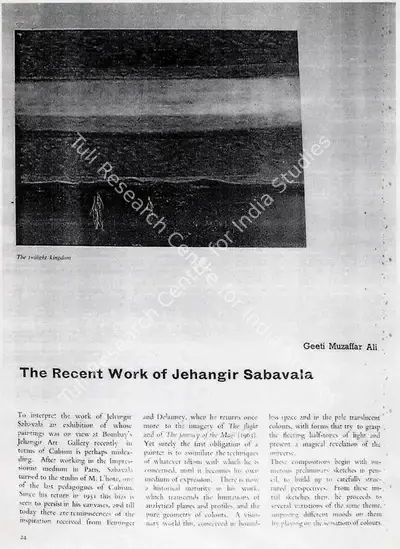
Tuli Research Centre
for India Studies

A free and open knowledge base for the modern and contemporary Indian arts, cinema, photography and cultural heritage.

Support

Contact Us

Discover

Tuli Research Centre for India StudiesVisionManifestoArchive & LibraryVanraja Sanctuary & Hospice
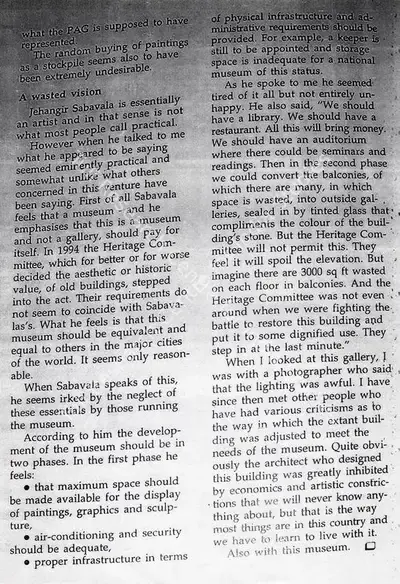
Legal

Privacy PolicyTerms & Conditions

Follow us

Youtube

Youtube

Instagram

Instagram

Facebook

Facebook

© Tuli Research Centre for India Studies 2026
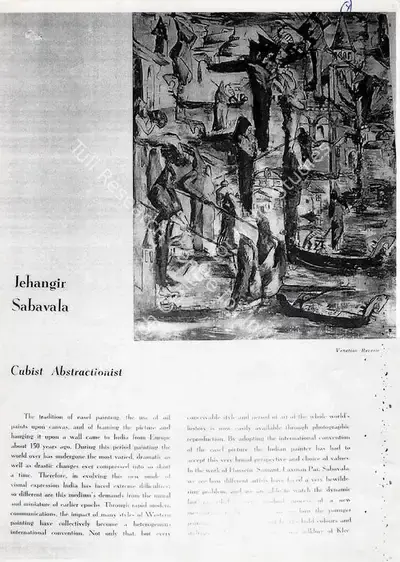
Tuli Research Centre for India Studies
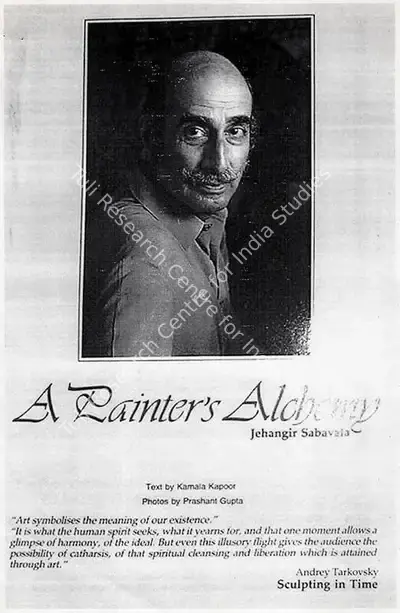
Tuli Research Centre
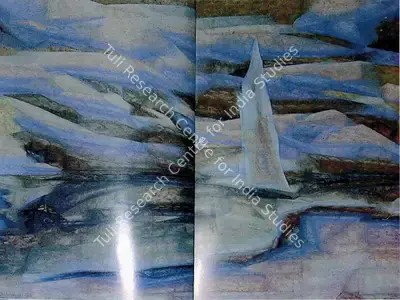
for India Studies

A free and open knowledge base for the modern and contemporary Indian arts, cinema, photography and cultural heritage.

Tuli Research Centre for India StudiesVisionManifestoArchive & LibraryVanraja Sanctuary & Hospice
Contact Us
Privacy PolicyTerms & Conditions

Follow us

YoutubeInstagramFacebook

© Tuli Research Centre for India Studies 2026
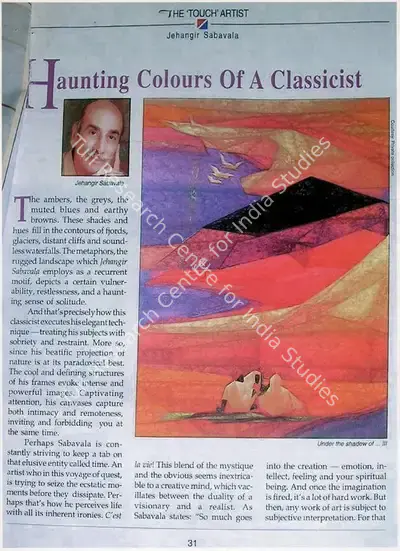
              Dalmia, Yashodhara (Author). The Making of Modern Indian Art - The Progressives. New Delhi: Oxford University Press, 2001 | Authored Book | FineArts | 00169555
              Yashodhara Dalmia (Author)
              TitleThe Making of Modern Indian Art - The Progressives
              Contributor(s)Amitava Das
              Document TypeAuthored Book
              PublisherOxford University Press, New Delhi
              Date of Publication2001
              First Edition2001
              Pages339
              BindingHardbound
              LanguageEnglish
              ISBN9780195653281

              Research Categories

              2_FineArts
              12_Scholarship
              15_SpiritualPoetics

              Related Links42

              Masterlist39
              K H AraF N SouzaM F HusainAuthored Edited BooksN S BendreJogen ChowdhuryAmitava DasJatin DasA M DavierwallaBiren DeM V DhurandharH a GadeV S GaitondeSatish GujralK K HebbarP V JanakiramKanwal KrishnaBhupen KhakharKrishen KhannaPrabhakar KolteGeorge KeytSailoz MookherjeaNandalal BoseAkbar PadamseeLaxman PaiK C S PanikerPilloo PochkhanawalaA RamachandranS H RazaJehangir SabavalaG R SantoshParitosh SenAmrita Sher GilK G SubramanyanVivan SundaramJ SwaminathanAbanindranath TagoreGaganendranath TagoreRabindranath Tagore
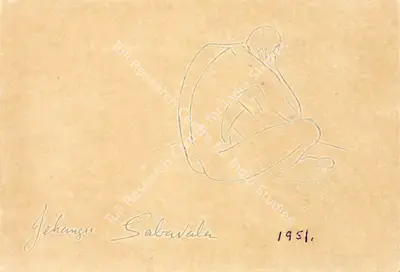
              Research Categories3
              02Modern and Contemporary Indian Fine Arts12The History & Historiography of Scholarship in the Arts, Humanities, and Social Sciences15The Religious-Spiritual-Poetic-Philosophical Framework