Nandalal Bose
b. 03 Dec 1882, Kharagpur, West Bengal, India
d. 16 Apr 1966, Santiniketan
Related Links
- A. Ramachandran
- Abanindranath Tagore
- Akbar Padamsee
- Amrita Sher-Gil
- Art Heritage Annual
- Bhupen P. Khakhar
- Bikash Bhattacharjee
- Christie's
- Ebrahim Alkazi
- F.N. Souza
- G.R. Iranna
- Gaganendranath Tagore
- Ganesh Pyne
- Geeta Kapur
- H.A. Gade
- HEART
- J. Sultan Ali
- J. Swaminathan
- Jamini Roy
- Jeram Patel
- Jogen Chowdhury
- Journal of Arts & Ideas
- Jyoti Bhatt
- K.G. Subramanyan
- Lalit Kala Contemporary Journal
- M.F. Husain
- Manjit Bawa
- Marg
- Meera Mukherjee
- N.S. Bendre
- Nalanda
- Nicholas Roerich
- P.V. Janakiram
- Prabhakar Barwe
- Raja Ravi Varma
- Ramkumar
- Ratan Parimoo
- Sayed Haider Raza
- Satish Gujral
- Shanti Dave
- Somnath Hore
- Sunil Das
- Tyeb Mehta
- V.S. Gaitonde
- Vivan Sundaram
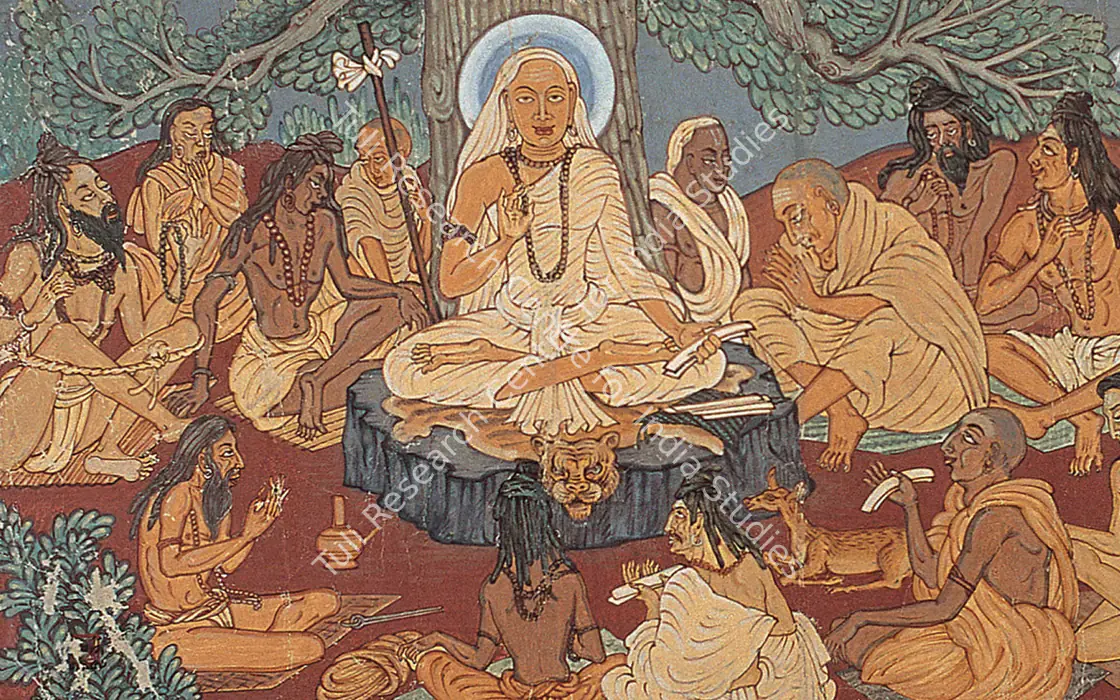
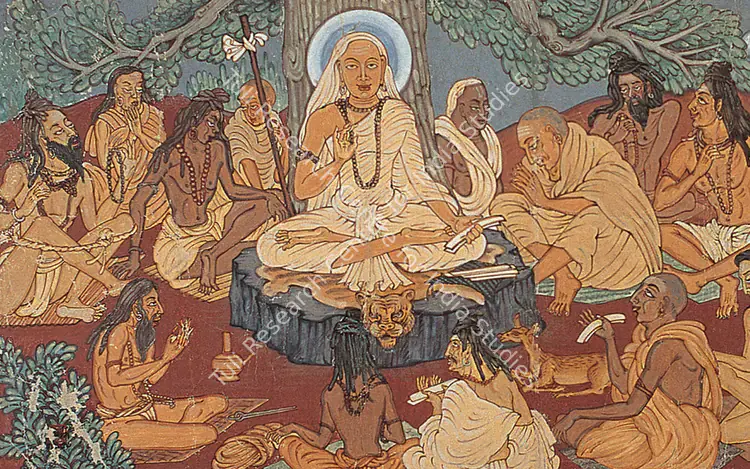
Introduction
Date of Birth
03 Dec 1882
Zodiac sign
Sagittarius
Date of Death
16 Apr 1966
Age
83
Place of Birth
Kharagpur, West Bengal, India
Place of Death
Santiniketan
State Country of Birth
West Bengal, India
1893
Studied at the Middle Vernacular School, Kharagpur, Bihar, India
1897
Studied at the Khudiram Bose Central Collegiate School, Kolkata, India
1903
Studied Commerce, Presidency College, Kolkata, India
1905
Studied under the tutelage of Vice-principal Abanindranath Tagore, Government School of Arts, Kolkata, India
1916
Learned Japanese Ink Painting techniques from Arai Kempo, a visiting artist at Jorasanko, Kolkata, India
Illustrated Rabindranath Tagore's book of poems Chayanika
At the insistance of Abanindranath Tagore and Sister Nivedita, joined Asit Kumar Haldar, Samarendranath Gupta, K. Venkatappa and others to copy the Frescoes of the Ajanta Caves, under the patronage of Lady Herringham
Part-time Art Classes at Vichitra Club. Indian Society of Oriental Art, Kolkata, India
Part-time teacher at Nivedita Girl's School, Jorasanko, Kolkata, India
Founder-Member with Rabindranath Tagore, Vichitra Sabha, Kolkata, India
Executed Murals at the residence of Sir Jagdish Chandra Bose and Basu Vigyan Mandir, Kolkata, India
Illustrated Rabindranath Tagore's Book of Songs and Verse 'Gitabitan' (Garden of Songs)
Taught intermittently at Indian Society of oriental Art, Kolkata and Viswa Bharati, Santiniketan, India
Illustrated Rabindranath Tagore's Nobel Prize winning Book of Verse Gitanjali
Joined Kala Bhavan, Santiniketan with Asit Haldar & others, copied Frescoes at Bagh Caves
Decorated the walls of the old library building at Santiniketan, India
Principal, Kala-Bhavan, Visva Bharati University, Santiniketan, India
Painted a large mural to commemorate the first Hala Karshna in Italian Fresco technique
Made efforts to form an Artists' Cooperative
Illustrated the popular Bengali Textbook Sahaj Path for Children
Painted the front wall of the ground floor of the old Library Building using Rajasthani Technique at Kala Bhavan, Santiniketan, India
Delivered a New Education Fellowship Lecture on The Place of Art in Education, organised during the Bengal Education Week in Kolkata, India
A book containing selected poems by Rabindranath Tagore and Drawings by Nandalal Bose was published
Contributed to decorate Congress Pandal at Faizpur
Decorated the stalls of the Indian National Congress at Haripura with a set of attractive posters
Exhanged views with Mahatama Gandhi on the future of Visva Bharati and Kala Bhavan, Santiniketan, India
His article 'Ornamental Art' was published in Visva Bharati Quarterly
Painted a mural, 'Life of Mira Bai' in Kirti Mandir, Vadodara, India
Painted a mural 'Natir Puja', Cheena Bhavan, Santiniketan, India
His article `Art as Sashana' based on discussion he had with Pavitrananda Swamiji, Mayawati Advaita Ashram, was published in Prabhuddha Bharat
Published 'Shilpa Katha' containing his views on art
Painted a mural Mahabhrata, Kirti Mandir, Vadodara, India
Delivered a talk on Abanindranath Tagore on his birthday celebration, Santiniketan, India
Published his article 'Shilpa Guru Abanindranath' in Desh
Planned the layout and design of the Ramakrishna Temple at Kamarpukur
Designed emblems for the Government of India's awards, including Bharat Ratna and Padma Shri
Fellowship, Lalit Kala Akademi, Rabindra Bhavan, New Delhi, India
Published 'Shilpa Chakra' containing his views on art
No more items to load
Date of Birth
03 Dec 1882
Zodiac sign
Sagittarius
Date of Death
16 Apr 1966
Age
83
Place of Birth
Kharagpur, West Bengal, India
Place of Death
Santiniketan
State Country of Birth
West Bengal, India
1893
Studied at the Middle Vernacular School, Kharagpur, Bihar, India
1897
Studied at the Khudiram Bose Central Collegiate School, Kolkata, India
1903
Studied Commerce, Presidency College, Kolkata, India
1905
Studied under the tutelage of Vice-principal Abanindranath Tagore, Government School of Arts, Kolkata, India
1916
Learned Japanese Ink Painting techniques from Arai Kempo, a visiting artist at Jorasanko, Kolkata, India
Illustrated Rabindranath Tagore's book of poems Chayanika
At the insistance of Abanindranath Tagore and Sister Nivedita, joined Asit Kumar Haldar, Samarendranath Gupta, K. Venkatappa and others to copy the Frescoes of the Ajanta Caves, under the patronage of Lady Herringham
Part-time Art Classes at Vichitra Club. Indian Society of Oriental Art, Kolkata, India
Part-time teacher at Nivedita Girl's School, Jorasanko, Kolkata, India
Founder-Member with Rabindranath Tagore, Vichitra Sabha, Kolkata, India
Executed Murals at the residence of Sir Jagdish Chandra Bose and Basu Vigyan Mandir, Kolkata, India
Illustrated Rabindranath Tagore's Book of Songs and Verse 'Gitabitan' (Garden of Songs)
Taught intermittently at Indian Society of oriental Art, Kolkata and Viswa Bharati, Santiniketan, India
Illustrated Rabindranath Tagore's Nobel Prize winning Book of Verse Gitanjali
Joined Kala Bhavan, Santiniketan with Asit Haldar & others, copied Frescoes at Bagh Caves
Decorated the walls of the old library building at Santiniketan, India
Principal, Kala-Bhavan, Visva Bharati University, Santiniketan, India
Painted a large mural to commemorate the first Hala Karshna in Italian Fresco technique
Made efforts to form an Artists' Cooperative
Illustrated the popular Bengali Textbook Sahaj Path for Children
Painted the front wall of the ground floor of the old Library Building using Rajasthani Technique at Kala Bhavan, Santiniketan, India
Delivered a New Education Fellowship Lecture on The Place of Art in Education, organised during the Bengal Education Week in Kolkata, India
A book containing selected poems by Rabindranath Tagore and Drawings by Nandalal Bose was published
Contributed to decorate Congress Pandal at Faizpur
Decorated the stalls of the Indian National Congress at Haripura with a set of attractive posters
Exhanged views with Mahatama Gandhi on the future of Visva Bharati and Kala Bhavan, Santiniketan, India
His article 'Ornamental Art' was published in Visva Bharati Quarterly
Painted a mural, 'Life of Mira Bai' in Kirti Mandir, Vadodara, India
Painted a mural 'Natir Puja', Cheena Bhavan, Santiniketan, India
His article `Art as Sashana' based on discussion he had with Pavitrananda Swamiji, Mayawati Advaita Ashram, was published in Prabhuddha Bharat
Published 'Shilpa Katha' containing his views on art
Painted a mural Mahabhrata, Kirti Mandir, Vadodara, India
Delivered a talk on Abanindranath Tagore on his birthday celebration, Santiniketan, India
Published his article 'Shilpa Guru Abanindranath' in Desh
Planned the layout and design of the Ramakrishna Temple at Kamarpukur
Designed emblems for the Government of India's awards, including Bharat Ratna and Padma Shri
Fellowship, Lalit Kala Akademi, Rabindra Bhavan, New Delhi, India
Published 'Shilpa Chakra' containing his views on art
No more items to load
Exhibitions
 Inaugural Exibition, Indian Society of Oriental Art (ISOA), Kolkata, India
Indian Society of Oriental Art (ISOA), Shimla, India
Indian Society of Oriental Art (ISOA), Kolkata, India
Indian Society of Oriental Art's United Provinces Exhibition, Allahabad, India
Festival of Empire, Organised by Indian Society of Oriental Art for George V's Coronation, Crystal Palace, London, UK
Indian Society of Oriental Art, Kolkata, India
22nd Exhibition of Societe des Peintres Orientalistes Francais, Grand Palais, Paris; travelling to Belgium, Holland & Imperial Institute in London, UK
Young Men's Indian Association, Chennai, India
Indian Society of Oriental Art (ISOA), Kolkata, India
14th Annual Exhibition,The lndian Society of Oriental Art (ISOA), Kolkata, India
Travelling exhibition to USA, Organised by American Federation of Art and Indian Society of Oriental Art (ISOA), Kolkata, India
Athenee Gallery, Geneva, Switzerland
Athenee Gallery, Geneva, Switzerland
Exhibition by students of Kala Bhavan, Santiniketan at the Lucknow Session of the Indian National Congress, Lucknow, India
Haripura session of Indian National Congress, Surat, India
Nandalal Bose, Retrospective Exhibition, Mumbai, India
2nd International Contemporary Art Exhibition, All India Fine Arts and Crafts Society (AIFACS), New Delhi, India
Nandalal Bose, Retrospective Exhibition, Kolkata, India
A Handbook of Bengal School, National Gallery of Modern Art, New Delhi, India
Nandalal Bose (1882-1966) Centenary Exhibition, Presented by National Gallery of Modern Art (NGMA), New Delhi, India
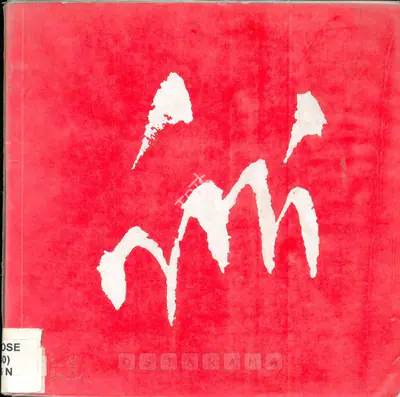
Bose, Nandalal (Artist). Nandalal Bose (1882-1966) Centenary Exhibition, 1983 | Solo Exhibition Catalogue | 00882085
Chronological Highlights
14 / 14
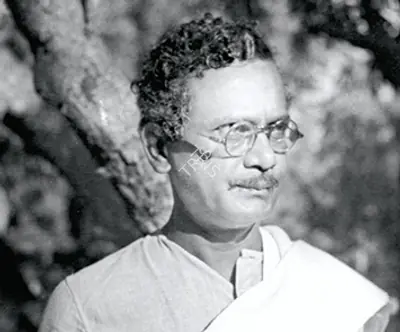
3 December 1882
Nandalal Bose was born in 3 December 1882 in Kharagpur, West Bengal, India.
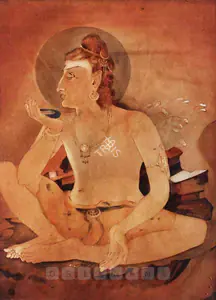
1933
Public Auction High
In 2006, the artist achieved a new high in the auction market with the sale of Shiva Drinking The World'S Poison (1933), offered in the Modern and Contemporary Indian Paintings by Triveda, which concluded on 25 October 2006 at New Delhi, achieving a sale price of ₹29,90,000 ($66,004). This record marked a defining moment in the artist's market history, reflecting both the significance of the artwork and its reception within the broader art world.
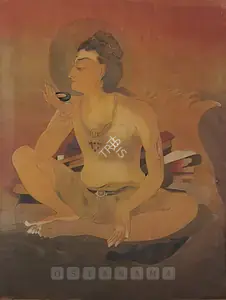
1936
Public Auction High
In 2011, the artist achieved a new high in the auction market with the sale of Shiva Drinking The World Poison (1936), offered in the Creative India Series 1: Bengal by Osian's, which concluded on 15 December 2011 at New Delhi, achieving a sale price of ₹60,00,000 ($110,629). This record marked a defining moment in the artist's market history, reflecting both the significance of the artwork and its reception within the broader art world.
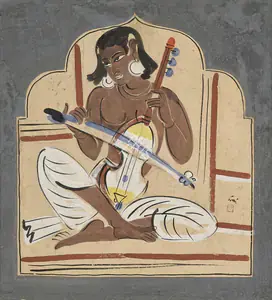
1937
Public Auction High
In 2025, the artist achieved a new high in the auction market with the sale of Esraj Player (1937), offered in the The Fine Art Sale by Pundole, which concluded on 27 March 2025 at Mumbai, achieving a sale price of ₹3,50,00,000 ($408,110.91). This record marked a defining moment in the artist's market history, reflecting both the significance of the artwork and its reception within the broader art world.
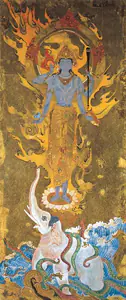
1941
Literary Reference
Pursuing the analysis further, but keeping in mind the same truth that creation is an unfolding away from, and not a harking back to, the origin, it has seemed to me that the various decorative designs may claim as their fundamental basis are the forms of the Buddhist symbols for the five elements: earth, water, fire, air and sky… Third element: Fire. The symbol is a cone, or triangle, standing on its base, point upwards. This represents the shape of an undistributed flame. Its interaction with air results in waves and eddies; but as fire, unlike water, is devoid of weight, the lines of these forms have an upward tendency.
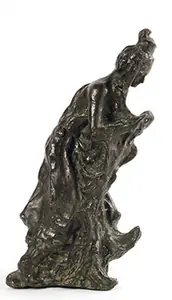
1943
Public Auction High
In 2015, the artist achieved a new high in the auction market with the sale of Nati (1943), offered in the Indian Art: Classical to Modern by Pundole, which concluded on 09 April 2015 at Mumbai, achieving a sale price of ₹80,00,000 ($128,501.67). This record marked a defining moment in the artist's market history, reflecting both the significance of the artwork and its reception within the broader art world.
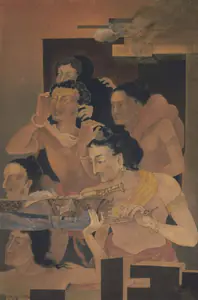
1943
Public Auction High
In 2015, the artist achieved a new high in the auction market with the sale of Untitled (1943), offered in the Modern Indian Art by Asta Guru, which concluded on 21 August 2015 at Online, achieving a sale price of ₹2,91,37,012 ($442,611.28). This record marked a defining moment in the artist's market history, reflecting both the significance of the artwork and its reception within the broader art world.
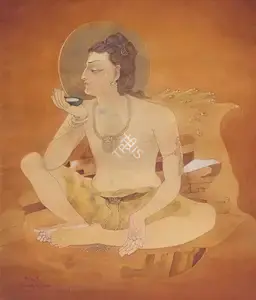
1943
Public Auction High
In 2026, the artist achieved a new high in the auction market with the sale of Untitled (Shiva Drinking World Poison) (1943), offered in the Masters Legacy by Asta Guru, which concluded on 11 March 2026 at Mumbai, achieving a sale price of ₹4,84,00,000 ($526,512.17). This record marked a defining moment in the artist's market history, reflecting both the significance of the artwork and its reception within the broader art world.
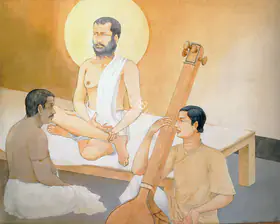
1945
Public Auction High
In 1999, the artist achieved a new high in the auction market with the sale of Bhairagi (1945), offered in the Indian and Southeast Asian Art by Sotheby's, which concluded on 16 September 1999 at New York, achieving a sale price of ₹13,76,975 ($31,625). This record marked a defining moment in the artist's market history, reflecting both the significance of the artwork and its reception within the broader art world.
1945
Public Auction High
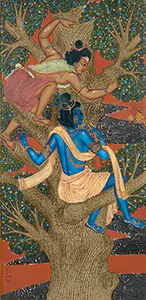
In 2015, the artist achieved a new high in the auction market with the sale of Krishna and Subal First Meeting Radha (1945), offered in the Indian Art: Classical to Modern by Pundole, which concluded on 09 April 2015 at Mumbai, achieving a sale price of ₹75,00,000 ($120,470.32). This record marked a defining moment in the artist's market history, reflecting both the significance of the artwork and its reception within the broader art world.
1947
Literary Reference
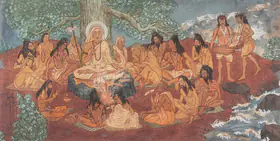
This painting represents one of those complete masterpieces where Nandalal Bose manages to artistically incorporate all the five elements of nature in his narrative, which were a critical area of his artistic research and interest during the early-mid 1940s, best clarified through his writings in ‘On Art’ Madras: Kalakshetra Publications 1956. “In these notes on arnamental art I have tried to show, so far, how the forms of natural objects … which have been used in our country for the purposes of decorative designing, could be reduced to certain typical shapes; adding the caution, however, that a mechanical insistance on these would tend to restrict creative variety, for the maintaining of which an everfresh study of nature is always needed. ... it has seemed to me that the various decorative designs may claim as their fundamental basis the forms of the Buddhist symbols for the five elements: earth, water, fire, air and sky. I now proceed to explain and illustrate my idea. ...Second Element: Water. The symbol for this is a sphere (in two dimensions, a circle). water, unsupported, tens to form spherical drops. Its shape depends on external containers or resistances. Its eddies due to contacts with earth are circular. The impact on it of air gives rise to wave forms. Being heavy as well as fluid, its lines of motion tend downward. All the forms so arising are to be found in scroll work. Third Element: Fire. The symbol is a cone, or triangle standing on its base, point upwards. This represents the shape of an undisturbed flame. its interaction with air results in waves and eddies; but as fire, unlike water, is devoid of weight, the lines of these have an upward tendency. Fourth Element: Air. The symbol is a crescent, emblematic of the forms created by the motion over earth and water. It is fluid, but being invisible, it can only manifest form throughits action on sand, dust, water, vapours etcetera. Its eddies and waves are prominently displayed in cloud shapes. Ascending spirals are characteristic of its lightness. Fifth Element: Sky. The symbol is an eggshell in shape - vaulted in each direction. The sky represents space itself, with no form of its own; but being the condition of every form, is thus fittingly symbolised by a vault-like cavity. The spaces, within and around the lines of a design, are as necessary parts of its form as are the lines themselves, and find their prototype in this element.”
1951
Public Auction High
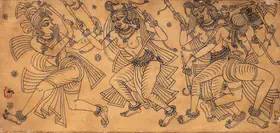
In 2010, the artist achieved a new high in the auction market with the sale of Dandiya Dance (1951), offered in the 101 Rare Artworks from the History of Indian Modern & Contemporary Art by Osian's, which concluded on 23 June 2010 at Mumbai, achieving a sale price of ₹31,20,000 ($67,372). This record marked a defining moment in the artist's market history, reflecting both the significance of the artwork and its reception within the broader art world.
1952
Public Auction High
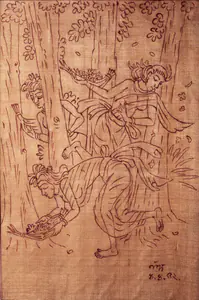
In 1997, the artist achieved a new high in the auction market with the sale of Untitled (1952), offered in the The Intuitive-Logic II: Modern & Contemporary Indian Paintings, Drawings, Graphics, Sculpture & Tapestry by HEART, which concluded on 15 November 1997 at Mumbai, achieving a sale price of ₹1,00,000 ($2,722). This record marked a defining moment in the artist's market history, reflecting both the significance of the artwork and its reception within the broader art world.

1996
First Auction Appearance | BOOK.AUC
On 19 September 1996, Nandalal Bose made their debut in the Indian public auction market when Untitled was presented as Lot 197 in Indian and Southeast Asian Art, conducted by Sotheby's in New York, USA. This auction marked the artist's first recorded appearance in the public auction market, establishing the earliest chapter of their auction history.
2011
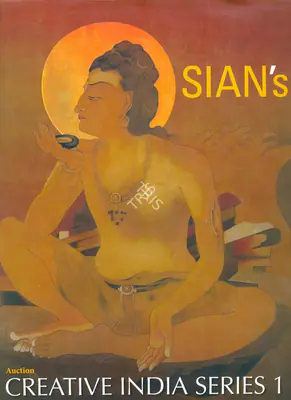
Featured on Auction Catalogue Cover | Os.Del/15.12.11
In 2011, an artwork by Nandalal Bose was featured on the cover of Osians: Creative India Series 1 (December 2011, New Delhi), marking a documented highlight in the artist's public and auction market visibility.
1933
1936
1937
1941
1943
1945
1947
1951
1952
1996
2011
Economics of Art
EN
EN
English
HI
Hindi
EN
EN
English
HI
Hindi