

K. Laxma Goud's Goat
About this post
Laxma Goud is a painter, draughtsman, sculptor and one of India’s finest printmakers.
Goud’s childhood was spent in Telangana's village-an environment that shaped his sensibility in the years to come. Goud received his training in drawing and painting at the Government College of Fine Arts and Architecture in Hyderabad and studied Mural Painting under veteran artist K.G. Subramanyan in the 1960s at Baroda.
To Goud, urban middle-class morality either repressed sexuality or treated it as taboo while rural societies had an unselfconscious and non-prudish attitude towards it. It is no surprise then that many of Goud’s works were overtly sexual in nature, fusing rural imagery with uninhibited eroticism.
While his mastery over printmaking is reflected in his monochromatic copper plate etchings, he expanded into sculptural language in the 1980s utilizing materials such as terracotta and bronze.
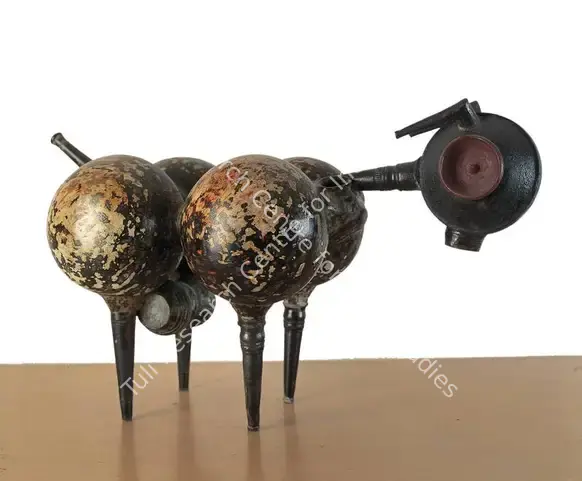
Goud's goat reflects a heavy sculptural form, returning to his traditional roots of Andhra’s craft traditions like leather puppetry and terracotta sculpting. Goud's goats hark, of course, to those dormant indigenous influences but they also, to some extent, remind one of the goat renderings of Picasso, who had famously kept a pet goat named Esmeralda. In both cases, the goat emerges not merely as a pastoral motif but as a charged and affectionate presence too. In the Indian subcontinent, the goat occupies a long-standing place within agrarian and ritual life, tied closely to everyday economy and forming part of rural systems of livelihood across regions. In Goud's work, the goat is held within this spectrum of memory and the conditions of rural life.
Post 13
K. Laxma Goud's Goat
Post record
Published10 May 2026
Media1 image
Research Categories22_FineArts·16_Continuum
Masterlists3Neville Tuli·K. Laxma Goud·All Living Souls