TRIS logo image
Nandalal Bose — featured artwork

Introduction

Date of Birth
03 Dec 1882
Zodiac sign
Sagittarius
Date of Death
16 Apr 1966
Age
83
Place of Birth
Kharagpur, West Bengal, India
Place of Death
Santiniketan
State Country of Birth
West Bengal, India

Exhibitions

  1. 1908

    1. Inaugural Exibition, Indian Society of Oriental Art (ISOA), Kolkata, India
  2. 1909

    1. Indian Society of Oriental Art (ISOA), Shimla, India
  3. 1910

    1. Indian Society of Oriental Art (ISOA), Kolkata, India
  4. 1911

    1. Festival of Empire, Organised by Indian Society of Oriental Art for George V's Coronation, Crystal Palace, London, UK
    2. Indian Society of Oriental Art's United Provinces Exhibition, Allahabad, India
  5. 1912

    1. Indian Society of Oriental Art, Kolkata, India
  6. 1914

    1. 22nd Exhibition of Societe des Peintres Orientalistes Francais, Grand Palais, Paris; travelling to Belgium, Holland & Imperial Institute in London, UK
  7. 1915

    1. Young Men's Indian Association, Chennai, India
    2. Indian Society of Oriental Art (ISOA), Kolkata, India
  8. 1922

    1. 14th Annual Exhibition,The lndian Society of Oriental Art (ISOA), Kolkata, India
  9. 1924

    1. Travelling exhibition to USA, Organised by American Federation of Art and Indian Society of Oriental Art (ISOA), Kolkata, India
  10. 1928

    1. Athenee Gallery, Geneva, Switzerland
    2. Athenee Gallery, Geneva, Switzerland
  11. 1935

    1. Exhibition by students of Kala Bhavan, Santiniketan at the Lucknow Session of the Indian National Congress, Lucknow, India
  12. 1938

    1. Haripura session of Indian National Congress, Surat, India
  13. 1953

    1. Nandalal Bose, Retrospective Exhibition, Mumbai, India
    2. 2nd International Contemporary Art Exhibition, All India Fine Arts and Crafts Society (AIFACS), New Delhi, India
  14. 1954

    1. Nandalal Bose, Retrospective Exhibition, Kolkata, India
  15. 1975

    1. A Handbook of Bengal School, National Gallery of Modern Art, New Delhi, India
  16. 1983

  17. 1987

    1. Festival of India, USSR & Switzerland
  18. 1988

    1. Takaoka Municipal Museum of Art & Meguro Museum of Art, Tokyo, Japan
    2. Olympiad of Art, Seoul, South Korea
  19. 1990

    1. Kala Yatra, Santiniketan, India
  20. 1991

    1. 05 Feb 1991 to 15 Feb 1991

    2. National Exposition of Contemporary Art, National Gallery of Modern Art (NGMA), New Delhi, India
  21. 1992

    1. Nandan Art Gallery, Kala Bhavan, Santiniketan, India
  22. 1993

    1. Little Gallery, Kolkata, India
  23. 1995

    1. Le Monde De I Art, Paris, France
    2. Gallery Raku, Kyoto, Japan
    3. Man and Nature: Reflections of Six Artists, National Gallery of Modern Art (NGMA), New Delhi, India
  24. 1997

    1. Santiniketan: The Making of Contextual Modernism, National Gallery of Modern Art (NGMA), New Delhi, India
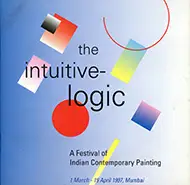
    2. Intuitive Logic: A Festival of Indian Contemporary Painting, Presented by The Tuli Foundation for Holistic Education & Art (HEART) at National Gallery of Modern Art (NGMA), Mumbai, India

      01 Mar 1997 to 19 Apr 1997

    3. 13 Dec 1997 to 24 Dec 1997

  25. 1998

    1. 10 Jul 1998 to 27 Jul 1998

  26. 1999

    1. Early Masters: Rare Paintings of the Bengal Renaissance, Presented by Bose Pacia Modern, New York, USA

      06 Feb 1999 to 27 Mar 1999

  27. 2000

    1. Face off 1900-1980s: An Exhibition of Indian Old Masters and Moderns, Delhi Art Gallery, New Delhi, India

      15 Apr 2000 to 31 May 2000

  28. 2001

    1. 07 Aug 2001 to 14 Aug 2001

    2. Art of Bengal: Past and Present, Presented by Centre of International Modern Art (CIMA), at National Gallery of Modern Art (NGMA), Mumbai, India

      09 Jan 2001 to 25 Jan 2001

40 of 111
Bose, Nandalal (Artist). Nandalal Bose (1882-1966) Centenary Exhibition, 1983 | Solo Exhibition Catalogue | 00882085
1 / 6

Bose, Nandalal (Artist). Nandalal Bose (1882-1966) Centenary Exhibition, 1983 | Solo Exhibition Catalogue | 00882085

Chronicled Highlights

14 entries
Nandalal Bose
3 December 1882Born
Nandalal Bose
Nandalal Bose was born in 3 December 1882 in Kharagpur, West Bengal, India.
Bose, Nandalal (Artist). Shiva Drinking The World'S Poison. Line wash and watercolour on paper, 1933 | Painting  | 00881637
Bose, Nandalal (Artist). Shiva Drinking The World'S Poison. Line wash and watercolour on paper, 1933 | Painting | 00881637
In 2006, the artist achieved a new high in the auction market with the sale of Shiva Drinking The World'S Poison (1933), offered in the Modern and Contemporary Indian Paintings by Triveda, which concluded on 25 October 2006 at New Delhi, achieving a sale price of ₹29,90,000 ($66,004). This record marked a defining moment in the artist's market history, reflecting both the significance of the artwork and its reception within the broader art world.
Bose, Nandalal (Artist). Shiva Drinking The World Poison. Tempera on silk, c.1936 | Painting | FineArts | 00757188
In 2011, the artist achieved a new high in the auction market with the sale of Shiva Drinking The World Poison (1936), offered in the Creative India Series 1: Bengal by Osian's, which concluded on 15 December 2011 at New Delhi, achieving a sale price of ₹60,00,000 ($110,629). This record marked a defining moment in the artist's market history, reflecting both the significance of the artwork and its reception within the broader art world.
Bose, Nandalal (Artist). Esraj Player. Tempera on paper, 1937 | Painting | EconomicsArt | 00869941
In 2025, the artist achieved a new high in the auction market with the sale of Esraj Player (1937), offered in the The Fine Art Sale by Pundole, which concluded on 27 March 2025 at Mumbai, achieving a sale price of ₹3,50,00,000 ($408,110.91). This record marked a defining moment in the artist's market history, reflecting both the significance of the artwork and its reception within the broader art world.
Bose, Nandalal (Artist). Indra & Airavata. Tempera on Japanese golden board, early 1940s | Painting | FineArts | 00371639
Pursuing the analysis further, but keeping in mind the same truth that creation is an unfolding away from, and not a harking back to, the origin, it has seemed to me that the various decorative designs may claim as their fundamental basis are the forms of the Buddhist symbols for the five elements: earth, water, fire, air and sky… Third element: Fire. The symbol is a cone, or triangle, standing on its base, point upwards. This represents the shape of an undistributed flame. Its interaction with air results in waves and eddies; but as fire, unlike water, is devoid of weight, the lines of these forms have an upward tendency.
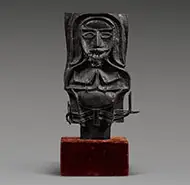
Bose, Nandalal (Artist). Nati . Bronze, 1943 | Sculpture | FineArts | 00331655
In 2015, the artist achieved a new high in the auction market with the sale of Nati (1943), offered in the Indian Art: Classical to Modern by Pundole, which concluded on 09 April 2015 at Mumbai, achieving a sale price of ₹80,00,000 ($128,501.67). This record marked a defining moment in the artist's market history, reflecting both the significance of the artwork and its reception within the broader art world.
Bose, Nandalal (Artist). Untitled. Watercolour and wash on paper pasted on board, 1943 | Painting | FineArts | 00332589
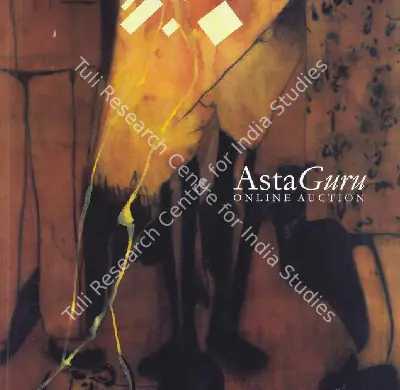
In 2015, the artist achieved a new high in the auction market with the sale of Untitled (1943), offered in the Modern Indian Art by Asta Guru, which concluded on 21 August 2015 at Online, achieving a sale price of ₹2,91,37,012 ($442,611.28). This record marked a defining moment in the artist's market history, reflecting both the significance of the artwork and its reception within the broader art world.
Bose, Nandalal (Artist). Untitled (Shiva Drinking World Poison). Watercolour on paper, 1943 | Painting | EconomicsArt | 00872424
In 2026, the artist achieved a new high in the auction market with the sale of Untitled (Shiva Drinking World Poison) (1943), offered in the Masters Legacy by Asta Guru, which concluded on 11 March 2026 at Mumbai, achieving a sale price of ₹4,84,00,000 ($526,512.17). This record marked a defining moment in the artist's market history, reflecting both the significance of the artwork and its reception within the broader art world.
Bose, Nandalal (Artist). Bhairagi. Mixed media on canvas, 1945 | Painting  | 00877218
Bose, Nandalal (Artist). Bhairagi. Mixed media on canvas, 1945 | Painting | 00877218
In 1999, the artist achieved a new high in the auction market with the sale of Bhairagi (1945), offered in the Indian and Southeast Asian Art by Sotheby's, which concluded on 16 September 1999 at New York, achieving a sale price of ₹13,76,975 ($31,625). This record marked a defining moment in the artist's market history, reflecting both the significance of the artwork and its reception within the broader art world.
Bose, Nandalal (Artist). Krishna and Subal First Meeting Radha. Tempera on wooden panel, 1945 | Painting | FineArts | 00331653
In 2015, the artist achieved a new high in the auction market with the sale of Krishna and Subal First Meeting Radha (1945), offered in the Indian Art: Classical to Modern by Pundole, which concluded on 09 April 2015 at Mumbai, achieving a sale price of ₹75,00,000 ($120,470.32). This record marked a defining moment in the artist's market history, reflecting both the significance of the artwork and its reception within the broader art world.
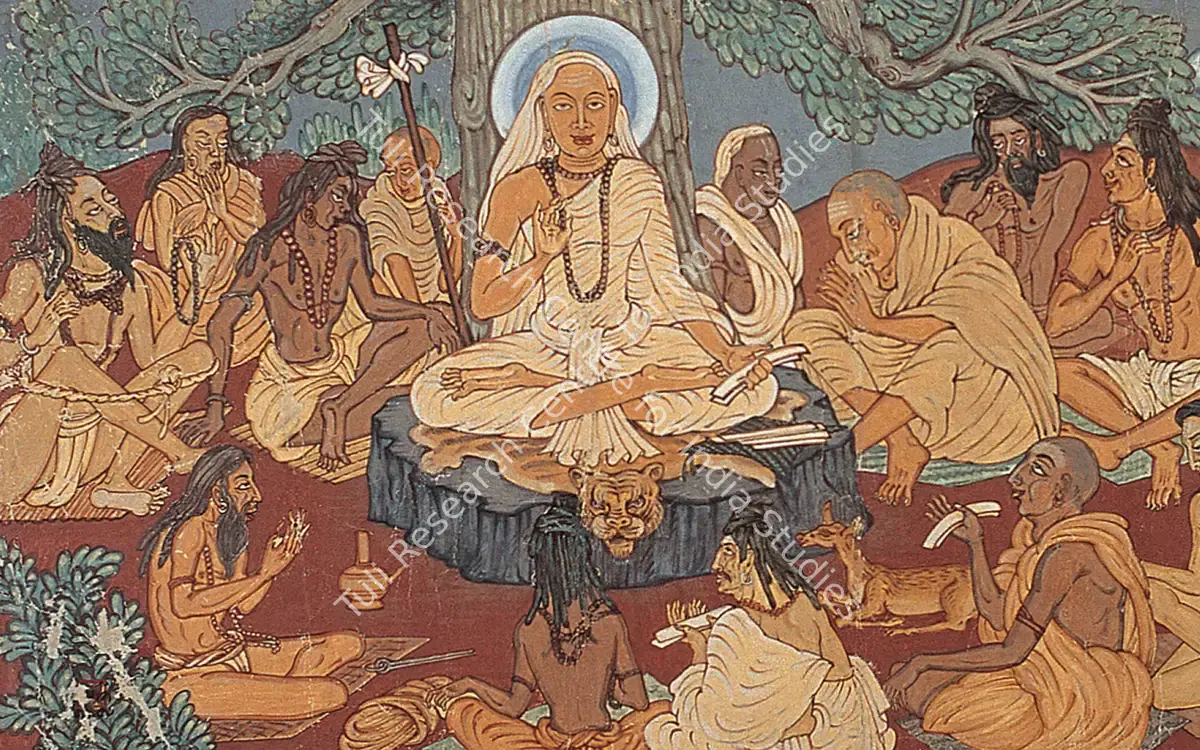
Bose, Nandalal (Artist). Sankaracharya with Disciples. Watercolour on paper, 1947 | Painting | FineArts | 00332031
This painting represents one of those complete masterpieces where Nandalal Bose manages to artistically incorporate all the five elements of nature in his narrative, which were a critical area of his artistic research and interest during the early-mid 1940s, best clarified through his writings in ‘On Art’ Madras: Kalakshetra Publications 1956.
“In these notes on arnamental art I have tried to show, so far, how the forms of natural objects … which have been used in our country for the purposes of decorative designing, could be reduced to certain typical shapes; adding the caution, however, that a mechanical insistance on these would tend to restrict creative variety, for the maintaining of which an everfresh study of nature is always needed. ... it has seemed to me that the various decorative designs may claim as their fundamental basis the forms of the Buddhist symbols for the five elements: earth, water, fire, air and sky. I now proceed to explain and illustrate my idea. ...Second Element: Water. The symbol for this is a sphere (in two dimensions, a circle). water, unsupported, tens to form spherical drops. Its shape depends on external containers or resistances. Its eddies due to contacts with earth are circular. The impact on it of air gives rise to wave forms. Being heavy as well as fluid, its lines of motion tend downward. All the forms so arising are to be found in scroll work. Third Element: Fire. The symbol is a cone, or triangle standing on its base, point upwards. This represents the shape of an undisturbed flame. its interaction with air results in waves and eddies; but as fire, unlike water, is devoid of weight, the lines of these have an upward tendency. Fourth Element: Air. The symbol is a crescent, emblematic of the forms created by the motion over earth and water. It is fluid, but being invisible, it can only manifest form throughits action on sand, dust, water, vapours etcetera. Its eddies and waves are prominently displayed in cloud shapes. Ascending spirals are characteristic of its lightness. Fifth Element: Sky. The symbol is an eggshell in shape - vaulted in each direction. The sky represents space itself, with no form of its own; but being the condition of every form, is thus fittingly symbolised by a vault-like cavity. The spaces, within and around the lines of a design, are as necessary parts of its form as are the lines themselves, and find their prototype in this element.”
Bose, Nandalal (Artist). Dandiya Dance. Brush and ink on silk (pasted on paper), 1951 | Drawing | FineArts | 00755786
In 2010, the artist achieved a new high in the auction market with the sale of Dandiya Dance (1951), offered in the 101 Rare Artworks from the History of Indian Modern & Contemporary Art by Osian's, which concluded on 23 June 2010 at Mumbai, achieving a sale price of ₹31,20,000 ($67,372). This record marked a defining moment in the artist's market history, reflecting both the significance of the artwork and its reception within the broader art world.
Bose, Nandalal (Artist). Untitled. Brush on Monga silk, 1952 | Drawing | FineArts | 00375754
In 1997, the artist achieved a new high in the auction market with the sale of Untitled (1952), offered in the The Intuitive-Logic II: Modern & Contemporary Indian Paintings, Drawings, Graphics, Sculpture & Tapestry by HEART, which concluded on 15 November 1997 at Mumbai, achieving a sale price of ₹1,00,000 ($2,722). This record marked a defining moment in the artist's market history, reflecting both the significance of the artwork and its reception within the broader art world.
Sotheby's (Auction House). Indian and Southeast Asian Art. 19 September 1996, New York | Auction Catalogue | EconomicsArt | 00861847
1 / 2
Sotheby's (Auction House). Indian and Southeast Asian Art. 19 September 1996, New York | Auction Catalogue | EconomicsArt | 00861847
On 19 September 1996, Nandalal Bose made their debut in the Indian public auction market when Untitled was presented as Lot 197 in Indian and Southeast Asian Art, conducted by Sotheby's in New York, USA. This auction marked the artist's first recorded appearance in the public auction market, establishing the earliest chapter of their auction history.
Osians (Auction House) and Neville Tuli (Curator). Creative India Series 1 - Bengal. 15 December 2011, New Delhi | Auction Catalogue | EconomicsArt | 00862103
In 2011, an artwork by Nandalal Bose was featured on the cover of Osians: Creative India Series 1 (December 2011, New Delhi), marking a documented highlight in the artist's public and auction market visibility.

Economics of Art

Research Centre

Posts 2

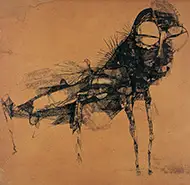
  1. Krishna Reddy's Spider Web and Jellyfish
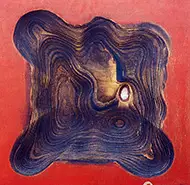
    Krishna Reddy, one of the world's finest printmakers, developed complex viscosity printing techniques to build layered surfaces for his organic artforms, resembling webs or marine organisms which emerge through dense tonal structures. The insect or organism becomes a study of interconnected systems and movement, rooted through a brilliant aesthetic fusing of his individual creative spirit and his unique educational experiences and inspirations at Rabindranath Tagore's Santiniketan with Nandalal Bose, the Slade School of Art with Henry Moore, the Academie Grande Chaumiere with Ossip Zadkine, Atelier 17, Paris with Stanley Hayter and Academia Di Belle Arti Di Brera with Marino Marini during the period 1947-57.
  2. SWARAJ - Revisualising India's Political History
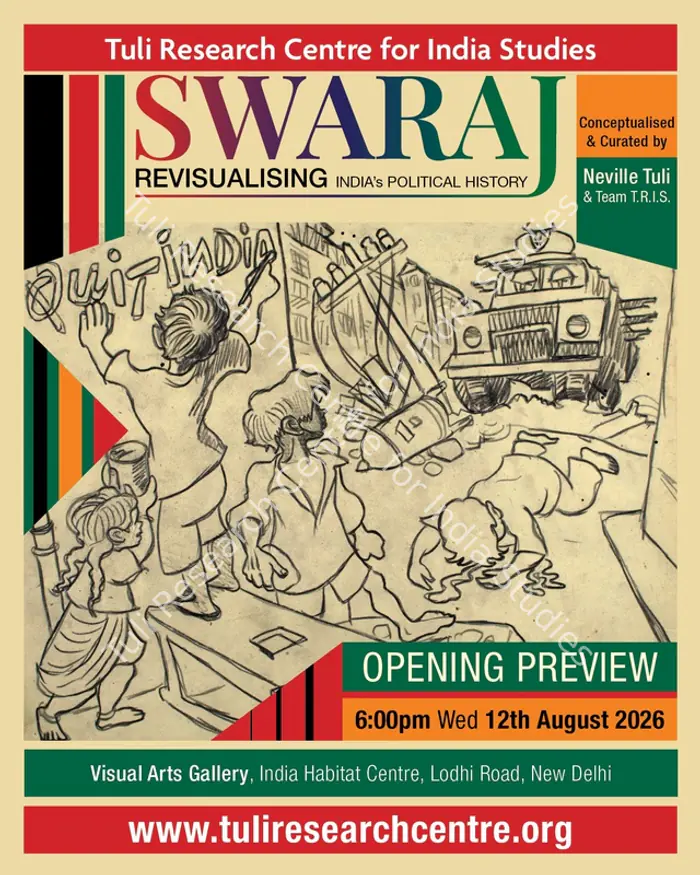
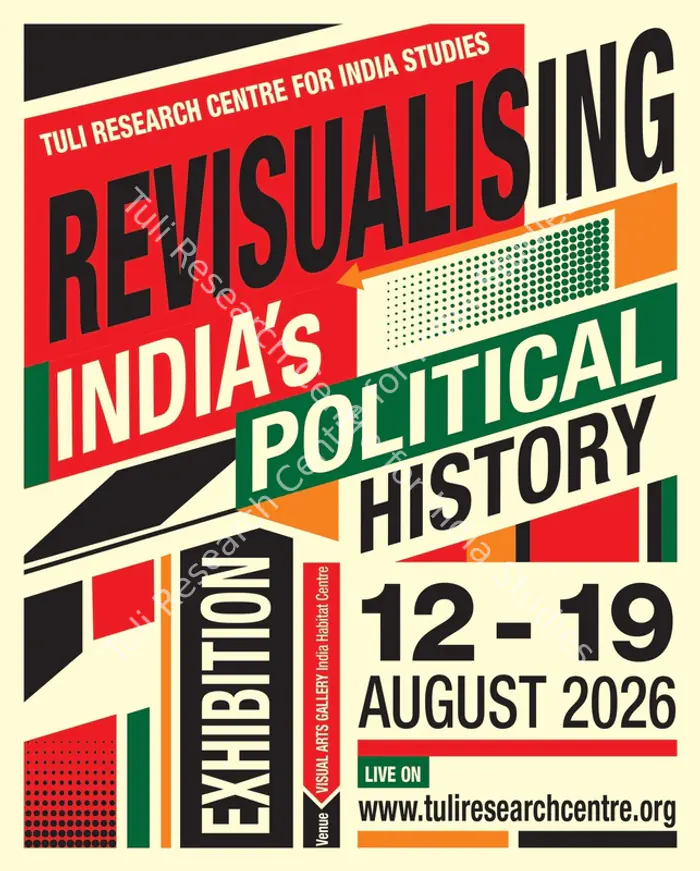
    "What does 𝗦𝘄𝗮𝗿𝗮𝗷 truly mean? Is freedom achieved at a single historic moment or period, or must self-rule be continually imagined, questioned and renewed? India's journey towards Swaraj was shaped not by one voice or one path, but through reform and resistance, revolution and non-violence, political thought, public protest, art, print, photography, cinema and the collective will of its people. The Tuli Research Centre for India Studies (T.R.I.S.) presents 𝗦𝗪𝗔𝗥𝗔𝗝: 𝗥𝗲𝘃𝗶𝘀𝘂𝗮𝗹𝗶𝘀𝗶𝗻𝗴 𝗜𝗻𝗱𝗶𝗮'𝘀 𝗣𝗼𝗹𝗶𝘁𝗶𝗰𝗮𝗹 𝗛𝗶𝘀𝘁𝗼𝗿𝘆, a pioneering exhibition curated by Neville Tuli. Bringing together rare artworks, prints, photographs, books, film publicity art, political propaganda and visual-textual-audio archives, SWARAJ traces India's complex journey towards political self-rule and self-discovery. From early European coastal encounters, the Bengal Renaissance and the First War of Independence in 1857 to the rise of Bharat Mata, the Tiranga, Gandhiji's inspired satyagraha, civil disobedience and mass mobilisation, the exhibition explores how the idea of India was envisioned, contested and transformed. It journeys through revolutionary movements and non-violence, subaltern uprisings, the Partition, the Constitution, the integration of the Princely States, the Emergency, wars, civic dissent and people's protests. It also foregrounds the vital role of artists, photographers, publishers, newspapers, journals, cartoons and cinema in recording and shaping the nation's political consciousness. SWARAJ invites us to encounter history not as something distant or settled, but as a daily living inheritance that continues to influence who we are and how we understand freedom, identity, and ourselves today. Watch the video for a glimpse into this expansive visual journey, and follow the exhibition as it revisualises India's political history through art, image, text and sound.

Calendar 3

  1. SWARAJ - Revisualising India's Political History
    LiveExhibitionProject 81
    SWARAJ - Revisualising India's Political History
    An Exhibition of Modern & Contemporary Fine & Popular Arts, Photography, Film Memorabilia and Visual-Textual-Audio Archive
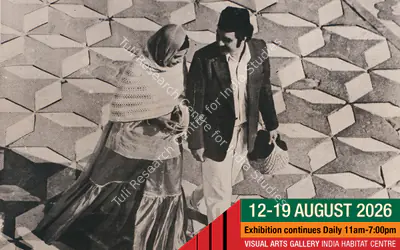
    12th - 19th August 2026
    10:00 AM - 7:00 PM
    Visual Arts Gallery, India Habitat Centre, Lodhi Road, New Delhi,
    19
    The Tuli Research Centre for India Studies (T.R.I.S.) announces its seventh exhibition. “Swaraj – Revisualising India's Political History” -- An exhibition of Modern and Contemporary Fine and Popular Arts, Photography, Film Memorabilia and Visual-Textual-Audio Archives. Swaraj will open at 6 p.m. on Wednesday, 12 August 2026 at the Visual Arts Gallery and will remain open till 7 p.m. Sunday, 16 August 2026. Tuli Research Centre for India Studies (T.R.I.S.) presents SWARAJ | Revisualising India's Political History, a pioneering inter-disciplinary offline-online exhibition conceptualised and curated by Neville Tuli with Team T.R.I.S.. SWARAJ explores India's journey towards political self-rule and self-discovery through a remarkable collection of rare modern and contemporary fine and popular arts, albums, photographs, books, prints, propaganda, cartoons, film publicity artworks and other "text-visual-audio" archives contextualised within a clear historical framework, which defines T.R.I.S.' pedagogic approach to learning. The Exhibition will be of particular interest to students and scholars of India & Cultural Studies, and India's political and modern histories as well as those interested in the passage of events and ideas from the mid-1850s leading up to the turn of the 21st century. Unique to the Tuli Research Centre for India Studies is the richness of visual material that not only exhorts a deeper understanding of the art and archival materials on display but also brings alive the multi-layered narratives of the exhibition and naturally India's journey in being ad searching for herself.
    Read More →
    +16 more
  2. SWARAJ - Revisualising India's Political History
    ArchivedOpening PreviewProject 82
    SWARAJ - Revisualising India's Political History
    An Exhibition of Modern & Contemporary Fine & Popular Arts, Photography, Film Memorabilia and Visual-Textual-Audio Archive
    12th August 2026
    6:00 PM - 9:00 PM
    Visual Arts Gallery, India Habitat Centre, Lodhi Road, New Delhi,
    The Tuli Research Centre for India Studies (T.R.I.S.) announces its seventh exhibition. “Swaraj – Revisualising India's Political History” -- An exhibition of Modern and Contemporary Fine and Popular Arts, Photography, Film Memorabilia and Visual-Textual-Audio Archives. Swaraj will open at 6 p.m. on Wednesday, 12 August 2026 at the Visual Arts Gallery and will remain open till 7 p.m. Sunday, 16 August 2026. Tuli Research Centre for India Studies (T.R.I.S.) presents SWARAJ | Revisualising India's Political History, a pioneering inter-disciplinary offline-online exhibition conceptualised and curated by Neville Tuli with Team T.R.I.S.. SWARAJ explores India's journey towards political self-rule and self-discovery through a remarkable collection of rare modern and contemporary fine and popular arts, albums, photographs, books, prints, propaganda, cartoons, film publicity artworks and other "text-visual-audio" archives contextualised within a clear historical framework, which defines T.R.I.S.' pedagogic approach to learning. The Exhibition will be of particular interest to students and scholars of India & Cultural Studies, and India's political and modern histories as well as those interested in the passage of events and ideas from the mid-1850s leading up to the turn of the 21st century. Unique to the Tuli Research Centre for India Studies is the richness of visual material that not only exhorts a deeper understanding of the art and archival materials on display but also brings alive the multi-layered narratives of the exhibition and naturally India's journey in being ad searching for herself.
    Read More →
    +16 more
  3. Self Discovery via Rediscovering India Series Part V Mahatma Gandhi
    ArchivedExhibitionProject 8
    Self Discovery via Rediscovering India Series Part V Mahatma Gandhi
    25th April 2025
    as part of the Rediscovering India via Self-Discovery Exhibition Series Part V
    Read More →
    +59 more