Om Dar-b-Dar1988
Introduction
Body of Work
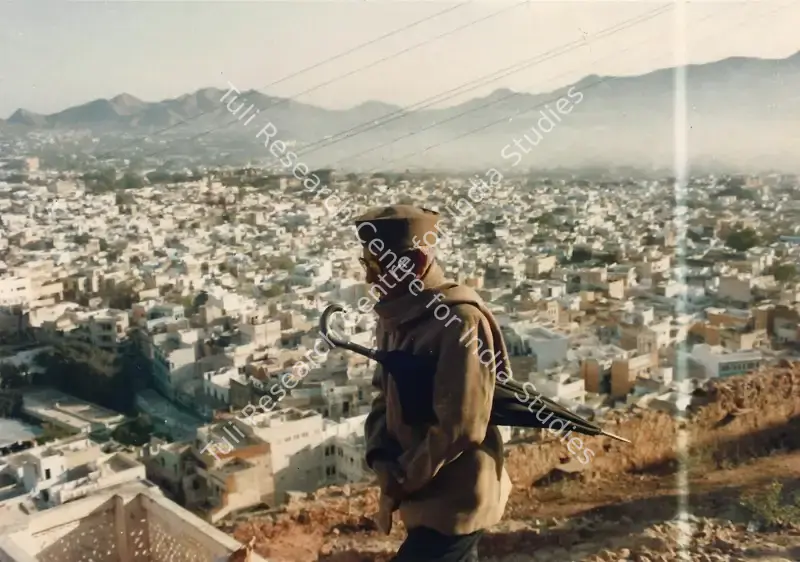
Kamal Swaroop's Om Dar-b-Dar, (literally Om from Door to Door), a full –length feature financed by NFDC, is possibly the most significant film made in India in recent years in terms of the new directions it opens up. Swaroop is an old FTII alumnus, but as he himself said, 'This film is like an extended student film for me. It belongs to my own adolescence.' More precisely, it is an articulation of coming to terms with organized expression amid the 'flux of identity' (as Anup Singh uses the phrase). Based in the 'small town' of Ajmer (itself a sort of metaphor), the film works through the adolescence of a modern society, that, even as it discovers its own limbs, is split asunder by the bizarre intrusions of a world it simply cannot comprehend. The narrative departs from almost all anchoring in dramatic continuities, taking on an entire universe outside even as it seeks, desperately, to validate itself – to atone for its own excesses. The film breaks new ground all the time, in its ability to speak of the particular within a new concept of globality and the way this achieved in, for instance, its use of sound, of performance, of the very notion of cinematic text. The film is based on an eight-hour script. The script, from which Swaroop has had to veer away considerably in the process of shooting and editing has itself been acclaimed as a literary masterpiece. He does not hesitate to adopt conventions from folk tales, advertising media, the popular cinema and the intrigues of chap novelettes. The editing, which was done by a very recent FTII graduate, Priya Krishnaswamy, is extraordinary and a part of the struggle to find narrative coherence. It loads every brief shot with all the weight of the information it must carry, the trauma of finding language when there is so much to say. (Source: Ashish Rajadhyaksha, Cinemaya 1, 1988)