
The Indian Street and MF Husain’s Line
About this post
India’s energy and rhythm lives within her colours, forms, lines, textures, and stories. Art is that glorious way of seeing and reading India as a vibrant continuum of ideas, emotions, experiences and the beyond.
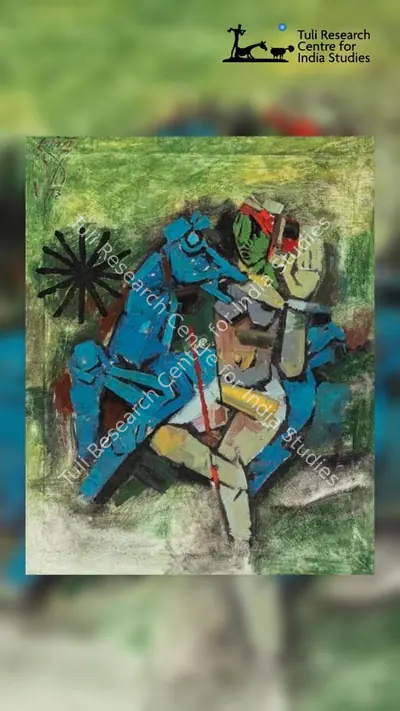
Today on his birthday, we remember M.F. Husain, a key figure in the history of modern Indian art and India, whose restless imagination helped to transform the visual language of modern India.
Maqbool Fida Husain (17th September 1915, Pandharpur) began his career by painting cinema hoardings and designing children’s furniture and toys in Bombay. As a member of the Progressive Artists’ Group, brought in by his dear friend and early mentor - Francis Newton Souza - he stood at a unique juncture as part of the first generation of post-Independence modernists.
Curious and restless by nature, Husain drew inspiration from everything - epics, village life, cities, horses, women, music, cinema, the political life of the nation.
His swift lines and bold compositions, along with his recurring motifs, made his work instantly recognisable. His creativity extended to filmmaking, with “Through the Eyes of a Painter” receiving the Golden Bear for Short Film at the Berlin International Film Festival in 1967.
Awarded the Padma Shri, Padma Bhushan, and Padma Vibhushan, and nominated to the Rajya Sabha in 1986, Husain remained a graphic storyteller and visual documenter of the changing landscape of his time.
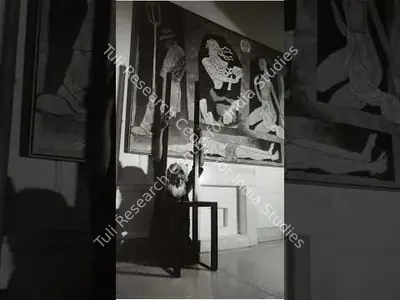
On his birth anniversary, Tuli Research Centre for India Studies pays tribute to the artist and the remarkable life behind the art. In this reel, Neville Tuli briefly shares his first discussion with M.F. Husain in October 1993, offering a personal glimpse into an encounter with one of modern India’s most distinctive artists.
Post 41
The Indian Street and MF Husain’s Line
Post record
Published20 Sep 2026
Media1 image, 1 video
Research Categories12_FineArts
Masterlists2M.F. Husain·Neville Tuli