
Centre Stage1991
Introduction
Body of Work
Stanley Kwan's Ruan Lingyu is by far his most mature film yet. It is a significant departure from his tendency towards style as an end in itself which, one suspects, was behind the international success of his most famous film, Rouge (1988).
In depicting the screen biography of Ruan Lingyu, probably the most famous star of the Chinese silent cinema, Kwan has used the documentary format, interpolating throughout the film's main 'fictional' narrative, black-and-white footage of himself and members of his cast talking about their roles and their feelings for Ruan Lingyu.
Ruan has been described as the 'Chinese Garbo'. Garbo was certainly an influence, and so was Marlene Dietrich. Traces of Garbo and Dietrich-like mannerisms, facial gestures and body movements were Ruan Lingyu trademarks. However, her success as a star lay in her own achievement of pure grace in the creation of a tragic persona in Chinese silent cinema. Her own life often mirrored those of the tragic characters whom she depicted. One of her most famous portrayals was that of a prostitute in a picture entitled Shen Nü (The Goddess). Paradoxically, her frail physique and sullen glares evoked a sense of spiritual strength, provoking sympathy for her as a 'Goddess' of truth and will. The term Shen Nü or 'Goddess' was also a euphemism for prostitutes. Due to the scandal involving her personal life, she committed suicide in 1935. She was then only 25 years old.
It is difficult to assess whether Ruan's death was an immeasurable loss to Chinese cinema. Her career represented one aspect of that cinema and is crucial to an understanding of the country's silent pictures, (Chinese filmmakers continued to make silent pictures way into the 30s, even after the first sound-on-film movie was released in 1931). We will never know what her contribution would be like in sound pictures for, had she lived, she would have been required to make the transition into sound. Besides her undoubted status as a star, Ruan also represented one aspect of drama which Chinese cinema never really developed until relatively recently. This was an intellectual approach which Ruan portrayed with melancholic grace in the best of her silent pictures.
Following the style of Garbo, she could also be stylistic, an ability which ran against the grain of realism then rearing its aesthetic head among Chinese filmmakers of the period. At the centre of Ruan's formalism and stylization lay an inner spiritual core that filmmakers attempted to manifest in their social and realistic genres. There were different levels to her success in overcoming the constraints of formalism (many of her early films are now lost). Hence, the contradictions between style and formalism on the one hand and realism and content on the other are ingrained in the overall conception of Kwan's screen biography of the great Chinese star.
At first it appears surprising that Kwan should have immersed himself in a tussle between formalism and content. However, in retrospect, this was a tussle between formalism and content. However, in retrospect, this was a tussle which he grappled with in Renzai Nuyue (Full Moon in New York, 1990) and lost. In Ruan Lingyu, Kwan tries a second time but it takes a while for one to come to a startling conclusion: That Kwan has not only departed from an overwhelming emphasis on style but has even begun to tackle the most fundamental dichotomy in filmmaking, that of documentary truth vs. fictional interpretation.
At its most successful, the daring (for Hong Kong cinema) concept of a documentary interpolated within a mainstream melodramatic narrative serves to bring forth a dialectical, self-critical symmetry. In its unsuccessful moments (particularly towards the end) Kwan seems to have over-extended his documentary format; it begins to annoy coming across as self-indulgent and intrusive. Nevertheless, Kwan should be commended for, firstly, attempting film criticism within and without the context of his own work; secondly, attempting self –criticism with constant and extraordinary references to his own work in Ruan Lingyu and, perhaps unconsciously, to his failure in tackling content in Full Moon in New York, thirdly, providing a pre-1949 (i.e. pre-Communist) historical view of Chinese cinema in what is essentially a melodramatic work.
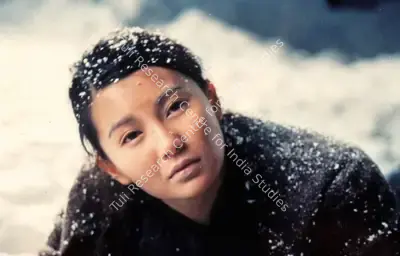
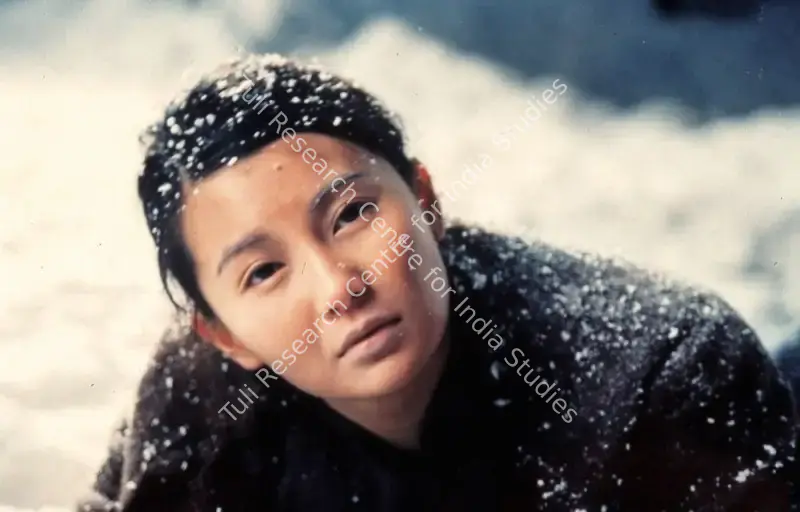
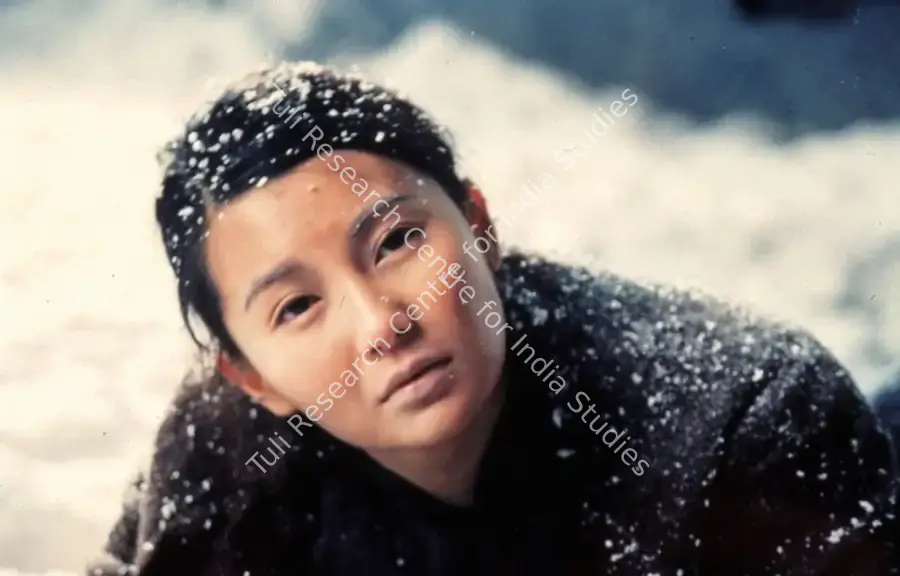
Kwan's craftsmanship nearly does his vision justice. The cinematography captures the dialect of documentary and melodrama. The art direction and production design is keyed equally towards a moribund sort of Art Deco (befitting a Shanghai studio look in the 30s) and verismo stage realism. Ultimately, the whole film falls back on the interpretation of Maggie Cheung's Ruan Lingyu. It is a wonderful performance, both credible for the way she has captured Ruan's silent-star mannerisms and vulnerable for the personal effort she has invested in playing the role of a tortured star.
It is worth noting here that Kwan's ability with actors lies in his empathy with those actors who come from his own Hong Kong-Cantonese background. This 'Cantonese-dialect' factor cannot be underestimated. So far, this has been a strength in the aesthetic understanding of his works. In Ruan Lingyu, the use of Cantonese is a crucial barometer of the emotions of the eponymous character (apart from pointing out that she originated from Guangdong). The whole atmosphere of a near Bohemian quality partly stems from the characters' exchanges of regional Chinese dialects (apart from Cantonese, Shanghainese is the other crucial dialect) and Mandarin. Their mutual comprehension is not stunted. In private, we see the key characters at ease with their own tongues.
Although less so in this film, Kwan's depiction of non-Cantonese characters depends on the utilsation of stereotypes or, more precisely, on what the Chinese themselves think a Cantonese, a Shanghainese, or a Northerner, should be. Kwan, as a Hong Kong Cantonese director, cannot completely transcend the pull of his regional background. Yet he has shown himself willing to work against this background by tackling the 'big' theme of China and the extended family of the Chinese people speaking regional dialects and Mandarin. Ruan Lingyu has the advantage, at least, of a self-critical approach. It is not so much about the extended Chinese family, with all its political implications, as about the family of Chinese filmmakers caught in tumultuous times. It is theme close to Kwan's own aesthetic and social experience.
Finally, there is the matter of Ruan Lingyu's screenplay. Two writing styles are juxtaposed, indeed even pitted against each other. This is the crux of the film's dialectics. For the first time, Kwan has employed the writing talents of a film critic. The portion of the screenplay in which a dialectical, monochromatic and historical perspective is offered and opposed to the more melodramatic impulses on the rest of the film, is clearly the contribution of Taiwanese film critic and writer Chiao Hsiung-ping. The other writer who is credited is Kwan's usual collaborator, Qiu Dai Amping, who has written all of Kwan's films to date. His contribution here, as in all of Kwan's previous works, is in laying down the melodramatic law.
The worst excesses of melodrama – in Qiu's case, vain efforts at establishing stylistic flourishes and dilettantish attempts at 'profundity' – have always marked the Kwan-Qiu collaborations even in the best works. Considering that the failure of Full Moon in New York was in essence a failure of melodramatic contrivance, it is ironic that in Ruan Lingyu it is the melodramatic features of the screenplay which seem to work best. Furthermore, it is the melodrama which provides the spine holding the work together.
In fact, the most startling things about Ruan Lingyu – the documentary, the film history, the self-criticism – are also the sources of its weakness. Critics who tend not to like Ruan Lingyu argue against the 'documentary' episodes. They fail to recognize that the contradictory effect o juxtaposing documentary and melodramatic narrative is Kwan's attempt at rising above his own limitations. For all his touted achievements in Rouge, it now looks as if that was a much easier film to make than Ruan Lingyu.
Teo, Stephen. (1992). On Screen: Ruan Lingyu (Centrestage). Cinemaya The Asian Film Quarterly. 14 (4), p25-26.