
How did Sudhir Patwardhan bring marginalised lives within the modern city into public view?
About this post
How did Sudhir Patwardhan bring marginalised lives within the modern city into public view?
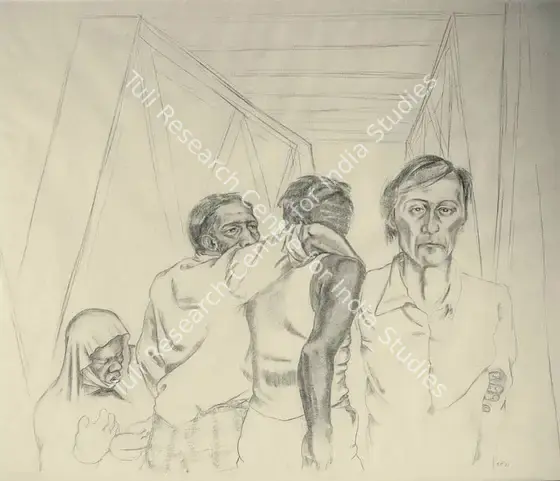
In “Overbridge” (1981) four people coincide upon a pedestrian bridge. This wonderfully large pencil drawing preceded Patwardhan's oil painting of the same title.
Two men walk with their arms across each other's shoulders, suggesting that very Indian form of camaraderie within every city. A solitary man faces us Kafkaesque like, while a veiled woman at the edge appears marked by illness, possibly leprosy, and exclusion. Patwardhan observes them as they truly are, as stoic rather than heroic subjects.
Created amid social and economic change, Overbridge reflects urban alienation and marginalisation. Subaltern Studies was also taking shape, bringing lives excluded from dominant histories into focus. Patwardhan similarly gives overlooked urban subjects visibility and dignity.
Trained as a doctor, Patwardhan works as a radiologist in Thane alongside his self-taught artistic practice. Encounters with commuters, labourers and patients shape his urban realism, a genuinely empathic expression of our people and their daily grind endured with grace and resilience, but not romanticised.
Within SWARAJ: Revisualising India's Political History Exhibition, the drawing asks how freedom is experienced at society's margins, placing dignity, recognition and companionship at the heart of Swaraj.
Artwork: Overbridge (1981), Pencil Drawing on paper
Artist: Sudhir Patwardhan
In “Overbridge” (1981) four people coincide upon a pedestrian bridge. This wonderfully large pencil drawing preceded Patwardhan's oil painting of the same title.
Two men walk with their arms across each other's shoulders, suggesting that very Indian form of camaraderie within every city. A solitary man faces us Kafkaesque like, while a veiled woman at the edge appears marked by illness, possibly leprosy, and exclusion. Patwardhan observes them as they truly are, as stoic rather than heroic subjects.
Created amid social and economic change, Overbridge reflects urban alienation and marginalisation. Subaltern Studies was also taking shape, bringing lives excluded from dominant histories into focus. Patwardhan similarly gives overlooked urban subjects visibility and dignity.
Trained as a doctor, Patwardhan works as a radiologist in Thane alongside his self-taught artistic practice. Encounters with commuters, labourers and patients shape his urban realism, a genuinely empathic expression of our people and their daily grind endured with grace and resilience, but not romanticised.
Within SWARAJ: Revisualising India's Political History Exhibition, the drawing asks how freedom is experienced at society's margins, placing dignity, recognition and companionship at the heart of Swaraj.
Artwork: Overbridge (1981), Pencil Drawing on paper
Artist: Sudhir Patwardhan
Post 36
How did Sudhir Patwardhan bring marginalised lives within the modern city into public view?
Post record