
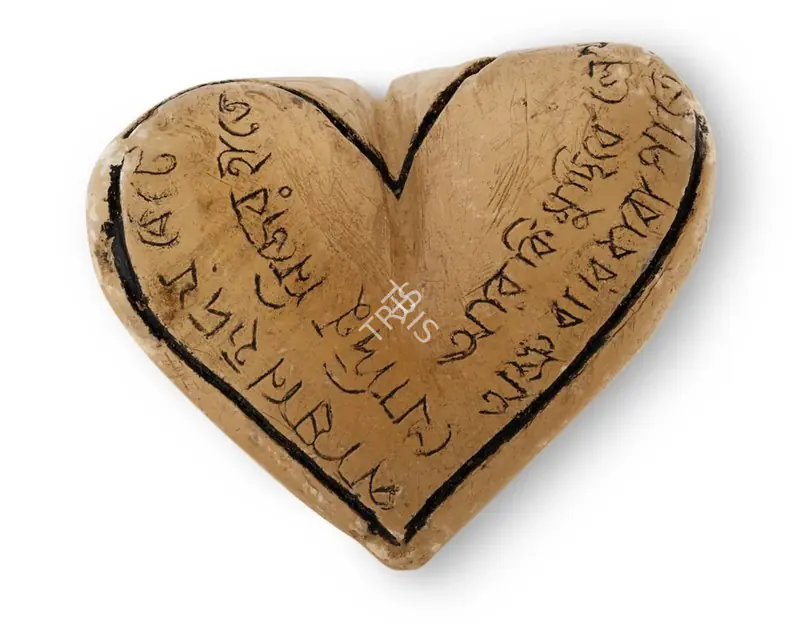
Tagore, Rabindranath (Artist). The Heart, circa 1883 | Sculpture
Estimates
₹5,500,000 - 7,000,000
$64,283 - 81,815
Winning Bid
₹10,452,210
$122,163
Lot Ratio | Hammer Price / Lower Estimate
1.90
Rabindranath Tagore | 06 May 1861 – 07 Aug 1941 | National Art Treasure
ArtistRabindranath Tagore
TitleThe Heart
MediumQuartzite stone
Datecirca 1883
Size1.60 x 1.80 in (4.06 x 4.57 cm)
Lot Number20
Auction HouseAsta Guru
Venue / LocationOnline
Date of Auction27 June 2025
Type of AuctionOnline
Provenance
Rabindranath Tagore’s Heart– A Singular Masterpiece
‘The Heart’ is the only known sculptural piece attributed to Rabindranath Tagore. This extraordinary quartzite piece—heart-shaped and measuring 4 x 4.5 x 3 cm—was created in 1883 during a contemplative retreat in Karwar, Karnataka. The visit, shaped by the region’s natural beauty and the presence of his brother, Satyendranath Tagore, and sister-in-law, Jnanadanandini Devi, yielded this unique artefact of emotional and artistic resonance.
Engraved in Tagore’s own hand are the words:
"Having cut my heart of stone,
I have engraved (the words) with my own hand.
Will it (the writing) be ever effaced by the flow of tears?"
He was 22 at the time. The work is believed to have been dedicated to Kadambari Devi. Preserved in a russet pouch, this intimate object reveals a lesser-known dimension of the Nobel laureate’s creative life: a brief foray into sculpture infused with emotional vulnerability. Seen by many as a gesture of unrequited love, the sculpture transforms inner grief into form—bearing the emotional weight of a young Tagore’s private longing, etched forever in stone. This heart of stone is referenced in Tagore’s 1887 novel Rajorshi, documented in the Calcutta Municipal Gazette (1941), and was publicly exhibited in Kolkata in 2024. According to Prabhat Kumar Mukhopadhyay’s biography Rabindrajibani, the piece was initially gifted by Tagore to his friend Akshoychandra Choudhury. It eventually came into the possession of the family of the painter Atul Bose, in whose care it remained until its recent re-emergence for public appreciation. Both a poetic relic and a sculptural rarity, this object opens a new window into the early emotional and artistic explorations of one of India’s greatest minds.
Research Categories
Source