

EN
EN
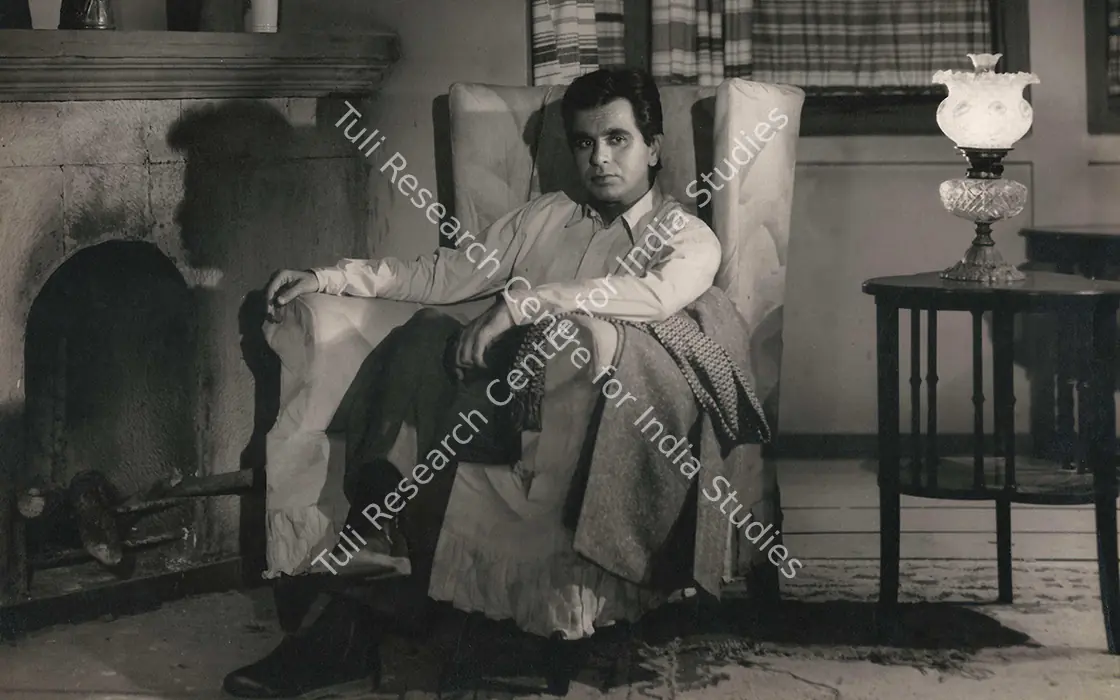
Dilip Kumar, born Muhammad Yusuf Khan in December 1922 amid the storied lanes of Qissa Khwani Bazaar in Peshawar, the man the world would come to revere as Dilip Kumar rose like a luminous constellation over the firmament of Indian cinema. Son of Lala Ghulam Sarwar Ali Khan, a humble fruit merchant, the young Yusuf moved between orchards in Deolali and the vibrant alleys of his ancestral city, where fate placed him beside another future titan, Raj Kapoor, as a childhood companion. Later, together with Dev Anand and Raj Kapoor, he commanded immense reverence as one of the triumvirates of legendary actors who reshaped the very contours of performance and stardom in Indian cinema. Destiny, inscrutable yet irresistible, led him to Bombay, where Devika Rani anointed him with the name that would echo across generations. Thus, in Jwar Bhata (1944), he stepped onto the cinematic stage—not yet as a conqueror, but as a quiet herald of greatness. His ascent began with Jugnu (1947), followed by the resounding successes of Shaheed and Mela (1948), each film a rung on the ladder toward immortality. His first towering milestone, Andaz (1949), placed him alongside Raj Kapoor and Nargis, shattering box-office records and inaugurating an era defined by his magnetic presence. What followed was a cascade of triumphs—Babul, Deedar, Aan, Uran Khatola, Insaniyat, Naya Daur, Madhumati, Paigham—works that enshrined him as the monarch of Hindi cinema's golden age. His portrayals in Devdas, Amar, Musafir, Yahudi, and Sunghursh crystallised his legend as the pioneer of subtle, internalised—almost alchemical—method acting. At the zenith of his reign came his portrayal of Prince Salim in K. Asif's monumental epic Mughal-e-Azam (1960), a cinematic colossus whose grandeur remains unmatched. Here, his restrained fire, his whispered rebellions, and his regal bearing transformed not merely a character, but the very grammar of screen acting. Though the 1970s dimmed the blaze of his earlier decade, he returned with sovereign majesty in Kranti (1981), and continued to command the screen in Vidhaata, Karma, and Saudagar. His final bow came in Qila (1998), closing an illustrious chapter of 57 films over five radiant decades. His marriage to Saira Banu became one of Indian cinema's most cherished unions, a sanctuary away from the glare he so gracefully avoided. Laurels adorned him—the Padma Bhushan, Padma Vibhushan, Dadasaheb Phalke Award, and Pakistan's Nishan-e-Imtiaz, a singular honour never again bestowed on an Indian artist. When he departed in July 2021, he left not merely memories but a mythic legacy. And in Peshawar, the house of his childhood—now a national heritage monument—stands as a shrine to the thespian who transformed silence into poetry and performance into immortality.