

EN
EN
English
HI
Hindi
EN
EN
English
HI
Hindi
About
About
Research Categories
Research Categories
REGISTER
Mahesh Bhatt
Time Periods
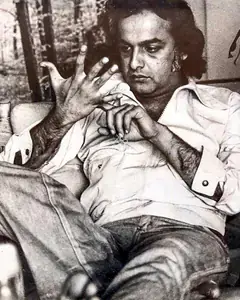
20 September 1948
Mahesh Bhatt was born to Nanabhai Bhatt, a Hindu Nagar Brahmin, and Shirin Mohammad Ali, a Shia Muslim. Their religious identities and the shadow of illegitimacy would later inspire and haunt his cinema. His parents never married, which deeply influenced his work. He was one of four children, including his brother Mukesh and sisters Heena and Sheila. He was educated at Don Bosco School, Matunga.
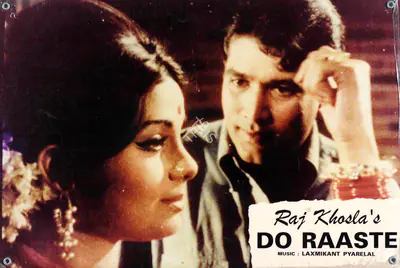
1969-1973
Even as a student, realising that he must contribute financially to the family, Mahesh Bhatt took up several odd jobs, including stints in sales and advertising. Finally, at the behest of his cousin, he met filmmaker Raj Khosla and began assisting him. He worked with Khosla on three films: Do Raaste (1969), Mera Gaon Mera Desh (1971), and Do Chor (1973), a film that Raj Khosla produced. He married Lorraine Bright (renamed Kiran), whom he had met and fallen in love with during his school days; their relationship later became the basis for one of Bhatt's most popular films, Aashiqui in 1991.

1974
Mahesh Bhatt befriended Johnny Bakshi while working with Raj Khosla. Both Bhatt and Bakshi debuted as director and producer, respectively, with Manzilein Aur Bhi Hain (1974). The iconoclast in Bhatt emerged from that very first film, which challenged established notions of love and marriage. The film depicted three individuals on the fringes of society (Kabir Bedi, Gulshan Arora, and Prema Narayan) falling in love and choosing to live together. The film flopped upon release. The film was initially denied a censor certificate as it was seen to be challenging the institution of marriage. A review committee was formed with people from the film industry, where senior film personalities watched the film and scrutinised it. Bhatt countered their questions and criticisms but eventually the review committee upheld the decision of the censor board. This setback affected him deeply. The film was released later, with several cuts.

1975-1979
Even as he was shooting for Sholay, Sanjeev Kumar fulfilled an old promise to Mahesh Bhatt by playing the lead in his film Vishwasghaat (1977). The film, Bhatt's reimagination of The Godfather, featured Sanjeev Kumar reprising Marlon Brando's Don Vito Corleone. This was followed by Naya Daur (1978), starring Rishi Kapoor and Danny Denzongpa. The film did not leave much of an impact, but the next film, Lahu ke Do Rang (1979), won Helen her first Filmfare Award for Best Actress. Mahesh's films weren't working, and he felt a void within himself. There was a spiritual quest that led him to Osho Rajneesh, a godman. Mahesh took him as a guru, spent time in his ashram, and sported robes and beads. But his questions remained unanswered. He dabbled briefly with the books and ideas of Jiddu Krishnamurti, but his spiritual life took a turn when he met another Krishnamurti: U.G. Krishnamurti. Meeting U.G. Krishnamurti had a profound impact on his life. He realised that it is the “quest” that's the problem. In some ways, it was U.G.'s emphasis on brutal honesty and the stripping away of any moral posturing or hypocrisy that led Mahesh to take the plunge into more candour in his storytelling and his approach to life.

1982
For his next film, Mahesh Bhatt looked inward. He poured the turmoil of his personal life into Arth (1982), his first foray into autobiographical territory. His turbulent relationship with Parveen Babi, even as he was married to Kiran, found reflection in the film. The ending of the film, in which the wife refuses to forgive her husband for his lapse, was initially rejected by distributors, and there was pressure on him to reshoot. But Mahesh stuck to his guns, and Arth ended up as his first success, acclaimed by both audiences and critics. The film won two National Awards: Shabana Azmi for Best Actress, and Keshav Hirani for Best Editing. Arth was the beginning of a new realisation, a new narrative quest for Mahesh Bhatt. He could exorcise his demons viscerally through his work, and audiences reacted to that. Much like his mentor Raj Khosla and Khosla's mentor Guru Dutt, it was this autobiographical exploration that defined a significant part of Bhatt's career.

1984
Mahesh Bhatt followed up Arth with an intensely human study of an old couple coping with the loss of their only son: Saaransh. The germ of the story, written by Mahesh himself, came partly from the news of a Maharashtrian couple whose son had been murdered in New York, and partly from the death of his spiritual guru U.G. Krishnamurti's son. The film underscored bureaucratic bottlenecks that ordinary citizens had to face in such situations, while also underscoring the loneliness of seniors. The highlight of the film was a dazzling performance by the 29-year-old Anupam Kher playing an old man, a role that bagged him a Filmfare Award for Best Actor. Rohini was also acclaimed for her performance.
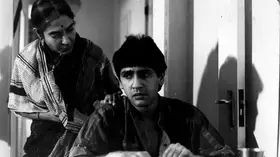
1985
Janam followed closely on the heels of Saraansh. It was another deeply autobiographical exploration, which told of Mahesh's early life as he tried to find his voice and an identity. Kumar Gaurav's performance in the central role is considered one of his best.
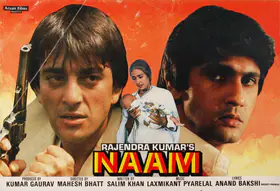
1986
Naam was Mahesh Bhatt's first out-and-out mainstream commercial film, with multiple stars such as Sanjay Dutt, Amrita Singh, Kumar Gaurav, Poonam Dhillon, and Nutan, while at the same time boasting some intense, hard-hitting performances. It was Salim Khan's first screenplay since the Salim–Javed split, and Sanjay Dutt's first major success since his comeback after rehab, which helped reshape his image.
1987
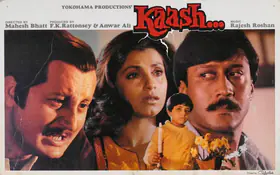
Kaash (1987) featured Jackie Shroff and Dimple Kapadia as a divorced couple facing the imminent death of their seven-year-old son from cancer. The film, for the first time, showcased Jackie Shroff as a sensitive performer. So far, he had seen great success and acceptance as an action hero, but Kaash showcased his intensity and showered him with critical acclaim. Dimple Kapadia and Anupam Kher delivered strong performances. The soundtrack, composed by Rajesh Roshan, boasted some evocative numbers by Kishore Kumar, who passed away the year Kaash released.

1989
Daddy (1989) marked the acting debut of Mahesh Bhatt's daughter Pooja and featured Anupam Kher in an author-backed role as an alcoholic father who has been estranged from his daughter and finds her later in life. The father, once a famous singer, had spiralled due to alcoholism and he took off, leaving his family — and a singing career — behind. Many years later, his daughter finds him at the brink of disaster and tries to save him from himself. While Anupam Kher gets into the skin of the character with dexterity and plays the troubled father with astonishing ease, Pooja displays great maturity and warmth for a newcomer. The music by Rajesh Roshan featured a string of soulful ghazals by Talat Aziz. While he had done playback before, this was the first time all the songs in a film were performed by him. Kher won a National Film Award, while Pooja was conferred the Filmfare Award for “New Face of the Year.”
1987-1990
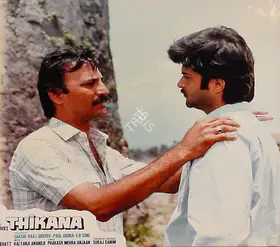
Following this, Mahesh Bhatt continued making films in two broad spectrums. On the one hand were intense exploratory narratives, which included films such as Thikana, Aaj, and Awargi. Alongside these were mainstream thrillers like Kabzaa and Jurm. This seemed like a transition phase, but Mahesh didn't seem to be choosing one path over the other. Although he kept reinforcing that he made films for the man on the street, not the intellectuals who crowd film festivals, he wanted all his films to reach out to the common people, the lay audience. It is this approach, coupled with sensitive films devoid of stars and conventional mainstream formula, that explains the dichotomy in Bhatt's creative choices. While he wished to explore his art, his audience—often the simple-minded, working-class audience—mattered a lot to him.

1990
Aashiqui (1990), a love story framed after Mahesh's own experience courting his first wife, Kiran, was born out of a discussion with T-Series owner Gulshan Kumar and a bevy of new musical talents, including Nadeem–Shravan, Kumar Sanu, and Anuradha Paudwal. What resulted was a “young story” that brought youngsters back to the theatres. The film was a massive success, giving rise to a series of love stories. The music of the film had a monumental impact. Hindi film music was in a rut, and Aashiqui brought in a new sound that characterised the 1990s. Nadeem–Shravan, who had been waiting in the wings for a while, broke out with this album, and Kumar Sanu became an overnight sensation. The album broke all sales records, managing to become the highest-selling Hindi film soundtrack at the time of its release, garnering a sale of 20 million units.
1991
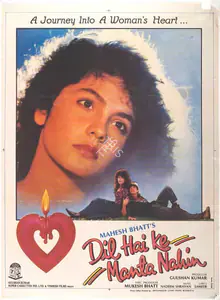
Frank Capra's It Happened One Night (1934) worked as the inspiration for several films in Indian cinema, a list that includes titles like Nadan (1951), Chori Chori (1956), Nau Do Gyarah (1957), Solva Saal (1958), a Bengali film Chawa Pawa (1959), and Chandrodayam (1966). But Mahesh Bhatt's Dil Hai Ke Maanta Nahin (1991) was possibly the most faithful to the source material. But it was contemporarised, and entirely in line with the “young love stories” that Mahesh was making those days, what with Aashiqui being such a huge success. Anupam Kher's comedy track was added, in addition to some action sequences and songs.
1992-1993
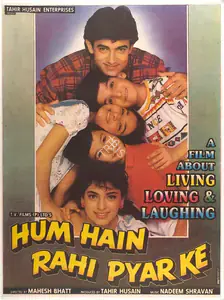
Hum Hain Rahi Pyar Ke was partially inspired by Houseboat, but was a breath of fresh air at the time it came out. Most other films were usually slotted as comedy, romance, or action. The film had elements of comedy, romance, and family drama, but neither of just those. It had a feel-good, jubilant vibe without making it an out-and-out comedy, and it had some mushy romantic moments, but it wasn't a love story either. Just as in Dil Hai Ke Maanta Nahin, Hum Hain Rahi Pyar Ki was contemporarised and Indianised, which worked greatly with audiences.

1991-1994
Sanjay Dutt, whose career was given a new lease of life by Naam (1986), returned to work with Mahesh Bhatt on several films, including action films such as Kabzaa, Gumraah, and Kartoos. Their most successful and iconic collaboration was Sadak (1991), which can best be described as a romantic action film. The film remains one of Mahesh Bhatt's highest-grossing films. The story of a man falling in love with and rescuing a young girl being sold into prostitution drew elements from Martin Scorsese's Taxi Driver (1976). Sadak featured a notable performance by Sadashiv Amrapurkar as the ominous villain Maharani, a trans woman. During the same phase, his film Sir (1998) was a young love story that was also a tribute to the British film To Sir, with Love (1967). Paresh Rawal's performance in the film earned him a National Award.
1995-1997
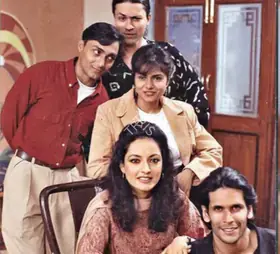
Around 1995, Indian television was on a growth path, and Mahesh Bhatt signed on to take it to the next phase. He launched two revolutionary TV series that launched several careers and altered TV viewing in India: a daily soap titled Swabhimaan and an English series titled A Mouthful of Sky. While the latter featured Rahul Bose, Milind Soman, Arjun Rampal, and Simone Singh, Swabhimaan launched Manoj Bajpai, Ashutosh Rana, Rohit Roy, and several others. Besides these, Mahesh also headlined another TV project titled Kabhie Kabhie, featuring Shefali Shah.
1995-1998
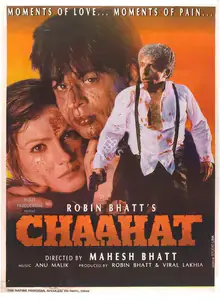
During this time, Mahesh worked on two films starring Shah Rukh Khan, Chaahat and Duplicate, both of which failed to set the cash registers ringing. Despite being much-awaited team-ups and featuring fairly popular songs, the films flopped. The screenplay and plausibility of both films came under some criticism. While some blamed the lack of cohesion between the crime and comedy elements in Duplicate, Chaahat was said to suffer from a lack of chemistry between the lead pair.
1996-1998
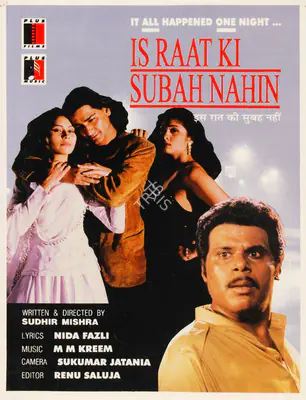
From 1996, Mahesh would produce a bevy of films for Plus Channel, set up by media maven Amit Khanna, who was a friend and colleague. This included films like Papa Kehte Hain, directed by Mahesh himself, Shyam Benegal's Sardari Begum (1996), Sudhir Mishra's Iss Raat Ki Subah Nahin (1996), Aruna Raje's Bhairavi (1996), Gautam Ghose's Gudia (1997), Basu Chatterjee's Gudgudee (1997), and Lekh Tandon's Do Rahein (1997). Plus Channel was backing a bouquet of films and TV content, which included bold themes and different, experimental films and casting. Sardari Begum earned Mahesh his second National Film Award for Best Feature Film in Urdu. In a similar vein, he won his third National Film Award for producing Gautam Ghose's film Gudia.

1998-2000
Even as he continued to direct star vehicles such as Criminal (with Nagarjuna), The Gentleman (with Chiranjeevi), and Angaaray (with Akshay Kumar/Nagarjuna), around 1998 Mahesh turned inward again. He made Zakhm, a coming-of-age story about the trauma of his childhood and the relationship between his parents (played by Pooja Bhatt and Nagarjuna). Ajay Devgn's sensitive portrayal attracted critical acclaim and a plethora of awards, including a National Film Award for Best Actor. While Mahesh had embarked on autobiographical explorations of his marriage and relationships in the past, Zakhm was unique because this time, he had turned the lens on his mother, her struggles, and his early life. And it was his daughter who was playing his mother. As with Arth, Janam, and Aashiqui, he takes some elements from his life and then adds other fictional characters and themes. In Zakhm, the theme of communalism comes up when his mother, a Muslim by birth who's married to a Hindu, is killed by Muslim rioters, and Hindu right-wing leaders try to politicise it.

1998-2000
Tamanna, a film about a eunuch adopting and raising a daughter, won Mahesh Bhatt yet another National Film Award. Mahesh had based it on the real-life story of Tiku, a transgender who had rescued and raised an abandoned baby girl, called Tamanna. The role of the eunuch was played by Paresh Rawal, gaining critical acclaim and appreciation. The film featured adaptations of several poems by Nida Fazli, including Ghar se masjid. Mahesh's last film during this phase was Kartoos (1999), which contained elements from The Rock (1996).
2001-2026
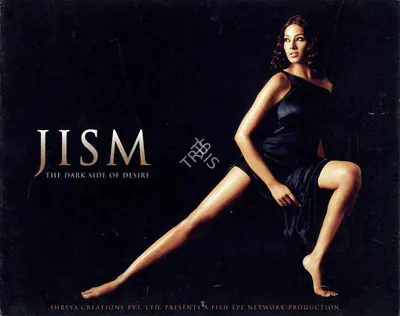
After quitting direction, Mahesh Bhatt focused on producing films for his home production, Vishesh Films, often collaborating with his daughter Pooja. He produced erotic thrillers such as Jism, Murder, and Murder 2; the horror franchise Raaz; and wrote films such as Gangster, Hamaari Adhuri Kahani, and Woh Lamhe, the latter being an exploration of his relationship with Parveen Babi.
2001-2026
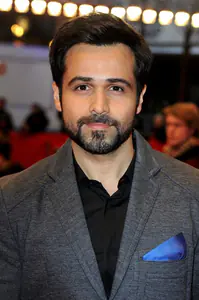
During this phase, he mentored actors like Emraan Hashmi, John Abraham, and Kangana Ranaut, as well as filmmakers like Mohit Suri, Milan Luthria, and Vikram Bhatt. In fact, one of the things that Mahesh Bhatt has come to be known for is mentoring talent. Like his own mentor Raj Khosla and his mentor Guru Dutt, Mahesh has consistently helped young talent to flourish, and during his directorial career alone, he gave early breaks to actors like Rahul Roy, Rohit Roy, Manoj Bajpayee, Ashutosh Rana, Milind Soman, Rahul Bose, Harsh Chhaya, Dipak Tijori, Anu Agarwal, Kitu Gidwani, Kumud Mishra, and several others.
2001-2026
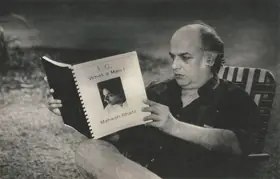
In 2007, his guru U.G. Krishnamurthi passed away, prompting him to write a book on him and his last days, A Taste of Life (2010). Krishnamurthi, over the years, had a deep impact on Mahesh Bhatt's life and how he viewed it. His influence was one of the reasons that Mahesh turned inward in his filmmaking, and started making autobiographical cinema. There were many turmoils in his life that U.G. was a witness to, and he was always there when Mahesh needed to vent, or needed someone to speak to or argue with. He had turned his life upside down, in the best way possible. So when U.G. passed away, it was a major blow, which caused the book to come forth.
2001-2026
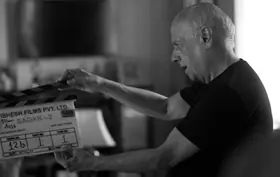
His elder daughter Pooja debuted as an actress, then moved to filmmaking and production. His younger daughter, Alia Bhatt, broke out as an actress of reckoning in 2014, and went on to be a star by featuring in a diverse array of performances like Highway, 2 States, Humpty Sharma ki Dulhaniya, Kapoor & Sons, Udta Punjab, Kapoor & Sons, Raazi, and Gangubai Kathiawadi. In 2020, Mahesh held the megaphone one last time to direct Sadak 2, featuring Sanjay Dutt and Aditya Roy Kapur alongside Alia.
2001-2026
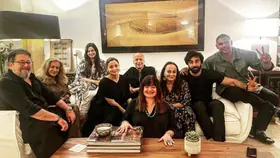
Mahesh Bhatt is the product of — and witness to — an unfulfilled marriage. Part of what drove him was the idea that he couldn't have a conventional family, where his parents would live together under one roof and take care of the children. When he began his own family by marrying Kiran and having kids, his relationship with Parveen Babi took it to the brink but they weathered the storm. In the 1980s, Soni Razdan, who played a role in Saaransh, entered his life, and he married for a second time, and had two kids through her. The family, having gone through several trials and tribulations, stayed together.
1948
1973
1974
1979
1982
1984
1985
1986
1987
1989
1990
1991
1993
1994
1997
2000
2026